


5 Best Portable Water Filters for Travel in 2026
Navigating the backcountry or exploring remote international destinations brings unparalleled freedom, but it also carries the undeniable risk of waterborne illnesses. From our experience, relying on single-use plastic bottles is not only environmentally destructive but logistically exhausting. The modern adventurer requires self-reliance. This is exactly why investing in the best portable water filters for travel has become a mandatory step for any serious packing list in 2026.

We recommend approaching your hydration strategy with the utmost severity. A simple bout of giardia or a viral infection can instantly terminate a meticulously planned expedition. The landscape of portable water filters for travel has evolved drastically over the last few years, pushing hollow-fiber membranes and activated carbon technology into highly compact, ultralight formats. Whether you are drinking from a questionable tap in a hostel or filtering snowmelt on the Continental Divide Trail, there is a specialized tool for the job.
In this comprehensive guide, we will break down the science of filtration, review the five absolute best portable water filters for travel currently dominating the market, and provide authoritative advice on choosing the exact system to match your travel profile.
Table of Contents
The Science: Filtration vs. Purification
Before diving into our top picks for portable water filters for travel, you must understand a critical industry distinction that most novice travelers overlook: the difference between a filter and a purifier. We see this mistake routinely, and it is a dangerous one to make.
A water filter operates by pushing water through microscopic pores—typically sized between 0.1 and 0.2 microns. This physical barrier easily blocks protozoa (like Giardia and Cryptosporidium) and bacteria (like E. coli and Salmonella). If you are backpacking in the United States, Canada, or Western Europe, a standard microfilter is entirely sufficient for backcountry streams and lakes.
A water purifier, on the other hand, is required when the threat of waterborne viruses (like Norovirus, Rotavirus, or Hepatitis A) is present. Viruses are incredibly tiny—often measuring around 0.02 microns—meaning they will slip right through a standard 0.1-micron hollow-fiber filter. Purifiers rely on either chemical treatment, UV light, or ultra-fine electroadsorption media to neutralize or trap these microscopic threats. If you are assessing portable water filters for travel for use in developing nations where tap water is compromised, you must elevate your setup to include viral protection.
The 5 Best Portable Water Filters for Travel
1. Grayl GeoPress Water Purifier

When it comes to international travel, the Grayl GeoPress is the undisputed heavyweight champion. From our experience, no other device offers the same level of absolute confidence when staring down a murky tap in a remote village. It functions like a French press for your drinking water. You fill the outer cup, insert the inner cartridge, and press down using your body weight.
Because it utilizes electroadsorption technology, the GeoPress actively binds to viruses, bacteria, and protozoa, rendering the water completely safe in just eight seconds. Furthermore, the activated carbon core vastly improves the taste and removes heavy metals and microplastics. While it is on the heavier side and requires semi-frequent, expensive cartridge replacements, it stands as one of the most reliable portable water filters for travel across all seven continents.
2. Puflow Portable Outdoor Water Filter Bottle
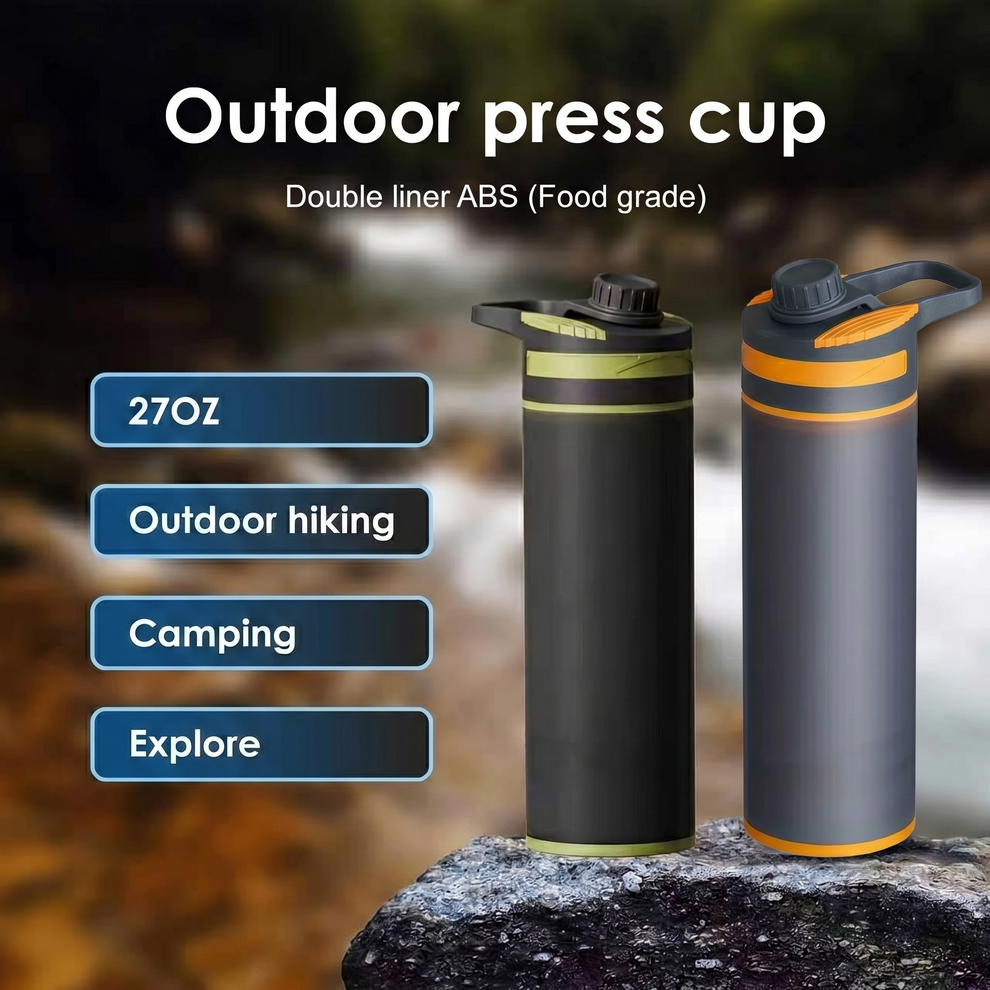
For hikers, campers, and emergency preparedness enthusiasts, finding a balance between flow rate, capacity, and extreme filtration density is difficult. The Puflow Portable Outdoor Water Filter Bottle strikes this balance flawlessly. We recommend this unit as one of the most structurally robust portable water filters for travel on the market today. It relies on a sophisticated 3-stage filtration process that drops the pore size down to an astonishing 0.01 microns via its UF (Ultrafiltration) Membrane.
This 0.01-micron threshold guarantees absolute protection against bacteria, microplastics, and protozoan cysts, while the PP Cotton and Activated Carbon Fiber handle sediment, bad tastes, and chemical odors. A staggering 10,000-liter filter life means this bottle will realistically outlast years of intense backcountry abuse.
3. Sawyer Squeeze
The Sawyer Squeeze is a legend in the thru-hiking community, and for good reason. It is the defining standard by which all other lightweight portable water filters for travel are judged. Weighing in at just 3 ounces, this hollow-fiber membrane filter screws directly onto a standard 28mm threaded water bottle (like a SmartWater bottle) or the included squeeze pouches.
We recommend the full-size Sawyer Squeeze over its smaller siblings (the Mini or Micro) because its flow rate is vastly superior and it is less prone to clogging. Its most impressive feature is its longevity; with regular backflushing using the included syringe, this filter is rated for a virtually infinite lifespan. It is strictly a filter (not a viral purifier), making it perfect for North American wilderness exploration.
4. Platypus QuickDraw
Entering the market to directly challenge the Sawyer Squeeze, the Platypus QuickDraw has rapidly become one of our favorite portable water filters for travel. It takes the squeeze filter concept and refines the ergonomics. It features a rugged, tank-like plastic housing and dual threads that allow it to attach to standard 28mm bottles as well as Platypus’s proprietary wide-mouth reservoirs.
The flow rate on the QuickDraw is astonishingly fast, capable of pushing out up to 3 liters per minute under high pressure. Additionally, it features an easy tool-free shake-to-clean method, eliminating the need to carry a backflush syringe into the woods. While its 1,000-liter lifespan is shorter than the Sawyer, the sheer user-friendliness makes it a top-tier choice.
5. Katadyn BeFree
If speed and packability are your absolute highest priorities, the Katadyn BeFree demands your attention. This filter is integrated directly into a HydraPak soft flask. When empty, the entire system collapses down to the size of a tennis ball and weighs a mere 2.3 ounces. It is one of the most convenient portable water filters for travel for trail runners and fastpackers.
To use it, you simply scoop water into the wide-mouth soft flask, screw on the filter cap, and drink. The flow rate is incredibly fast, and cleaning it simply involves swishing the filter element in clear water. However, we advise caution regarding the durability of the soft flask; it can puncture if thrown carelessly into a pack with sharp objects, so treat it with the respect your primary water source deserves.
Beyond Travel: Securing Your Home Hydration
While mastering the use of portable water filters for travel is critical for protecting yourself on the road, your permanent residence requires an entirely different approach. Coming home to tap water loaded with chlorine, heavy metals, and municipal contaminants defeats the purpose of maintaining a healthy lifestyle. From our experience, relying on a pitcher filter is insufficient for modern tap water. We recommend exploring a New Arrival reverse osmosis system for home to ensure your daily drinking water is held to the highest possible standard.
Reverse Osmosis (RO) systems strip out dissolved solids, lead, and PFAS (forever chemicals) with surgical precision. To see the complete lineup of technologies designed to safeguard your family, check out our All products reverse osmosis system for home catalog. The beauty of modern water filtration is that there is a form factor for every living situation.
For renters or those who absolutely refuse to drill into their countertops, Countertop RO Systems offer plug-and-play convenience without sacrificing medical-grade filtration. If you live off-grid, frequently move in an RV, or simply want disaster preparedness built into your home, a Portable & Non-Electric unit bridges the gap between household capacity and survival utility.
Larger families with high daily water demands benefit immensely from High-Flow RO Systems, which eliminate the annoying wait times traditionally associated with reverse osmosis. Finally, for a sleek, minimalist kitchen aesthetic, Under-Sink RO Systems remain the gold standard, hiding the heavy lifting below the counter while delivering pristine water through a dedicated faucet.
Summary Comparison Table
| Filter Name | Best Suited For | Protection Level | Pore Size | Weight |
|---|---|---|---|---|
| Grayl GeoPress | International Travel / Suspect Tap Water | Viruses, Bacteria, Protozoa, Heavy Metals | Electroadsorption | 15.9 oz |
| Puflow Portable Bottle | Hiking, Camping, Emergency Prep | Bacteria, Protozoa, Sediment, Bad Taste | 0.01 μm | Lightweight ABS |
| Sawyer Squeeze | Thru-Hiking / Backcountry | Bacteria, Protozoa | 0.1 μm | 3.0 oz |
| Platypus QuickDraw | Weekend Backpacking / Fast Flow | Bacteria, Protozoa | 0.2 μm | 2.9 oz |
| Katadyn BeFree | Trail Running / Fastpacking | Bacteria, Protozoa | 0.1 μm | 2.3 oz |
Frequently Asked Questions
Not all of them. Standard hollow-fiber microfilters (like the Sawyer Squeeze or Katadyn BeFree) filter down to 0.1 microns, which blocks bacteria and protozoa but allows viruses to pass through. To remove viruses, you must use a dedicated purifier (like the Grayl GeoPress) or complement your filter with chemical treatment drops or UV light.
We recommend backflushing your filter immediately if you notice the flow rate slowing down. If you are forced to filter highly turbid, muddy, or glacial silt-filled water, you may need to backflush it daily. Always backflush and thoroughly dry your filter before putting it into long-term storage to prevent mold growth.
Absolutely not. None of the portable water filters for travel on this list can desalinate ocean water. Removing salt requires industrial-grade reverse osmosis membranes operating under extreme pressure, or distillation. Pushing saltwater through a standard hiking filter will ruin the filter and leave you drinking salt.
If a hollow-fiber filter freezes, the water trapped inside the microscopic tubes expands into ice, shattering the membrane. A frozen filter is permanently broken and will no longer protect you from pathogens, even though water will still flow through it. If you are traveling in sub-freezing temperatures, you must keep your filter close to your body during the day and inside your sleeping bag at night.