


10 Factors That Affect Whole House RO Filter System Costs
A whole house reverse osmosis (RO) system is a substantial investment, and its actual cost depends on considerably more than the price of the membrane or filtration equipment. Water quality, daily consumption, treatment capacity, pretreatment requirements, installation complexity, and ongoing maintenance can all change the total project budget.

From our experience in water filtration, one of the most common purchasing mistakes is comparing whole house RO systems using equipment prices alone. A system that appears inexpensive initially may require additional pumps, sediment filters, water storage, plumbing modifications, and frequent membrane replacement before it can reliably supply an entire property.
If you are evaluating a whole house RO filter system for a residential property, commercial building, or industrial application, understanding these ten cost factors will help you avoid unnecessary spending and select equipment that matches your actual water requirements.
Quick Answer: What Affects Whole House RO Filter System Costs?
The ten main factors are: system capacity, incoming water quality, pretreatment requirements, RO membrane configuration, water recovery rate, operating pressure, storage and distribution infrastructure, installation complexity, automation and monitoring, and ongoing maintenance.
A small residential installation supplied with relatively clean municipal water generally requires a different investment from a high-capacity system treating hard, saline, or otherwise challenging water for a large property.
Our recommendation: Establish your daily water demand and obtain a water analysis before requesting equipment quotations. A correctly sized system with appropriate pretreatment is usually a better investment than purchasing the largest or most heavily advertised RO unit.
Quick Summary: Whole House RO System Cost Factors
| Cost Factor | What Influences the Price | Potential Cost Impact |
|---|---|---|
| 1. System Capacity | Daily water production and peak flow demand | Very High |
| 2. Incoming Water Quality | TDS, hardness, iron, chlorine, and contaminants | High |
| 3. Pretreatment Equipment | Sediment filters, carbon filters, softeners, and specialty treatment | High |
| 4. Membrane Configuration | Membrane quantity, quality, pressure vessels, and design | High |
| 5. Water Recovery Rate | Concentrate discharge, efficiency, and water costs | Medium to High |
| 6. Pump and Pressure Requirements | Feed pressure, pump capacity, and energy consumption | Medium to High |
| 7. Storage and Distribution | Water tanks, booster pumps, and plumbing infrastructure | Medium to High |
| 8. Installation Complexity | Plumbing, drainage, electrical work, and equipment location | Medium to High |
| 9. Automation and Monitoring | Controllers, sensors, alarms, and automatic flushing | Medium |
| 10. Maintenance and Operating Costs | Filter replacements, membrane life, servicing, and energy | Long-Term High |
Cost impact indicates the relative potential to influence a project budget, not a fixed percentage or universal price ranking. Actual costs depend on site conditions and system specifications.
What Is a Whole House RO Filter System?
A whole house reverse osmosis filter system is a point-of-entry water treatment installation designed to process water before it enters a building's distribution network. Unlike a conventional under-sink RO purifier, which treats water for one or several drinking-water outlets, a whole house system is designed to supply treated water to multiple fixtures throughout a property.
Reverse osmosis works by applying pressure to incoming water and forcing it through a semipermeable membrane. The membrane separates water into two streams:
- Permeate: The treated water that passes through the membrane.
- Concentrate: The reject stream containing a higher concentration of substances retained by the membrane.
The process can reduce dissolved salts and selected contaminants, depending on membrane performance, operating conditions, and the specific substances being targeted.
However, whole house RO is not automatically the best treatment choice for every property. Treating all water used for showers, laundry, toilets, cleaning, and drinking can require substantial production capacity and create considerable reject-water volumes.
In most professional situations, we recommend evaluating whether the property genuinely needs RO-quality water at every outlet. Some buildings only require RO treatment for drinking and cooking, while other applications justify whole-property treatment because of high dissolved mineral content or specific process-water requirements.
1. System Capacity and Daily Water Demand
System capacity is one of the biggest factors affecting whole house RO filter system costs. The more treated water a property requires, the larger and more capable the equipment must be.
Manufacturers commonly describe RO production capacity in gallons per day (GPD), gallons per minute (GPM), or cubic meters per day. These figures are not interchangeable. Daily production describes total output over time, while peak flow describes how much water the system can deliver when several fixtures operate simultaneously.
Why Capacity Changes Equipment Costs
A higher-capacity installation may require:
- More RO membranes and pressure vessels.
- Larger feed and booster pumps.
- Higher-capacity pretreatment filters.
- Larger storage tanks.
- More substantial plumbing and distribution equipment.
- Additional monitoring and control components.
Consider a property where several showers, washing machines, and kitchen faucets operate simultaneously. A system designed only around average daily consumption may fail to deliver sufficient water during peak demand.
For commercial users, the consequences can be more serious. Insufficient production capacity may interrupt cleaning operations, manufacturing processes, or other water-dependent activities.
2. Incoming Water Quality and Contamination Levels
The quality of incoming water directly affects the treatment process, equipment configuration, and operating costs.
Municipal water with relatively stable quality may require a simpler pretreatment arrangement than well water containing elevated hardness, iron, suspended solids, or dissolved salts.
Water Quality Parameters That Affect Costs
| Water Parameter | Potential Problem | Possible Treatment Requirement |
|---|---|---|
| Total Dissolved Solids (TDS) | High dissolved mineral and salt concentration | Appropriate RO membrane configuration and operating pressure |
| Water Hardness | Calcium and magnesium scale formation | Water softener or other scale-control strategy |
| Iron and Manganese | Membrane fouling and deposits | Oxidation and suitable removal filtration where necessary |
| Chlorine | Potential damage to chlorine-sensitive RO membranes | Compatible dechlorination pretreatment |
| Sediment and Turbidity | Prefilter blockage and membrane fouling | Multistage sediment filtration |
| Silica | Scaling and membrane performance problems | Specialized scale management or pretreatment |
For example, a property using groundwater with high hardness and iron may need additional treatment before water reaches the RO membrane. This increases initial equipment costs but can reduce the risk of premature membrane replacement.
From our experience, requesting a quotation without providing a water analysis often results in inaccurate equipment recommendations. Suppliers may quote a standard configuration that does not adequately address the actual feed-water conditions.
Before purchasing, arrange testing for TDS, pH, hardness, iron, manganese, turbidity, chlorine, and any location-specific contaminants of concern. Microbiological testing is also important when the source is a private well or otherwise presents a biological risk.
3. Pretreatment Equipment Requirements
Pretreatment is frequently underestimated when buyers calculate whole house RO filter system costs. Yet it can determine whether an expensive membrane installation operates reliably or experiences repeated fouling and maintenance problems.
RO membranes are designed for particular feed-water conditions. Sending unsuitable water directly into the membrane system can shorten its service life and increase operating expenses.
Common Pretreatment Components
- Sediment filtration: Removes suspended particles that could obstruct downstream components.
- Activated carbon filtration: Reduces chlorine and selected organic compounds when appropriately specified.
- Water softening: Controls calcium and magnesium hardness where scaling is a concern.
- Iron removal: Addresses elevated iron concentrations using a treatment process selected for the source water.
- Scale control: Uses suitable antiscalant dosing or other methods where membrane scaling risk requires management.
- Specialized filtration: Addresses particular contaminants identified through water testing.
Not every system needs all these components. Adding equipment without a clear treatment requirement increases the purchase price, maintenance workload, and potential points of failure.
For example, a municipal water supply with controlled turbidity and low hardness may need a relatively straightforward pretreatment arrangement. A well-water installation may need several additional stages.
4. RO Membrane Quality and System Configuration
The RO membrane is the central separation component of the system. Its quality, surface area, operating characteristics, and arrangement influence both equipment costs and long-term performance.
Whole house installations may use multiple membrane elements arranged in parallel or series, depending on the required production capacity, feed-water characteristics, and system design.
What Determines Membrane-Related Costs?
- Membrane material and manufacturer specifications.
- Salt rejection performance under defined operating conditions.
- Membrane surface area and individual element capacity.
- Number and size of pressure vessels.
- Operating pressure and temperature requirements.
- Compatibility with feed-water chemistry.
- Availability and replacement cost of matching membrane elements.
A cheaper membrane may reduce the initial equipment quotation, but its actual value depends on performance under the property's operating conditions. A membrane that requires frequent replacement can become more expensive over its service life.
Buyers should also distinguish between advertised rejection rates and verified performance data. Salt rejection percentages measured under controlled laboratory conditions do not automatically represent the results a household will achieve.
When evaluating certification, pay attention to the scope of the standard. NSF/ANSI 58 addresses point-of-use reverse osmosis drinking water systems. It should not automatically be treated as proof that an entire whole house point-of-entry installation is certified. Ask manufacturers for applicable component certifications, independent performance testing, and system-specific documentation.

For more information, see the NSF/ANSI 58 requirements for reverse osmosis drinking water systems.
5. Water Recovery Rate and Operating Efficiency
Water recovery rate describes how much incoming feed water becomes usable permeate. It is an important factor because an RO system does not convert every gallon of feed water into treated water.
For example, if a system receives 100 gallons of feed water and produces 50 gallons of permeate, its recovery rate is 50%.
The remaining water leaves as concentrate, carrying a higher concentration of rejected substances.
Why Recovery Rate Affects Total Cost
A lower recovery rate generally means more feed water is required for the same volume of treated water. This can increase:
- Water consumption charges.
- Wastewater or discharge expenses.
- Demand on pretreatment equipment.
- Overall environmental management requirements.
However, increasing recovery is not always a cost-saving improvement. Higher recovery concentrates dissolved minerals in the system, potentially increasing scaling risk and requiring more sophisticated pretreatment or chemical management.
For commercial users, the correct recovery target should be based on water chemistry, membrane design, and operating economics rather than the highest percentage advertised.
6. Pump Capacity and Operating Pressure
Reverse osmosis requires sufficient pressure to overcome the natural osmotic pressure of the incoming water and move water through the membrane.
If the incoming pressure is inadequate, the system may require a booster pump. High salinity applications can also demand higher operating pressure than relatively low-TDS municipal supplies.
Equipment That May Increase Pump-Related Costs
- Feed-water booster pumps.
- High-pressure pumps.
- Pressure gauges and transmitters.
- Variable-frequency drives.
- Pressure switches and automatic controls.
- Electrical protection and control panels.
Undersized pumps can result in insufficient water production, while oversized pumps can increase equipment and energy costs without delivering meaningful benefits.
For heavy-duty applications, we recommend selecting pumps according to the membrane manufacturer's operating requirements and the actual hydraulic conditions of the installation.
Do not evaluate pump capacity using motor power alone. Operating pressure, flow rate, efficiency, and expected duty cycle are all relevant.
7. Water Storage Tanks and Distribution Infrastructure
A whole house RO system needs to supply water when demand occurs, not simply produce a certain amount over 24 hours. This makes storage and distribution infrastructure an important part of the overall budget.
Many installations use treated-water storage tanks to separate membrane production from household demand. A storage tank allows the RO system to produce water steadily while the building draws water at higher instantaneous flow rates.
Infrastructure That Can Increase Costs
- Large treated-water storage tanks.
- Booster pumps for distribution.
- Pressure tanks and control valves.
- Additional plumbing connections.
- Water level sensors and overflow protection.
- Disinfection and hygienic storage arrangements where required.
Tank sizing should consider peak consumption, expected production downtime, available installation space, and the required reserve capacity.
For example, a large residential property with several bathrooms may require more storage and stronger distribution equipment than a small household with predictable water demand.
Another consideration is water quality after treatment. Storage tanks and downstream pipes must be designed to prevent contamination and maintain the required water quality throughout the distribution system.
We recommend including tank cleaning access, sanitary connections, and appropriate water-quality monitoring in the original design instead of adding these features after installation.
8. Installation Complexity and Labor Costs
Even when two properties purchase identical RO equipment, their installation costs can be significantly different.
A straightforward installation with accessible plumbing, adequate drainage, sufficient space, and an appropriate electrical supply is generally less complicated than a retrofit requiring substantial building modifications.
Common Installation Cost Factors
- Distance between the water inlet and equipment location.
- Existing plumbing condition and pipe diameter.
- Drainage access for concentrate discharge.
- Electrical wiring and power availability.
- Equipment room preparation and ventilation.
- Tank placement and structural considerations.
- Local plumbing permits and applicable code requirements.
- Professional commissioning and performance testing.
Whole house RO installations also need a properly engineered concentrate discharge arrangement. The concentrate stream should not simply be connected to an unsuitable drain or discharged without considering local requirements.
For commercial buildings, installation may require a dedicated equipment room, maintenance access, isolation valves, bypass plumbing, and additional safety measures.
From a purchasing perspective, ask suppliers whether their quotation includes installation, commissioning, plumbing modifications, and post-installation testing. Equipment-only quotations should never be compared directly with fully installed project quotations.
9. Automation, Monitoring, and Control Systems
Automation increases the initial price of a whole house RO installation, but it can reduce the workload associated with monitoring and operating the system.
Basic systems may rely on manual pressure readings and scheduled maintenance. More advanced installations can incorporate sensors, automatic flushing, electronic controls, and fault alarms.
Common Automation Features
| Feature | Function | Practical Value |
|---|---|---|
| Automatic flushing | Flushes membranes according to programmed operating conditions | Helps manage accumulated contaminants |
| TDS monitoring | Measures feed and treated-water conductivity or TDS estimates | Helps identify changes in water quality |
| Pressure sensors | Monitor pressure at important system stages | Helps identify abnormal operating conditions |
| Flow meters | Measure feed, permeate, or concentrate flow | Supports production and recovery calculations |
| Automatic shutoff | Stops operation under defined conditions | Improves operational protection |
| Leak detection | Identifies water leakage | Reduces the risk of unnoticed water damage |
For a small residential property, a complicated industrial control panel may provide little practical value. For commercial buildings and facilities with continuous water demand, more comprehensive monitoring can be worth the additional investment.
Our recommendation is to prioritize automatic protection, pressure monitoring, and clear maintenance alerts before purchasing advanced remote-control features.
10. Maintenance and Long-Term Operating Costs
The initial purchase price is only one part of whole house RO ownership. Filter replacements, membrane servicing, electricity, water consumption, and professional maintenance contribute to the total cost over time.
A system that is inexpensive to purchase but difficult to maintain may become an expensive long-term investment.
Typical Maintenance Expenses
- Sediment filter replacement: Necessary when filter loading or the manufacturer's service recommendations indicate replacement.
- Carbon filter replacement: Important for maintaining effective chlorine or organic compound reduction where carbon pretreatment is used.
- Membrane replacement: Depends on feed-water quality, pretreatment effectiveness, operating conditions, and membrane performance.
- Antiscalant and treatment chemicals: Required for some systems, depending on the water chemistry and design.
- Pump servicing: Includes inspection of seals, motors, and related components.
- System cleaning: May be needed to address membrane fouling and maintain production performance.
- Water and electricity: Ongoing costs associated with feed-water processing, pumping, and concentrate discharge.
Replacement intervals should follow actual operating conditions and manufacturer recommendations. A fixed replacement schedule may be a useful starting point, but pressure drop, water quality, flow, and membrane performance should guide maintenance decisions.
How to Evaluate Total Cost of Ownership
We recommend calculating the expected operating costs over at least three to five years rather than focusing only on the initial quotation.
A practical comparison should include:
Total ownership cost = Equipment purchase + Installation + Replacement filters and membranes + Electricity + Feed water and wastewater + Routine servicing + Other operating expenses.
For example, a higher-priced system with readily available replacement filters, lower energy requirements, and easier maintenance may offer better value than a cheaper system that requires expensive proprietary components.
Whole House RO vs. Alternative Water Filtration Systems
Whole house RO is not the only way to improve water quality. In fact, choosing a simpler treatment technology can significantly reduce equipment and operating costs when the water source does not require extensive dissolved-solids removal.
The most appropriate system depends on which contaminants need to be reduced and how much treated water the property actually requires.
| System Type | Primary Function | Initial Cost Consideration | Maintenance | Best Application |
|---|---|---|---|---|
| Whole House RO | Reduces dissolved salts and selected contaminants | Generally high due to system capacity and infrastructure | Multiple pretreatment and membrane components | Properties requiring extensive low-TDS water treatment |
| Whole House Carbon Filtration | Reduces chlorine, taste, odor, and selected organic compounds | Generally lower than a comparable whole house RO installation | Periodic media or cartridge replacement | Municipal water requiring aesthetic improvement |
| Water Softener | Reduces hardness minerals through ion exchange | Moderate, depending on capacity and installation | Salt replenishment and resin servicing | Hard water applications |
| Ultrafiltration (UF) | Removes suspended particles and selected microorganisms, depending on membrane specifications | Varies with flow capacity and configuration | Filter cleaning or replacement | Applications requiring particle and microbial barrier treatment |
| Under-Sink RO | Produces RO-treated water at selected outlets | Generally lower because it treats less water | Periodic cartridge and membrane replacement | Drinking and cooking water |
Which Alternative Should You Choose?
Choose whole house RO when the entire building genuinely requires reduced dissolved solids or specific RO-removable contaminants and the project can accommodate the associated water consumption, storage, and maintenance requirements.
Choose whole house carbon filtration when the primary concerns involve chlorine, taste, and odor rather than dissolved mineral content.
Choose water softening when hardness and scale formation are the main problems. RO is not necessarily the most economical way to address ordinary hard water throughout a building.
Choose ultrafiltration when suspended particles and the applicable microbial reduction requirements are the main treatment objectives, rather than dissolved salts.
Choose under-sink RO when the main objective is high-quality drinking and cooking water without treating the much larger volume used for showers, laundry, and cleaning.
For additional equipment options, explore under-sink RO systems and countertop RO systems.
Pros and Cons of a Whole House RO Filter System
Before committing to a large RO installation, buyers should understand the practical benefits as well as the limitations.
| Pros | Cons |
|---|---|
| Can reduce a wide range of dissolved contaminants when correctly designed. | Higher initial investment than many conventional filtration options. |
| Supplies treated water to multiple outlets throughout a property. | Requires larger production capacity and infrastructure. |
| Can address high-TDS water sources. | Produces a concentrate stream that requires appropriate disposal. |
| Can support specialized residential and commercial water requirements. | Requires pretreatment and ongoing technical maintenance. |
| Centralized treatment simplifies water quality management across connected outlets. | May require additional storage, booster pumps, and plumbing modifications. |
| Can be integrated with monitoring and automated controls. | Removes some minerals that may be desirable in certain applications. |
Our assessment: Whole house RO is worth considering when the water chemistry justifies it and the entire building benefits from RO-treated water. It is usually not the most economical choice for households that simply want better-tasting drinking water.
How to Choose a Whole House RO System Without Overspending
Once you understand the ten factors affecting whole house RO filter system costs, the next step is to compare equipment based on measurable requirements rather than marketing claims.
1. Start With a Professional Water Analysis
Ask for a complete water analysis before selecting a system. At minimum, consider TDS, hardness, pH, turbidity, iron, manganese, chlorine, and the contaminants identified as relevant to your local water source.
For private wells, include appropriate microbiological testing. A treatment system should be selected based on the actual water problem, not assumptions about the source.
2. Calculate Daily and Peak Water Demand
Estimate daily consumption, simultaneous fixture demand, and the reserve capacity needed during periods of high usage. Make sure the proposed system can meet both production and delivery requirements.
3. Request a Complete Equipment Configuration
A professional quotation should identify:
- RO membrane specifications and quantities.
- Pretreatment stages and filter media.
- Feed and high-pressure pump specifications.
- Expected permeate production.
- Design recovery rate.
- Feed-water operating limits.
- Storage tank capacity.
- Required electrical and drainage connections.
- Monitoring and safety components.
4. Check Performance Documentation
Do not rely exclusively on statements such as high rejection rate, advanced filtration, or commercial-grade membrane. Ask for test conditions, contaminant reduction data, operating pressure, and applicable certifications.
Certification should match the actual product category and claimed performance. A certification for an individual component does not necessarily establish that the complete installation meets the same requirements.
5. Compare Maintenance Costs and Replacement Availability
Ask how much replacement filters and membranes cost, how frequently they are expected to require servicing, and whether standard replacement components are available.
For commercial users, also consider local technical support, spare parts availability, and the time required to restore the system if a major component fails.
6. Evaluate the Complete Project Cost
Compare equipment, installation, commissioning, water consumption, energy use, and maintenance together. A supplier who only quotes the main RO equipment may not be providing a complete project price.
7. Avoid Paying for Unnecessary Features
Advanced automation, oversized storage tanks, and additional treatment stages can all be useful, but only when they solve an identifiable problem.
We recommend investing first in correct system sizing, suitable pretreatment, reliable pumps, and accessible replacement components. These fundamentals generally matter more than decorative control panels or unnecessary filtration stages.
When a Different Filtration Solution Makes More Sense: PUFLOW Options
Not every property needs whole house reverse osmosis. For many households, treating drinking and cooking water separately is a more practical way to balance filtration performance, installation expense, and long-term operating costs.
PUFLOW offers water filtration solutions for different household requirements, including under-sink filtration, RO purification, portable filtration, and atmospheric water generation.
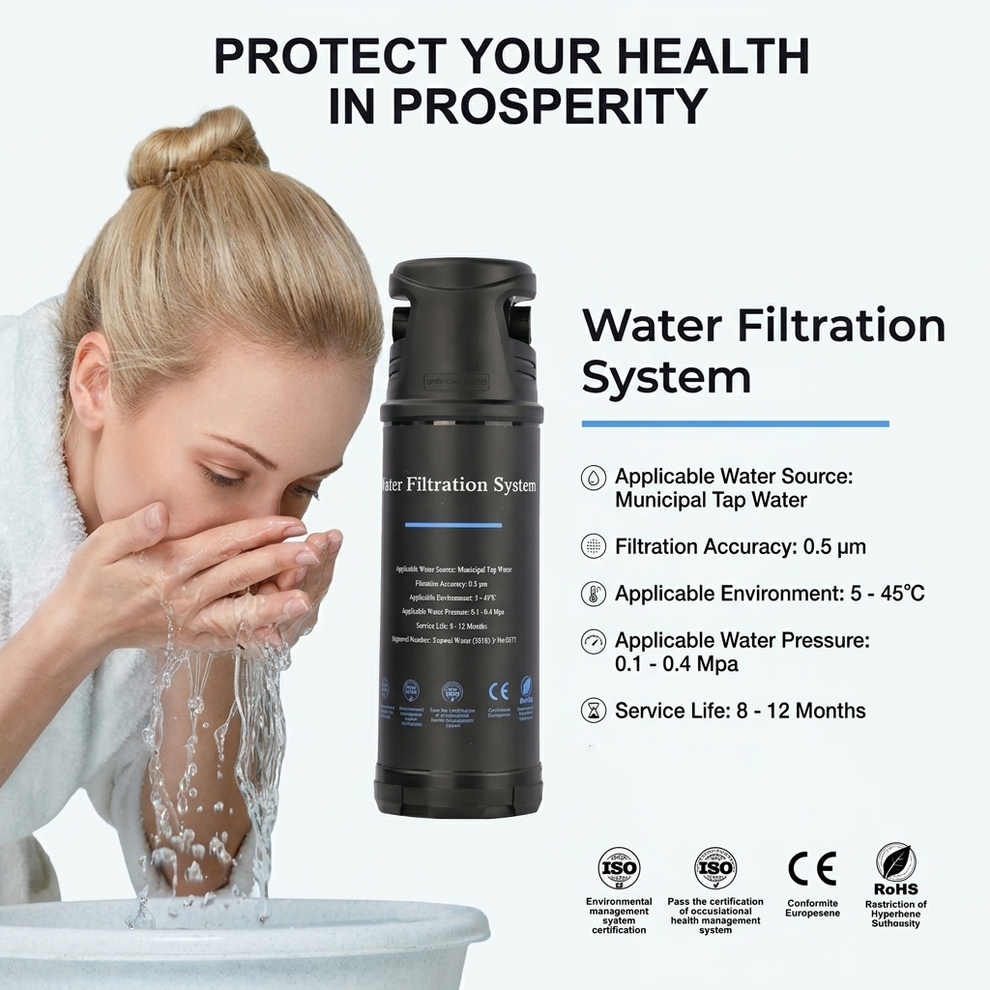
PUFLOW M8-2 Under Sink Water Filter System
For households using municipal tap water that need an under-sink filtration solution without installing a whole house RO system, the M8-2 is an alternative worth evaluating.
It uses ultrafiltration technology with a specified filtration accuracy of 0.01 μm. Its design focuses on under-sink installation and does not require electrical power.
| Filtration Accuracy | 0.01 μm |
| Flow Rate | Up to 400 L/h |
| Working Pressure | 0.1–0.4 MPa |
| Applicable Water | Municipal Tap Water |
| Operating Temperature | 5°C–45°C (41°F–113°F) |
| Connector Size | 3/8" or 1/2" |
| Product Size | 130 × 110 × 345 mm |
| Installation | Under Sink |
| Power Requirement | None |
It is important to understand the distinction: ultrafiltration and reverse osmosis address different water treatment requirements. The M8-2 should not be considered a replacement for whole house RO when dissolved salts or specific dissolved contaminants require RO treatment.
Other PUFLOW Solutions Worth Considering
- C9 Pro RO Water Purifier – An option for users looking for reverse osmosis purification at the drinking-water level.
- Under Sink RO Water System – Suitable for evaluating a dedicated under-sink RO installation.
- A10S RO Replacement Filter Set – A replacement filtration option for compatible equipment.
- High-Flow RO Systems – A collection to explore when higher water production is a priority.
- Portable and Non-Electric Water Filters – Alternatives for applications where portability and independent operation matter.
Our recommendation is to select a filtration category first and then compare products within that category. This avoids paying for a treatment process that your water supply does not actually require.
Common Mistakes When Estimating Whole House RO Filter System Costs
Even experienced property owners can underestimate the cost of an RO project when they focus too heavily on equipment specifications.
Mistake 1: Comparing Systems Only by Purchase Price
Two systems with similar advertised production capacity may have very different membrane configurations, pretreatment equipment, pumps, and control features. Compare the complete configuration rather than the headline price.
Mistake 2: Ignoring Pretreatment
Installing RO equipment without addressing hardness, sediment, chlorine, or other feed-water problems can lead to premature component failure. A properly designed pretreatment system is part of the investment, not an optional extra.
Mistake 3: Choosing Excessive Production Capacity
An oversized installation can increase capital expenditure, energy requirements, and maintenance complexity. Capacity should be based on actual demand and an appropriate operating margin.
Mistake 4: Ignoring Concentrate Water
Reject water is an unavoidable part of conventional RO operation. Buyers must consider water costs, wastewater arrangements, and local discharge requirements before installation.
Mistake 5: Assuming Every RO System Is Suitable for Whole House Use
Many compact RO purifiers are designed for a kitchen faucet rather than an entire building. A point-of-use product should not be treated as a whole house solution simply because it uses RO technology.
Mistake 6: Forgetting Replacement Filter Costs
Replacement filters and membranes should be included in the original budget. Check compatibility, availability, and the supplier's recommended service procedures.
Mistake 7: Overlooking Water Quality After Storage
Even properly treated water can be affected by poor storage tank hygiene or contaminated downstream plumbing. Include suitable tank design, cleaning access, and distribution-system protection.
Frequently Asked Questions About Whole House RO Filter System Costs
1. What is the biggest factor affecting whole house RO filter system costs?
System capacity is often one of the largest cost drivers because it determines membrane quantity, pump requirements, pretreatment capacity, storage, and associated infrastructure. However, challenging incoming water quality can also substantially increase project costs through additional pretreatment and maintenance requirements.
2. Is a whole house RO system more expensive than an under-sink RO system?
Generally, yes. A whole house RO system must process much larger volumes of water and typically requires more substantial pumps, membranes, storage, pretreatment, and plumbing. An under-sink RO system treats water at selected outlets, making it a more economical option for households primarily concerned with drinking and cooking water.
3. How much does it cost to install a whole house reverse osmosis system?
There is no reliable universal installation price because costs depend on production capacity, feed-water chemistry, equipment configuration, plumbing modifications, drainage, electrical requirements, and labor rates. Request a site-specific quotation that separates equipment, installation, commissioning, and ongoing operating expenses.
4. Does high TDS increase whole house RO system costs?
High TDS can increase costs because the system may need a different membrane configuration, higher operating pressure, or additional treatment measures. It can also affect water recovery and energy consumption. The correct design depends on the specific dissolved substances, their concentrations, and the required treated-water quality.
5. How often should whole house RO filters and membranes be replaced?
Replacement intervals depend on feed-water quality, pretreatment effectiveness, operating conditions, and component specifications. Sediment and carbon filters generally require more frequent attention than RO membranes. Follow manufacturer recommendations and use pressure, flow, and water-quality measurements to determine when maintenance is necessary.
6. Does a whole house RO system waste water?
Yes. Conventional RO systems produce a concentrate stream in addition to treated water. The quantity depends on membrane design, feed-water conditions, operating pressure, and recovery rate. Buyers should calculate the associated water and wastewater expenses before selecting a system.
7. Is whole house RO better than a water softener?
Neither technology is universally better. A water softener is designed to reduce hardness minerals through ion exchange, while RO reduces dissolved substances through membrane separation. If hardness is the main concern, a water softener is often a more targeted solution. RO is more appropriate when broader dissolved-solids reduction is required.
8. Is whole house RO necessary for municipal tap water?
Not necessarily. Many municipal supplies already meet applicable drinking-water requirements, and some households only need additional treatment for taste, odor, chlorine, or specific contaminants. Test the water and identify the treatment objective before purchasing a whole house RO system.
9. Can ultrafiltration replace a whole house RO system?
Ultrafiltration can be a suitable alternative when the main requirements involve suspended particles and certain microorganisms. However, UF does not provide the same dissolved-solids reduction as RO. The two technologies should be selected according to the contaminants that need to be treated.
10. How can I reduce whole house RO filter system costs?
Start with accurate water testing, correctly calculate water demand, avoid unnecessary treatment stages, choose appropriate recovery and pump configurations, and compare long-term replacement costs. If only drinking water requires RO treatment, consider an under-sink system instead of processing the entire property's water supply.
References and Technical Resources
The following authoritative resources provide additional information about reverse osmosis, home water treatment, membrane performance, and filtration standards.
-
Centers for Disease Control and Prevention (CDC)
About Home Water Treatment Systems
Provides guidance on testing household water and selecting treatment technologies based on specific contaminants. -
U.S. Environmental Protection Agency (EPA)
Overview of Drinking Water Treatment Technologies
Explains reverse osmosis and other treatment processes, including their operating principles and contaminant removal applications. -
NSF International
NSF/ANSI 58: Reverse Osmosis Drinking Water Treatment Systems
Describes performance testing, material safety, structural integrity, recovery ratings, and contaminant reduction requirements for applicable RO drinking water systems.
Final Recommendation: Evaluate the Complete Cost, Not Just the RO Equipment Price
The ten factors affecting whole house RO filter system costs demonstrate why choosing an RO installation requires more than comparing product prices. Capacity, feed-water quality, pretreatment, membrane configuration, recovery rate, pumps, storage, installation, automation, and maintenance all contribute to the final investment.
From our experience, the most cost-effective system is not necessarily the cheapest unit or the one with the highest production capacity. It is the system that consistently meets the property's water quality requirements without excessive energy consumption, unnecessary water waste, or avoidable maintenance expenses.
For residential users, the first decision should be whether RO treatment is necessary throughout the property or only at drinking-water outlets. For commercial users, accurate demand calculations, appropriate pretreatment, and long-term serviceability should guide equipment selection.
PUFLOW provides water filtration and purification solutions for different household needs. Whether you are comparing under-sink filtration, RO purification, or alternative treatment technologies, selecting the correct system begins with understanding your water source and actual consumption requirements.
Make the water quality requirement your starting point, calculate the total ownership cost, and invest in filtration equipment that delivers measurable value over its operating life.