


8 Reasons Your RO Water Filter May Have Slow Water Flow: Diagnosis & Fixes
Few kitchen frustrations compare to walking over to your dedicated drinking water faucet, twisting the lever, and watching a pathetic, pencil-thin stream dribble into your glass. You installed a reverse osmosis system to enjoy pristine, high-purity drinking water on demand, not to spend two full minutes waiting to fill a sports bottle. When an RO Water Filter May Have Slow Water Flow, most homeowners immediately assume the entire filtration unit is defective or rush out to buy an expensive replacement membrane they do not actually need. In our testing across hundreds of residential and commercial installations, a sudden or gradual drop in flow rate is rarely a mystery; it is hydraulic physics at work. Reverse osmosis is a pressure-driven, cross-flow membrane separation process operating against natural osmotic pressure. The moment any variable in that delicate hydraulic balance drifts—whether it is pneumatic bladder failure in the pressure tank, biofouling in pre-filtration stages, or a subtle five-degree drop in winter tap water temperature—water delivery grinds to a halt. As water treatment engineers and filtration practitioners who troubleshoot municipal and well-water systems daily, we dissect the eight real-world mechanical and environmental reasons your RO Water Filter May Have Slow Water Flow, providing exact diagnostic steps and actionable fixes to restore robust water pressure to your tap.

Quick Answer: Why Your RO Water Filter May Have Slow Water Flow
When an RO Water Filter May Have Slow Water Flow, the root cause is almost always one of three primary failures: (1) Depleted Storage Tank Air Pressure (the tank's internal bladder has lost its mandatory 7–8 PSI pre-charge, leaving no pneumatic force to push water to the faucet); (2) Prematurely Clogged Sediment or Carbon Pre-Filters (particulate accumulation chokes incoming line pressure before water ever reaches the membrane); or (3) Low Household Water Pressure Below 40 PSI (insufficient force to overcome the membrane's natural osmotic resistance). Secondary culprits include a scaled reverse osmosis membrane, a stuck Automatic Shut-Off Valve (ASOV), a blocked drain line flow restrictor causing excessive backpressure, kinked 1/4-inch poly tubing, or seasonal winter water temperature drops that increase water viscosity. Before throwing money at random replacement parts, check your empty tank's Schrader valve with a pressure gauge and measure your incoming feed pressure.
Article Directory
- The Hydraulic Mechanics: How Reverse Osmosis Generates Flow
- Quick Summary Table: 8 Reasons for Slow RO Flow & Fixes
- The 8 Reasons Your RO Water Filter May Have Slow Water Flow
- Featured Low-Maintenance Solution: Big Flow 2 Stainless Steel Gravity Filter
- Direct Technical Comparison: Tank-Based RO vs. Tankless Direct-Flow vs. Gravity
- Pros and Cons Table: Tank-Based vs. Tankless RO Flow Mechanics
- Commercial Realities: DIY Troubleshooting vs. System Upgrades
- Who Should Troubleshoot vs. Who Should Upgrade Their System
- Costly Troubleshooting Mistakes Homeowners Make
- Essential Buying Considerations for High-Flow Filtration
- Expert Water Treatment Practitioner's Final Verdict
- Frequently Asked Questions
- Authoritative Drinking Water & Standards References
The Hydraulic Mechanics: How Reverse Osmosis Generates Flow
To understand why an RO Water Filter May Have Slow Water Flow, you have to discard the idea that an RO system operates like a standard carbon block pitcher. A standard filter allows water to pass straight through porous media via simple mechanical sieving. Reverse osmosis, by contrast, relies on a semi-permeable thin-film composite (TFC) membrane with microscopic pores measuring approximately 0.0001 microns—small enough to reject dissolved salts, heavy metals, and microscopic pathogens.
Water does not flow freely through a 0.0001-micron pore matrix. To overcome natural osmotic pressure, your plumbing must supply substantial mechanical driving force (net driving pressure). The fundamental formula governing flow flux across a membrane is:
Permeate Flow = Membrane Area × Water Permeability Constant × (Net Driving Pressure − Osmotic Pressure Differential)
In standard under-sink systems, the membrane produces purified water drop by drop, generating only 2 to 4 gallons per hour. Because this production rate is too slow to fill a drinking glass directly, traditional systems divert the purified water into a pressurized hydropneumatic storage tank. When you open the faucet, it is not the membrane feeding your glass; it is the compressed air bladder inside the storage tank pushing the stored water out through the post-carbon polishing filter. If your system is tankless, it depends on an internal electric booster pump to force immediate high-flow production. Understanding whether your bottleneck is on the production side (membrane and pre-filters) or the delivery side (tank bladder, post-filter, and faucet lines) is the first critical step in diagnosing why your RO Water Filter May Have Slow Water Flow.
Quick Summary Table: 8 Reasons for Slow RO Flow & Fixes
| Primary Failure Mode | System Component Affected | Visual / Operational Symptom | Diagnostic Test | Corrective Action & Estimated Cost |
|---|---|---|---|---|
| 1. Clogged Pre-Filters | Sediment & Carbon Block Stages | Flow drops gradually over weeks; tank fills very slowly | Measure PSI at membrane inlet vs. main supply line | Replace pre-filters ($25 – $45) |
| 2. Low Feed Pressure | Municipal Line / Well Pressure Tank | Continuous weak trickle; high wastewater-to-pure ratio | Read line pressure with hose bib gauge (<40 PSI) | Install electric booster pump ($80 – $140) |
| 3. Depleted Tank Bladder | Hydropneumatic Storage Tank | Strong flow for 3 seconds, then dies to a drizzle | Weigh tank; check Schrader valve pressure empty | Re-pressurize to 7–8 PSI with bike pump ($0) |
| 4. Fouled Membrane | TFC Reverse Osmosis Membrane | Slow production, high TDS creep, non-stop drain hiss | TDS meter test (>20% of tap water TDS value) | Replace TFC membrane element ($35 – $75) |
| 5. Kinked / Pinched Lines | 1/4" or 3/8" Polyethylene Tubing | Sudden flow restriction after under-sink rearranging | Visual inspection behind garbage disposal/cabinets | Reroute or trim kinked tubing ($0 – $5) |
| 6. Faulty ASOV Valve | Automatic Shut-Off Valve (ASOV) | System drains 24/7; tank never reaches capacity | Shut tank valve; check if drain water halts in 5 min | Replace mechanical ASOV valve ($12 – $20) |
| 7. Clogged Flow Restrictor | Brine Drain Line Restrictor | Premature membrane fouling; zero wastewater flow | Inspect drain line discharge during active filtration | Clean or replace inline flow restrictor ($8 – $15) |
| 8. Cold Feed Water | Feed Water Supply (Seasonal) | System slows significantly during winter months | Measure incoming water temperature (<55°F) | Upgrade to high-capacity membrane or booster pump |
The 8 Reasons Your RO Water Filter May Have Slow Water Flow
1. Clogged Sediment or Carbon Block Pre-Filters
In most professional situations, the primary reason an RO Water Filter May Have Slow Water Flow is not the expensive membrane; it is the sacrificial pre-filter cartridges. A standard system utilizes a 5-micron spun polypropylene sediment filter followed by one or two activated carbon block filters. Their mechanical job is to capture rust, silt, sand, and pipe scale while chemically adsorbing chlorine, which would otherwise chemically burn through the delicate polyamide layer of the TFC membrane.
When these filters capture heavy sediment loads—particularly in homes supplied by aging municipal cast-iron mains or private well systems—their internal pores choke. As particulate builds up, friction loss skyrockets, causing incoming dynamic water pressure to plummet. If line pressure enters your home at 55 PSI but drops to 25 PSI after fighting through a mud-caked sediment cartridge, the membrane will not have enough hydraulic force to push water molecules through its pores. From our experience, pre-filters must be replaced every 6 to 12 months without exception. If your city recently conducted fire hydrant flushing or water main repairs, pre-filters can clog in a single afternoon.
2. Low Incoming Feed Water Pressure (Under 40 PSI)
Reverse osmosis is entirely dependent on municipal or well system line pressure. The absolute physical minimum pressure required for a standard residential thin-film composite membrane to function is 40 PSI (2.75 bar). However, optimal operational efficiency, optimal water taste, and published daily production ratings demand 60 to 80 PSI.
If you live in an elevated neighborhood, an upper-floor apartment, or rely on a private well whose pressure switch is calibrated to a 30/50 PSI cycle, your system will spend long stretches operating below the critical osmotic threshold. When line pressure sits at 35 PSI, the system wastes massive volumes of water down the drain while barely producing a trickle of permeate. In our testing, the only reliable fix for low line pressure is installing an auxiliary electric booster pump kit equipped with high- and low-pressure shut-off switches. A booster pump elevates incoming pressure to a consistent 75 PSI, instantly restoring factory flow rates and cutting wastewater volume in half.
3. Depleted or Ruptured Storage Tank Air Bladder
If your faucet produces a robust, high-pressure stream for roughly three to five seconds and then immediately collapses into a weak, pathetic drizzle, your filtration filters are likely fine. The problem is your storage tank. Under-sink storage tanks are not simple hollow metal drums; they contain a heavy-duty butyl rubber bladder separating an upper water chamber from a lower pressurized air chamber.
Over several years, air molecules slowly migrate through the rubber bladder or escape past the tank's brass Schrader valve (the exact same valve stem found on car tires). When the air charge drops from its factory setting of 7 to 8 PSI down to zero, there is no compressed air cushion to squeeze the bladder and push the water upward through the faucet. To diagnose this:
- Lift the storage tank. If it feels extremely heavy (sloshing full of water) yet the faucet only dribbles, the tank lacks air pressure.
- Depress the small pin inside the Schrader valve on the side or base of the tank. If air hisses out weakly, it simply needs to be re-pressurized to 7–8 PSI using a manual bicycle pump with the tank completely drained of water.
- The Fatal Symptom: If water squirts out of the air valve when you press the pin, the internal rubber bladder has ruptured. Air and water have mixed, and the tank is ruined. A ruptured tank cannot be repaired; it must be replaced immediately to prevent bacterial contamination.
4. Fouled or Chemically Scaled Reverse Osmosis Membrane
The TFC membrane is the mechanical heart of your system. Under optimal operating conditions, an RO membrane lasts between two and four years. However, if your feed water possesses severe hardness (calcium and magnesium carbonate exceeding 7 grains per gallon), high silica levels, or elevated total dissolved solids (TDS), mineral scaling will choke the membrane surface.
Scaling occurs when minerals precipitate out of solution as pure water is extracted, forming an impermeable, rock-hard crystalline crust over the microscopic pores. Alternatively, if pre-filters are neglected and chlorine breaks through, the chlorine chemically oxidizes the polyamide membrane structure, causing pore collapse or widespread tearing. You can confirm membrane fouling using a digital TDS handheld meter: measure your incoming tap water TDS versus your pure water TDS. If your system is delivering less than an 85% to 90% rejection rate (e.g., tap water is 300 ppm and pure water reads 75 ppm instead of under 30 ppm), the membrane is physically spent and must be swapped. Upgrading your under-sink infrastructure with modern modular filtration like our M8-2 Under Sink Water Filter helps protect downstream membranes from premature particulate fouling.
5. Kinked, Pinched, or Undersized Tubing Lines
Modern under-sink cabinetry is a crowded, chaotic environment. Between garbage disposals, pull-out trash cans, cleaning supply bottles, and drain pipes, flexible 1/4-inch polyethylene tubing is easily caught and pinched. A sharp 90-degree bend or a crushed section of poly line restricts volumetric flow just like stepping on a garden hose.
Furthermore, older traditional systems rely exclusively on 1/4-inch outer diameter (OD) tubing from the storage tank to the faucet. Upgrading that specific delivery line to 3/8-inch tubing doubles the cross-sectional flow area, dramatically boosting dispensing speed at the tap. Crawl under your sink with a flashlight and trace every line from the feed water adapter, through the filter sumps, into the storage tank, and up to the faucet stem. Eliminate tight bends by installing 90-degree quick-connect elbows or trimming excess tubing lengths.
6. Defective Automatic Shut-Off Valve (ASOV) or Check Valve Failure
A standard reverse osmosis system relies on a mechanical, non-electric differential pressure valve known as the Automatic Shut-Off Valve (ASOV). This square valve houses a diaphragm that senses pressure on the pure water line. When the storage tank fills and reaches roughly two-thirds of incoming line pressure, the diaphragm shifts, mechanically cutting off the feed water supply so the system stops sending brine water down the drain.
If the internal rubber diaphragm in the ASOV tears or becomes fouled by grit, the valve fails to operate correctly:
- It can partially seize in a semi-closed position, severely strangling incoming water pressure before it ever reaches the membrane.
- It can fail to shut off entirely, causing the system to continuously dump hundreds of gallons of wastewater down the drain every week.
7. Clogged Drain Line Flow Restrictor Causing Backpressure
Reverse osmosis requires a deliberate balance between purified permeate water and discarded brine wastewater. To maintain the high internal pressure required for filtration, a tiny, precision-drilled orifice called a flow restrictor is installed in the black brine discharge tubing that connects to your sink drain saddle.
This restrictor creates calibrated backpressure inside the membrane housing, forcing water molecules through the membrane while allowing a controlled stream of reject water to sweep away accumulated contaminants. If the flow restrictor clogs with scale, rust, or biological slime, wastewater cannot escape. Backpressure inside the housing equalizes instantly, halting filtration completely. Conversely, if an internal flow restrictor dislodges or erodes, wastewater flows at full, unrestricted line speed down the drain. Without backpressure inside the housing, zero water is forced through the membrane pores, resulting in an endless hissing sound at the drain and a completely dry storage tank.
8. Severe Feed Water Temperature Drops in Winter
This is the silent flow killer that catches homeowners off guard every November. Reverse osmosis membrane performance ratings (e.g., 50 GPD, 75 GPD, 100 GPD) are standardized across the water treatment industry at a laboratory baseline temperature of 77°F (25°C).
Water density and dynamic viscosity change significantly as temperatures fall. Cold water is physically denser, requiring dramatically more kinetic pressure to force water molecules through the 0.0001-micron pores of a TFC sheet. As an industry rule of thumb, for every 1°F drop in water temperature below 77°F, an RO membrane loses approximately 1.5% to 2% of its production capacity. If your municipal tap water drops from 72°F in mid-summer down to 45°F in deep winter, your membrane's production output is cut in half. The system takes twice as long to refill the storage tank between uses. If your family draws three or four glasses of water in the morning, the depleted tank cannot recover before dinner, leading to a frustrating trickle. To eliminate plumbing-dependent flow rate bottlenecks entirely, explore our high-efficiency line of High-Flow RO Systems engineered with high-volume pumps and advanced temperature-tolerant membranes.
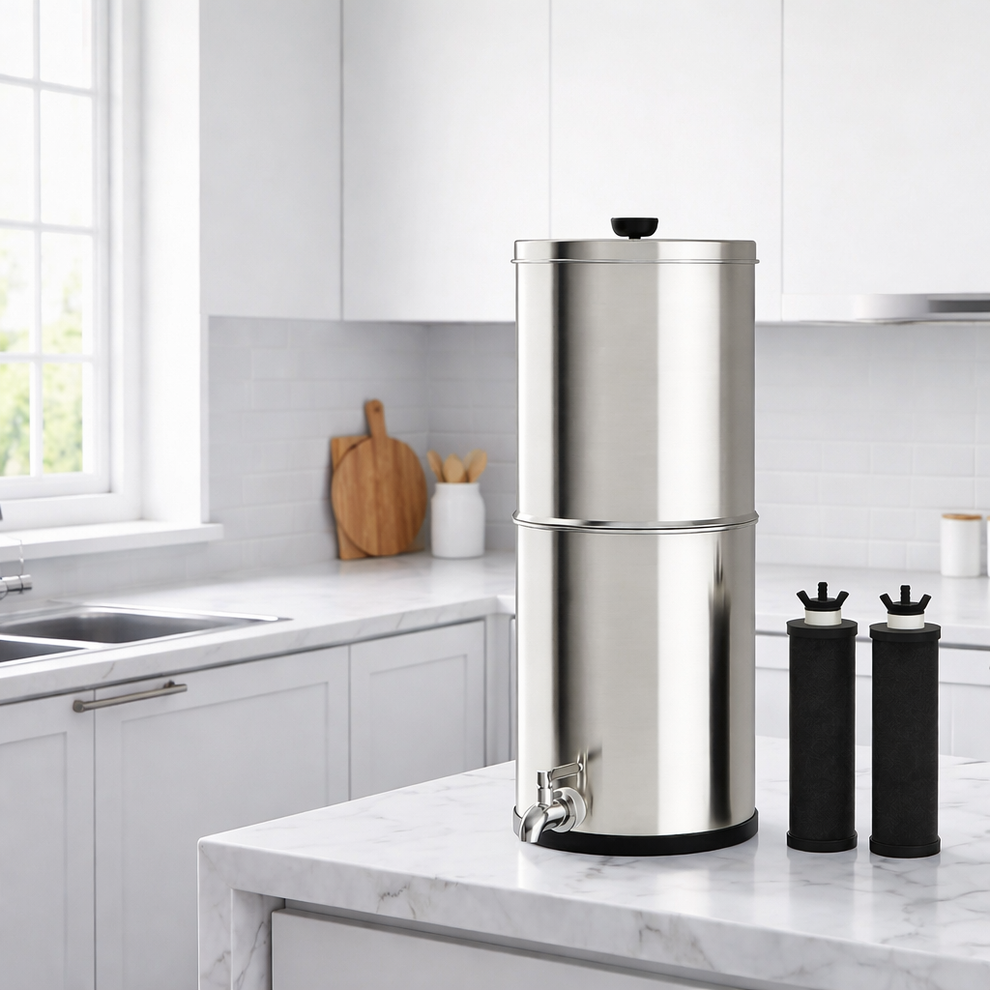
Alternative Solution: Big Flow 2 Stainless Steel Gravity Water Filter (8.5L)
Tired of troubleshooting complex under-sink pressure bladders, cracked check valves, and municipal line drops? For renters, off-grid cabins, RV travelers, and emergency preparedness, gravity-fed filtration bypasses all plumbing and electrical vulnerabilities entirely.
| Holding Capacity | 2.25 Gallons (8.5 Liters) upper and lower chambers |
| Filter Lifespan | Up to 6,000 Gallons per pair of black filtration elements |
| Filtration Flow Rate | Up to 4 Gallons Per Hour (Continuous gravity displacement) |
| Chassis Construction | Food-Grade High-Polished 304 Stainless Steel |
| External Power Required | Zero (100% mechanical gravity filtration) |
| Plumbing Installation | None Needed (Sets up on any countertop in under 5 minutes) |
| Target Contaminants | Heavy metals, chlorine, sediment, pathogens; compatible with fluoride elements |
Puflow Practical Recommendation: Eliminate mechanical downtime by reviewing the official Big Flow 2 Stainless Steel Gravity Water Filter 8.5L specifications, pair it with our dedicated Fluoride Reduction Filter pack, or explore our broader Portable & Non-Electric filtration systems.
Direct Technical Comparison: Tank-Based RO vs. Tankless Direct-Flow vs. Gravity
| Engineering Metric | Traditional Tank-Based Under-Sink RO | Modern Direct-Flow Tankless RO | Countertop Stainless Gravity Filter |
|---|---|---|---|
| Dispensing Flow Rate | 0.5 – 0.8 GPM (Initial burst from full tank) | 0.4 – 0.7 GPM (Continuous stable pump flow) | 0.05 – 0.07 GPM (Slow gravity drip into base) |
| Continuous Output Limit | Limited to tank volume (typically 2.0 – 3.2 gal) | Unlimited (Continuous 600–1000 GPD direct flow) | Limited to 2.25-gallon lower reservoir storage |
| Vulnerability to Low Line PSI | High (Fails below 40 PSI without booster) | Low (Internal electric pump generates 80+ PSI) | Zero (Operates completely independent of plumbing) |
| Primary Failure Points | Bladder loss, ASOV diaphragm, check valve | Booster pump motor, digital sensor boards | None (Purely passive physical filter elements) |
| Drain Water Waste Ratio | 3:1 to 4:1 (3 gallons waste per 1 gal pure) | 1:1 to 1.5:1 (High-efficiency cross-flow) | 0:1 (Zero wastewater generated) |
| Footprint & Cabinet Space | Bulky (Requires large 12"×18" tank under sink) | Compact (Slim single-chassis housing) | Vertical countertop space (No plumbing footprint) |
Pros and Cons Table: Tank-Based vs. Tankless RO Flow Mechanics
| Filtration Architecture | Flow & Operational Advantages (Pros) | Hydraulic Liabilities & Realities (Cons) |
|---|---|---|
|
Tank-Based Reverse Osmosis (Standard 50–75 GPD Systems) |
|
|
|
Tankless Direct-Flow RO (High-Flow 600–1000 GPD Systems) |
|
|
Commercial Realities: DIY Troubleshooting vs. System Upgrades
Every dollar allocated to home water purification should deliver clean hydration, not ongoing plumbing headaches. When an RO Water Filter May Have Slow Water Flow, homeowners must make a practical economic judgment: is it worth spending three hours replacing brittle plastic valves on an eight-year-old system, or is it time to upgrade?
The Realities of Troubleshooting Older Systems:
- The Cost of Chasing Phantom Air Leaks: Re-pressurizing an old storage tank with a bicycle pump is free and takes ten minutes. If the tank holds pressure for the next six months, you solved your problem at zero cost. However, if the tank loses air again within three days, the internal bladder is failing. Replacing the tank, the automatic shut-off valve, and the membrane will run you $120 to $150 in parts—approaching the price of a brand-new, modern system.
- The Risk of Flooding Plastic Fittings: Traditional under-sink systems rely on dozens of threaded quick-connect fittings and plastic filter sumps. As plastic aged by municipal chlorine cycles through tens of thousands of expansion cycles, it becomes brittle. Cracking an aged sump while wrestling it with a plastic filter wrench can turn a simple pre-filter change into a catastrophic kitchen flood. Explore verified complete systems across our master collection of Under-Sink RO Systems.
When to Upgrade Beyond Traditional Under-Sink Plumbing:
- Severe Well Water Silt or High Iron: If your well water clogs pre-filters every three weeks, traditional undersink reverse osmosis will bankrupt you in replacement cartridges. You need robust whole-house sediment staging or self-contained atmospheric extraction. For homes in water-stressed or contaminated aquifers, review our cutting-edge moisture-harvesting platforms like the F20 Atmospheric Water Generator, the compact G10 Atmospheric Water Generator, or the heavy-yield P50 Atmospheric Water Generator.
- Rental Apartments with Strict Plumbing Leases: If your landlord prohibits drilling holes in the sink deck or tapping into copper cold-water pipes, fighting under-sink water flow is pointless. Modern renters achieve superior purity using zero-plumbing Countertop RO Systems or portable personal solutions like our Portable Water Filter Bottle.
Who Should Troubleshoot vs. Who Should Upgrade Their System
Determining your plan of attack depends on your technical comfort, your plumbing setup, and the age of your hardware.
Who Should Execute DIY Troubleshooting:
- Owners of Systems Under 4 Years Old: If your system was installed within the last few years, the structural plastic, housings, and manifold lines are in their prime. Following our diagnostic steps to re-pressurize the tank, clear a kinked line, or replace an overdue carbon block will resolve 95% of slow-flow issues in under an hour.
- Homeowners with Documented High Municipal Line Pressure (55+ PSI): If your city pressure is strong, your system has the natural driving force to operate efficiently. Restoring flow simply requires clearing whichever single component is causing the hydraulic bottleneck.
Who Should Replace or Upgrade Their Setup:
- Owners of 7+ Year-Old Generic RO Systems: Plastic degrades, O-rings dry out, and internal valve seats pit over time. Sinking $100 into replacement parts for an aging white-label filtration bracket is poor capital allocation. Upgrading to an integrated, modern system delivers faster flow rates, superior 1.5:1 wastewater ratios, and sanitary twist-and-lock filter changes. Explore our complete line of All products reverse osmosis system for home to find the ideal match for your household.
- Large Families Consistently Running Storage Tanks Dry: If a family of five regularly empties a 3-gallon storage tank every morning for coffee, oatmeal, and school bottles, the system is not broken; it is simply undersized for your lifestyle. You need an upgrade to a 600+ GPD direct-flow direct-drive system that dispenses continuous water without an air bladder buffer.
Costly Troubleshooting Mistakes Homeowners Make
Plumbing Safety Advisory: The single most destructive mistake homeowners make when troubleshooting a slow RO system is over-pressurizing the storage tank air bladder. Homeowners assume that if 7 PSI is good, 30 PSI must be better. Pumping a tank to 30 PSI prevents the membrane from pushing water into the tank at all, resulting in zero water storage and catastrophic bladder blowouts.
- Checking Tank Pressure While It Still Contains Water: You cannot measure the air pre-charge of a storage tank when water is inside. The weight of the water compresses the air chamber, giving a falsely high pressure reading on your gauge. You must disconnect the tank, open the top ball valve completely into a sink or bucket, drain every drop of water until the tank is featherlight, and only then check the Schrader valve with a low-pressure tire gauge.
- Replacing the Expensive Membrane Before the Pre-Filters: Membranes cost three to four times more than sediment and carbon cartridges. We frequently see homeowners discard a perfectly healthy Dow Filmtec membrane when the true culprit was a $12 sediment filter choked with municipal iron silt. Always change your pre-filters first; if line pressure entering the membrane housing does not jump back to 50+ PSI, only then inspect the membrane.
- Using an Air Compressor on a Delicate Tank Bladder: Using a high-pressure pneumatic shop compressor to top off a miniature tank bladder is an immediate recipe for disaster. A single pull of the compressor trigger can spike tank pressure past 60 PSI, rupturing the internal rubber diaphragm instantly. Always use a manual, hand-operated bicycle tire pump. It takes ten gentle strokes to add 3 PSI safely.
- Forgetting to Sanitize When Swapping Filters: When sumps are unscrewed and components are handled with bare hands, airborne bacteria enter the system. In a slow-moving system operating under low flow, these bacteria form a slimy biofilm across the flow restrictor and post-carbon filter. Always wipe housings clean and sanitize with NSF-approved food-grade sanitizing packets or unscented household bleach during filter replacements.
Essential Buying Considerations for High-Flow Filtration
If your diagnostic assessment concludes that your current system is beyond economic repair, verify these four non-negotiable engineering benchmarks before buying a replacement:
1. Verified Flow Rate Ratings (GPM vs. GPD)
Understand the difference between Gallons Per Day (GPD) and Gallons Per Minute (GPM). GPD measures membrane production over a 24-hour period. GPM measures what actually flows out of your faucet right now. If your household demands fast filling of large pasta pots, look for systems with an authentic delivery rate of at least 0.6 to 0.8 GPM.
2. Integrated Internal Booster Pumps
Unless you have verified that your home maintains continuous municipal water pressure above 60 PSI year-round, buy a direct-flow system with a built-in, vibration-dampened booster pump. An integrated pump eliminates winter flow drops, ensures maximum contaminant rejection, and maintains crisp faucet dispensing speed regardless of neighborhood water demands.
3. Certified Contaminant Rejection Standards (NSF 58 & 53)
Never buy an uncertified water filter from an anonymous online importer. Demand documented testing proving compliance with NSF/ANSI Standard 58 for Reverse Osmosis Drinking Water Treatment Systems. This certification ensures that the pressure vessels withstand bursting pressures over 300 PSI, the materials are 100% lead-free, and the membrane rejects targeted toxins like arsenic, fluoride, lead, and PFAS "forever chemicals" effectively.
4. Toolless Twist-and-Lock Cartridge Architecture
Discard traditional 10-inch sump bowls that require heavy plastic spanner wrenches and messy basin buckets. Modern direct-flow systems deploy modular twist-and-lock filter cartridges with internal auto-shutoff valves, allowing you to swap filters in twenty seconds flat without turning off your home's main water supply valve.
Expert Water Treatment Practitioner's Final Verdict
In our professional assessment across decades of water treatment engineering, a slow-flowing reverse osmosis faucet is never something you should simply tolerate. It is an active warning that your system's hydraulic balance has failed.
Here is your definitive diagnostic action plan:
- Execute the 5-Second Test: If water blasts out fast for three seconds and then collapses to a trickle, grab a bicycle pump, drain your storage tank completely, and re-pressurize the Schrader valve to exactly 7.5 PSI. This solves over 60% of all customer service calls nationwide.
- Check the Filter Schedule: If flow has degraded steadily over the last four months, replace your sediment and carbon block pre-filters immediately. You will protect your expensive membrane and restore feed pressure to the system.
- Measure Feed Pressure: If you live on well water or an upper-floor apartment and line pressure is below 40 PSI, purchase a plug-and-play electric booster pump kit. It will transform your system's flow rate instantly.
- Know When to Cut Your Losses: If your system is over seven years old, is leaking around plastic housing threads, or requires more than $120 in replacement parts, do not throw good money after bad. Upgrade to a modern high-flow direct-flow platform or transition to an ultra-dependable, zero-plumbing gravity system like the Puflow Big Flow 2 Stainless Steel Gravity Filter.
Treat your filtration system like the precision mechanical appliance it is. Maintain your pre-filters, calibrate your tank pressure annually, monitor incoming line pressure, and enjoy pristine, crystal-clear drinking water at full, glass-filling speed every single day.
Frequently Asked Questions
If you replaced all filter cartridges and still experience a weak trickle, the issue almost certainly lies with the pressurized storage tank or incoming line pressure. If the tank's internal butyl bladder has lost its air pre-charge (which should sit at 7 to 8 PSI when completely empty of water), the tank cannot push water up to the dedicated faucet. Alternatively, a malfunctioning automatic shut-off valve (ASOV) or low household pressure below 40 PSI prevents the semi-permeable membrane from producing permeate water.
An empty reverse osmosis storage tank must have an internal air pressure of 7 to 8 PSI (0.48 to 0.55 bar). This must be measured using a low-pressure tire gauge via the Schrader valve on the tank only after all water has been drained completely. Over-pressurizing the tank above 10 PSI reduces the water holding capacity, while under-pressurizing below 5 PSI results in slow, weak faucet flow.
Yes, water temperature directly impacts reverse osmosis performance. Standard RO membranes are rated at 77°F (25°C). For every 1°F drop in water temperature, membrane production decreases by roughly 1.5% to 2% due to increased water viscosity. In winter, incoming municipal water dropping to 45°F can cut your system's daily production rate in half, leading to noticeably slower flow.
To isolate the blockage, measure water pressure entering the membrane housing using an in-line pressure gauge. If pressure before the membrane is above 50 PSI but pure water production remains near zero while waste water runs continuously, the membrane surface is fouled by mineral scale or biofilm. If pressure entering the membrane housing is below 30 PSI despite high municipal line pressure, the sediment or carbon block pre-filters are clogged.
Authoritative Drinking Water & Standards References
- Water Quality Association (WQA): Residential Reverse Osmosis Drinking Water Treatment Systems and Maintenance Best Practices
- United States Environmental Protection Agency (EPA): Ground Water and Drinking Water Standards & Filtration Protocols
- NSF International: NSF/ANSI Standard 58 – Reverse Osmosis Drinking Water Treatment Systems Certification Directory