


8 Things to Know About Reverse Osmosis Filter Replacement
Reverse osmosis filter replacement is essential to keeping an RO water filtration system working as intended, but replacing every filter on the same schedule is not always the right approach. Sediment and carbon prefilters, the RO membrane, and the final polishing filter perform different jobs. They wear at different rates, respond to different water conditions, and can create different symptoms when they need attention.

The practical rule is simple: follow the manufacturer's replacement schedule, then adjust based on water quality, usage, system performance, and the results of appropriate testing. Waiting until water tastes unpleasant can allow a clogged filter or exhausted component to affect performance. Replacing everything too early, however, wastes money and usable filter life.
Many household RO systems use staged replacement intervals: sediment and carbon prefilters are often replaced every 6–12 months, while an RO membrane may last roughly 2–5 years under suitable conditions. Postfilters commonly need replacement around every 6–12 months. These are general estimates, not universal rules; the system manual and actual water conditions take priority.
Our recommendation: Identify the exact filter model, record the installation date, and follow the manufacturer's schedule. If flow drops, taste changes, or water-quality readings shift, investigate the cause instead of automatically replacing every component. A TDS meter can help monitor trends, but it cannot verify the removal of every contaminant.
Table of Contents
- Quick Summary Table
- How Reverse Osmosis Filtration Works
- 8 Things to Know About RO Filter Replacement
- Filter Replacement Comparison Table
- Pros and Cons of Scheduled Replacement
- Signs Your RO Filters May Need Replacing
- How to Replace RO Filters
- How to Choose Replacement Filters
- Puflow System Option
- Cost-Benefit Analysis
- Expert Recommendation
- Frequently Asked Questions
- References
Quick Summary: Reverse Osmosis Filter Replacement
| Component | Typical Replacement Range | Main Function | What to Watch |
|---|---|---|---|
| Sediment prefilter | Often 6–12 months | Captures suspended particles before they reach downstream components | Clogging, reduced flow, visible sediment, pressure changes |
| Carbon prefilter | Often 6–12 months | Reduces chlorine and certain taste- or odor-causing substances, depending on media and certification | Schedule, source-water changes, membrane protection needs |
| RO membrane | Often 2–5 years | Separates many dissolved substances from water | Rejection performance, pressure, temperature, feed-water chemistry |
| Post-carbon filter | Often 6–12 months | Polishes treated water for taste and odor, depending on the design | Water taste, service interval, hygiene requirements |
| Specialty filter | Model- and media-dependent | Targets specified substances or adjusts water characteristics | Manufacturer's rated capacity, test results, replacement instructions |
Replacement intervals vary considerably with feed-water quality, household demand, system design, maintenance, and filter capacity. A high-sediment supply can shorten prefilter life. Low pressure, a degraded membrane, a restricted line, or a storage-tank problem can also reduce output, so low flow alone does not prove that the membrane has failed.
How Reverse Osmosis Filtration Works
Reverse osmosis (RO) uses pressure to move water through a semipermeable membrane. The membrane allows water to pass while rejecting a substantial proportion of many dissolved substances. The exact removal performance depends on the membrane, operating conditions, source water, and the contaminants being measured.
Most conventional household RO systems combine multiple filtration stages. A sediment filter captures suspended particles; carbon filtration can reduce chlorine and certain organic compounds; the RO membrane reduces many dissolved constituents; and a postfilter may improve taste before water reaches the faucet. Some systems include additional specialty stages, such as mineral media or filters designed for particular contaminants.
Each stage protects or complements the others. A clogged sediment filter may restrict flow. An exhausted carbon prefilter may fail to perform its intended role in protecting a chlorine-sensitive membrane. A damaged or fouled membrane may show declining rejection performance. A final polishing filter can also affect taste if it is overdue for service.
For households that need a compact drinking-water setup, Puflow offers several system categories, including under-sink RO and water filtration systems and countertop systems. The right configuration depends on installation space, source water, water demand, and the contaminants you need to address.
8 Things to Know About Reverse Osmosis Filter Replacement
1. Each filter stage has a different replacement schedule
The first mistake many owners make is treating the entire filter set as one component. Sediment, carbon, membrane, and postfilters have different functions and service lives. Their replacement intervals should not be assumed to match.
Sediment and carbon prefilters often need more frequent attention than the RO membrane. The prefilters receive the initial load of particles and certain chemicals, while the membrane performs the main dissolved-solids separation. The postfilter has a different role again, often improving taste or odor after the main treatment stage.
For most professional situations, use the system manual as the baseline and record the installation date for each cartridge. Replace components on schedule unless the manufacturer specifies another approach. If your water supply has high sediment levels, unusual chlorine conditions, or seasonal changes, consult the manufacturer about whether the standard schedule needs adjustment.
2. Water quality and household usage affect filter life
Two households using the same RO model may not get the same filter life. A home with several people filling bottles and cooking with RO water will process more water than a household that uses the system occasionally. Feed-water turbidity, hardness, chlorine, temperature, and pressure can also influence performance and maintenance needs.
High sediment loads can block a prefilter sooner than expected. Hardness and other dissolved constituents may contribute to membrane scaling under certain conditions. Inadequate pressure or poor maintenance can also affect output. A filter's rated life is therefore a planning estimate, not a guarantee that it will perform identically in every home.
We recommend keeping a simple log with the installation date, approximate water usage, any performance changes, and the date of each replacement. That history helps you identify recurring problems and avoid replacing components solely because a calendar reminder appears.
3. Reduced water flow does not automatically mean the membrane is bad
Slow RO production is a common reason people order a replacement membrane too soon. Before buying one, check the simpler causes: a clogged prefilter, a partially closed supply valve, low incoming pressure, a kinked tube, a restricted postfilter, or a storage tank that is not operating properly.
RO production is also affected by water temperature and pressure. Colder water can reduce output, while a system operating outside its specified pressure range may perform poorly. Compare performance under similar conditions before deciding that the membrane has reached the end of its useful life.
If flow remains low after the obvious restrictions have been checked, use the manufacturer's diagnostic process or seek qualified service. Replacing a membrane without identifying the cause can waste money and leave the actual fault unresolved.
4. A TDS meter is useful, but it does not test every contaminant
Total dissolved solids (TDS) readings are often used to monitor RO performance. By comparing feed-water and treated-water readings under reasonably consistent conditions, you can estimate apparent dissolved-solids rejection. A significant change may indicate that the membrane or system needs investigation.
However, TDS is not a complete water-safety test. It does not identify every individual contaminant, and a low reading does not prove that the water is free from microorganisms, specific chemicals, or other substances that may require targeted testing. Some contaminants may not be reflected reliably by a basic TDS measurement.
For a meaningful check, use the membrane manufacturer's procedure and compare readings under similar pressure and temperature conditions. If you have a specific concern—such as lead, nitrate, arsenic, PFAS, or microbiological contamination—use an appropriate laboratory test or a treatment system verified for that contaminant. Do not rely on TDS alone to decide whether water is safe.
5. Replacing prefilters on time can protect the membrane
Prefilters are not merely inexpensive add-ons. Their job is to condition the feed water before it reaches the RO membrane. Sediment filtration helps reduce particle loading, while a suitable carbon stage can reduce chlorine and other substances according to its media design and performance rating.
Some RO membranes are sensitive to chlorine exposure. If a carbon prefilter is exhausted or incorrectly specified, the membrane may be exposed to conditions it was not designed to tolerate. This is one reason why replacing only the membrane after a failure can be a poor maintenance strategy.
For cost-conscious owners, the sensible approach is to maintain prefilters at the specified interval and assess membrane condition separately. If your system uses a different pretreatment design, follow its documented instructions rather than assuming every RO system has the same stages.
6. Compatible replacement filters matter more than a generic fit
A cartridge that physically fits into a housing is not necessarily an appropriate replacement. Filter media, flow direction, sealing surfaces, rated capacity, pressure limits, and connection dimensions all affect compatibility. A poorly seated seal can cause leaks, while an unsuitable filter may fail to deliver the intended reduction in contaminants.
Before ordering, confirm the exact system model and cartridge part number. Check whether the manufacturer permits third-party cartridges, whether the replacement uses the same connection design, and whether its performance claims are supported for the intended use. For systems with quick-connect or proprietary cartridges, compatibility can be especially important.
Puflow's replacement filter collection is a useful starting point for identifying available options. Match any replacement to the specific system and stated application rather than selecting a filter based only on appearance or price.
7. Proper installation and sanitization are part of replacement
Even a suitable filter can cause problems if it is installed incorrectly. Before servicing the unit, follow the manufacturer's instructions for shutting off the feed-water supply, relieving pressure, handling the cartridge, and reconnecting the system. Never force a cartridge into a housing or reuse a damaged O-ring simply to finish the job quickly.
After installation, check every connection for leaks and flush the new filter as directed. Carbon cartridges can release harmless fines during initial flushing, and new membranes may require a longer initial flush or tank-discard procedure. The correct steps depend on the system design.
Sanitization may also be recommended when changing filters, particularly if the storage tank or plumbing has been opened. Use only the specified procedure and materials. Improvised chemical cleaning can damage components or leave residues, so follow the manual rather than applying a generic cleaning recipe to every system.
8. The cheapest replacement is not always the best value
A low-priced cartridge may appear attractive, but the purchase price is only one part of the decision. Consider rated capacity, compatibility, documented performance, replacement frequency, shipping costs, and the risk of leaks or premature failure. A cheaper filter that must be replaced more often may cost more over a year.
At the other extreme, do not pay for a specialty stage unless it addresses a real need. A fluoride-reduction filter, for example, may be worth evaluating when fluoride reduction is a specific treatment objective and the product's performance is appropriately documented. It is not automatically necessary for every household.
Our recommendation is to buy a correctly matched replacement with clear specifications, maintain it on schedule, and test the system when performance changes. This is more reliable than replacing components based on marketing claims or selecting the lowest price without checking the technical details.
RO Filter Replacement Comparison Table
| Filter or Service | Typical Purpose | When to Replace or Investigate | Buying Priority |
|---|---|---|---|
| Sediment filter | Reduces suspended particles | At the specified interval, or earlier if loading and performance indicate a problem | Correct micron rating, dimensions, and system compatibility |
| Carbon prefilter | Reduces chlorine and certain taste- or odor-causing substances | At the specified interval or rated capacity; sooner if the manufacturer or testing indicates | Appropriate media, capacity, and membrane-protection requirements |
| RO membrane | Reduces many dissolved substances | When validated performance or output remains outside expected limits after other causes are checked | Correct membrane type, dimensions, pressure, and rejection specification |
| Postfilter | Final taste and odor polishing in systems that use one | According to schedule or system-specific diagnostics | Correct connection and rated service life |
| Specialty reduction filter | Targets a specified contaminant or water characteristic | At rated capacity or the stated replacement interval | Contaminant-specific performance evidence and compatible installation |
| Professional inspection or water test | Identifies problems that a routine cartridge change may not solve | When water quality is uncertain, performance changes, or a safety concern exists | Appropriate testing method and qualified interpretation |
Pros and Cons of Scheduled Reverse Osmosis Filter Replacement
| Pros | Cons and Limitations |
|---|---|
| Helps maintain expected filtration performance when parts are changed according to the manufacturer's instructions | Replacing all stages too frequently can waste money and usable filter capacity |
| Routine prefilter changes can help protect downstream components | A replacement schedule cannot compensate for incorrect installation or poor source-water conditions |
| Recorded service dates make maintenance easier to plan | Calendar intervals alone do not reveal every performance problem |
| Compatible cartridges reduce the risk of fit and sealing problems | Some systems use proprietary parts that limit replacement choices |
| Testing can help identify membrane deterioration or other faults | TDS measurements alone cannot establish the presence or absence of every contaminant |
| Correct maintenance can reduce avoidable troubleshooting and downtime | Filters cannot correct every water-quality problem; some conditions require different treatment or professional advice |
Signs Your RO Filters May Need Replacing
Noticeably reduced water production
A drop in flow may indicate a clogged prefilter, fouled membrane, low supply pressure, a restricted line, or a storage-tank issue. Check the manufacturer's troubleshooting steps before ordering a membrane.
Changes in taste or odor
A change in taste or smell can be associated with a postfilter that is due for replacement, changes in source water, stagnant water, plumbing issues, or a system hygiene problem. Do not assume a new carbon filter will solve every odor. If the change is persistent or unusual, investigate the source and consider appropriate water testing.
A change in TDS rejection
If feed-water and product-water TDS readings change significantly under comparable conditions, investigate the membrane and system operation. Make sure the meter is working correctly and that readings are taken consistently. Use the manufacturer's threshold and diagnostic procedure instead of applying one universal rejection percentage to every system.
Leaks, unusual sounds, or repeated pressure problems
Leaks around a cartridge can indicate a damaged seal, incorrect installation, or an incompatible part. Persistent noises or pressure problems may relate to valves, pumps, tanks, or other components. Shut off the water supply if there is a significant leak and follow the manufacturer's safety instructions before servicing the system.
How to Replace RO Filters Correctly
- Identify the system. Record the brand, model, cartridge part numbers, and the stages that are due for service.
- Review the manual. Confirm the shutdown procedure, pressure-relief steps, cartridge orientation, flushing instructions, and whether sanitization is required.
- Prepare the work area. Have the correct replacement parts, clean towels, and any specified tools ready. Protect the cabinet from residual water.
- Shut off the supply and relieve pressure. Follow the system-specific instructions before opening housings or disconnecting fittings.
- Remove the old filter carefully. Inspect housings, seals, and connectors for damage, buildup, or wear.
- Install the correct replacement. Follow the flow direction and seating instructions. Replace seals only with compatible parts and as recommended.
- Flush and sanitize as directed. The flushing volume and tank-discard procedure differ between cartridge types and system designs.
- Check for leaks and verify operation. Inspect the system during operation and confirm that flow and other performance indicators are consistent with the manufacturer's specifications.
- Record the service date. Set the next reminder based on the specified interval and your actual usage conditions.
For beginners, follow the exact manual rather than a generic online procedure. Some systems use sealed cartridges, pressurized storage tanks, or proprietary connectors. If you cannot identify the cartridge or safely isolate the water supply, use a qualified installer or service technician.
How to Choose the Right RO Replacement Filters
Match the model and cartridge specification
Start with the exact system model and original filter code. Compare cartridge dimensions, connections, media type, rated capacity, flow direction, and operating limits. If the system has proprietary cartridges, confirm compatibility in writing before ordering an alternative.
Check the contaminant-reduction claim
Marketing terms such as “advanced filtration” do not establish what a filter removes. Look for the specific contaminant, the performance claim, the conditions under which it was tested, and any relevant independent certification. Standards and certifications are specific to a product and claim; a certification for one reduction claim should not be treated as proof of every possible filtration benefit.
Where relevant, look for product-specific certification from recognized bodies such as NSF or WQA, and confirm the exact standard and claims covered. A general statement that a product uses RO technology is not enough to establish its performance for a particular contaminant.
Consider pressure, flow, and operating conditions
Check the system's rated feed-water pressure and temperature range. A replacement component should be suitable for the actual operating conditions. If a household experiences consistently low pressure or very high demand, replacing filters alone may not resolve the underlying performance issue.
Compare cost per service period
Instead of comparing cartridge prices alone, estimate the annual cost of the complete replacement set. Include the replacement interval, shipping, any necessary tools, and whether the supplier provides clear installation instructions. A slightly higher upfront price may be reasonable if the part is correctly specified and offers documented performance; an expensive specialty filter is not worthwhile without a relevant need.
Choose the right system for the household
If filter maintenance is becoming expensive because of high usage, consider whether the system's rated capacity suits the household. A higher-flow system may help a family or small workplace with greater demand, while a compact countertop model may be better for renters or limited installation space. Compare high-flow water systems with the intended daily demand rather than assuming a larger model is automatically better.
For homes where under-sink space is limited, compare the installation requirements of countertop filtration systems. If portability and operation without electricity are priorities, review portable and non-electric water filtration options. These categories serve different use cases and should not be treated as direct substitutes without checking their filtration specifications.
Puflow Product Option: TM8-2 Under Sink Water Filter System
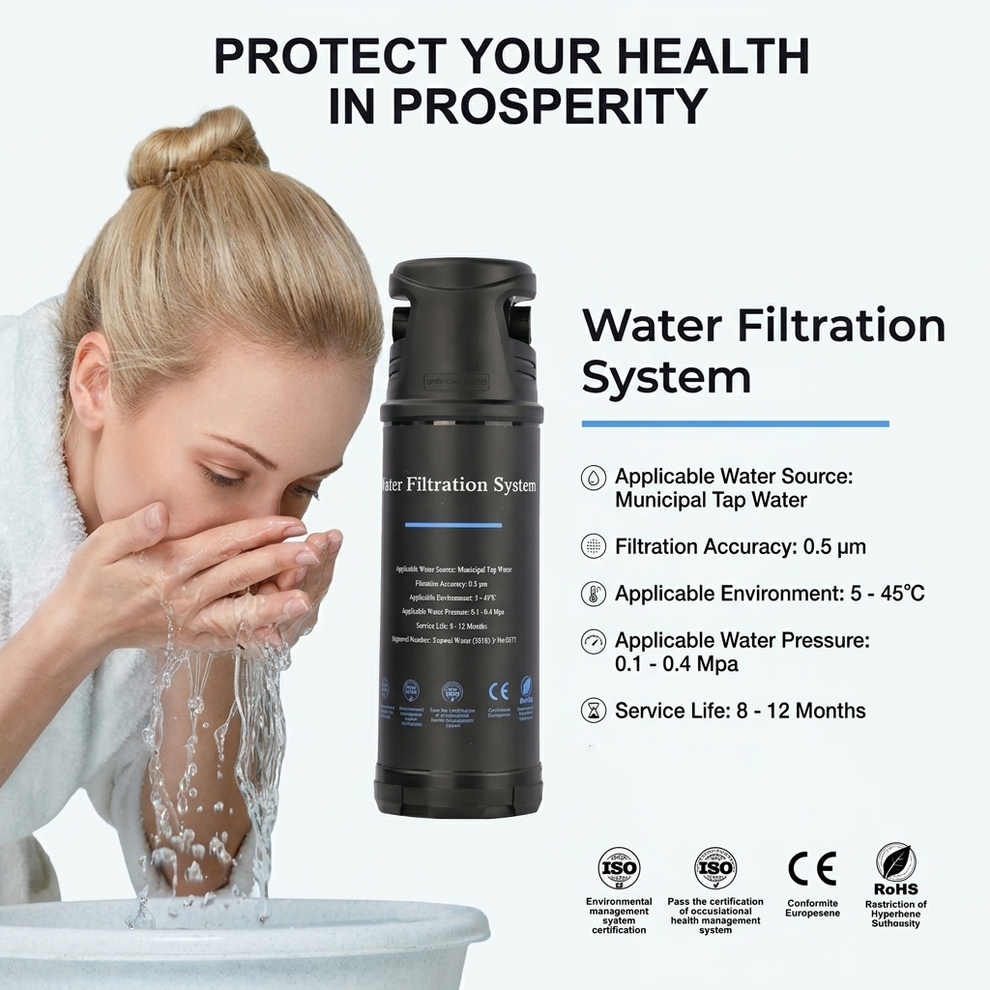
TM8-2 Under Sink Water Filter System 0.01 μm Ultrafiltration
The Puflow TM8-2 is an under-sink water filtration system described as using 0.01 μm ultrafiltration. Its listed specifications are:
- Filtration accuracy: 0.01 μm
- Flow rate: Up to 400 L/h
- Working pressure: 0.1–0.4 MPa
- Applicable water: Municipal tap water
- Operating temperature: 5°C–45°C (41°F–113°F)
- Connector size: 3/8 inch or 1/2 inch
- Product size: 130 × 110 × 345 mm
- Installation location: Under sink
- Power requirement: None
This product is an ultrafiltration system, not an RO membrane system. That distinction matters when buying replacement filters: the TM8-2 should not be assumed to have the same membrane, maintenance schedule, or dissolved-solids reduction performance as a reverse osmosis unit.
Consider it when you want an under-sink filtration option for municipal tap water and its documented performance matches your needs. If your objective is to reduce total dissolved solids or a particular dissolved contaminant, verify that the product is rated and independently supported for that specific reduction before choosing it.
For households using RO, the same purchasing principle applies: match the replacement part to the exact model and intended treatment goal. Puflow's fluoride reduction filter may be worth evaluating when fluoride reduction is a specific requirement, but you should confirm system compatibility and the product's stated performance claims before buying.
Cost-Benefit Analysis: Replace Filters or Upgrade the System?
Replacing a filter is usually the sensible first step when a known cartridge has reached its service interval and the system otherwise operates correctly. Upgrading the entire unit is more defensible when the system is obsolete, replacement parts are difficult to obtain, the household's water demand has changed, or the existing design cannot address a confirmed water-quality requirement.
| Situation | Recommended Action | Cost-Benefit Reason |
|---|---|---|
| Prefilter is due and the system performs normally | Replace the specified prefilter | Maintains routine service without unnecessary component replacement |
| Low flow begins unexpectedly | Diagnose pressure, restrictions, tank condition, and filter loading first | Avoids buying a membrane before identifying the cause |
| Membrane performance remains poor after other causes are ruled out | Test and replace the membrane if indicated | Targets the component most likely responsible for the confirmed performance issue |
| Replacement cartridges are unavailable or costly | Compare total ownership cost with a compatible new system | May reduce long-term maintenance difficulty |
| Household water demand has increased | Evaluate capacity and flow requirements | A system matched to demand may reduce inconvenience and bottlenecks |
| A new contaminant concern is identified | Test the water and choose treatment verified for that contaminant | A generic filter change may not address the actual problem |
For a fair comparison, calculate the annual cost of the current system, including filters, service calls, and downtime. Then compare it with the purchase and installation cost of an alternative, plus its expected maintenance. Do not assume a newer or more expensive system will solve a problem unless its specifications and testing support that conclusion.
Expert Recommendation: Build a Maintenance Plan, Not a Guessing Habit
From our experience with filtration decisions, the most reliable maintenance plan combines the manufacturer's schedule with observation and testing. Calendar reminders help you avoid missed service, but performance changes deserve investigation rather than an automatic purchase of a complete replacement kit.
For beginners, record the system model, filter part numbers, and installation dates. Keep the manual available, use compatible cartridges, and follow the flushing instructions after every change. For commercial users or households with unusual water conditions, consider periodic water testing appropriate to the actual treatment goals.
Do not treat a low TDS reading as proof that all contaminants have been removed, and do not assume that every under-sink filtration system is an RO system. Ultrafiltration and reverse osmosis use different treatment mechanisms and have different strengths. Choose based on the water-quality issue you need to address, the required flow rate, and the verified performance of the specific product.
Bottom line: Replace RO filters at the correct interval, use the exact compatible parts, and verify system performance when something changes. Replace prefilters on schedule to support the membrane, test before diagnosing a membrane failure, and buy specialty filters only when their documented capabilities match your needs.
If you are planning maintenance or comparing systems, start with Puflow's replacement filter collection and confirm the cartridge specification for your exact model before ordering.
Frequently Asked Questions About Reverse Osmosis Filter Replacement
1. How often should reverse osmosis filters be replaced?
Many systems use 6–12 month intervals for sediment and carbon prefilters and postfilters, while an RO membrane may last around 2–5 years under suitable conditions. Always follow the system-specific manual, because water quality, usage, and design affect the actual service life.
2. How do I know whether my RO membrane needs replacing?
Look for a sustained change in dissolved-solids rejection, reduced production that persists after simpler causes are checked, or results from appropriate water testing. Verify supply pressure, prefilter condition, temperature, and system restrictions before buying a new membrane.
3. Can I replace RO filters myself?
Many household systems are designed for owner maintenance, but procedures vary. Follow the exact manual for shutting off water, relieving pressure, changing cartridges, flushing, sanitizing, and checking for leaks. Seek qualified help if the system uses unfamiliar connections or you cannot service it safely.
4. Should I replace all RO filters at the same time?
Only if the manufacturer's maintenance schedule calls for it or the components are all due for replacement. Different stages have different service lives, so replacing everything at once can waste usable filter capacity. Record each stage's service date and follow the system's instructions.
5. Does a low TDS reading mean my RO water is safe?
No. TDS is a general measure of dissolved substances and does not identify every contaminant. Use suitable testing for specific concerns and select a system verified for the contaminants you need to reduce. Follow local public-health guidance if contamination is suspected.
6. Why is my RO system producing water slowly after a filter change?
Possible causes include low incoming pressure, colder feed water, a restricted line, a poorly seated cartridge, a tank issue, or a membrane problem. Confirm that the replacement is compatible and correctly installed, then follow the manufacturer's troubleshooting procedure.
7. Can I use a universal replacement filter in my RO system?
Do not assume a universal cartridge is suitable just because it fits. Confirm the filter media, connection design, dimensions, rated capacity, operating limits, and supported contaminant-reduction claims. Some systems require proprietary cartridges or specific configurations.
8. Is the Puflow TM8-2 an RO system?
The listed TM8-2 product uses 0.01 μm ultrafiltration. Ultrafiltration is different from reverse osmosis and should not be assumed to provide the same dissolved-solids reduction. Choose it only if its documented performance fits your treatment requirements.
9. Is a more expensive replacement filter always better?
No. The best value is a compatible filter with suitable performance documentation, an appropriate service interval, and a reasonable total cost. Pay for specialized reduction capabilities only when they address a real water-quality requirement.
10. What should I check before ordering replacement filters?
Confirm the system model, cartridge part number, dimensions, connections, filtration media, replacement interval, rated capacity, and any relevant certification. If the filter targets a specific contaminant, verify the claim and the conditions under which its performance was established.
References
- NSF — Water Filters, Testing and Treatment. Consumer guidance on water treatment and the importance of evaluating product-specific filtration claims.
- U.S. Environmental Protection Agency — Ground Water and Drinking Water. Official drinking-water resources and information on contaminants and water-quality concerns.
- U.S. Centers for Disease Control and Prevention — About Home Water Treatment Systems. Guidance on choosing home water treatment based on the water source and treatment objective.