


Are Countertop Reverse Osmosis Filters Worth It in 2026?
The residential water filtration market is currently flooded with aggressive marketing campaigns pushing freestanding purification units. Consumers are constantly asking us: are countertop reverse osmosis filters worth it? From our experience engineering and testing advanced filtration systems at Puflow, the answer is rarely a simple yes or no. It depends entirely on your living situation, your patience for manual maintenance, and your daily water consumption.

Countertop reverse osmosis (RO) systems have seen massive technological leaps by 2026. They have transitioned from bulky, inefficient machines to sleek, pump-driven appliances capable of removing 99.9% of total dissolved solids (TDS), heavy metals, and microplastics. However, they also demand valuable counter space and require manual refilling if not hooked directly to a water line. We will bypass the generic sales pitches and apply commercial and practical judgment to help you decide whether a countertop RO system is a brilliant investment or a complete waste of your money.
Quick Answer: Are countertop reverse osmosis filters worth it?
Yes, for renters, students, and small households. If you live in an apartment where modifying the plumbing is prohibited, a countertop RO filter is unequivocally worth the investment. It provides under-sink-level water purity without the installation hassle. No, for homeowners and large families. In most professional situations, if you own your home and have cabinet space, purchasing a countertop unit is a logistical mistake. You are much better served installing Under-Sink RO Systems like the A10S 800G Tankless RO System, which offers infinite, on-demand water without the frustration of manually refilling a tiny 1-gallon reservoir multiple times a day.
Table of Contents
- What is a Countertop Reverse Osmosis Filter?
- How It Works
- Quick Summary Table
- The True Benefits
- Limitations You Must Consider
- Comparison Table: Countertop vs Under-Sink
- Who Should Use It & Who Should Not
- Pros and Cons Table
- Common Mistakes Buyers Make
- Buying Considerations & Guide
- Expert Recommendation
- Frequently Asked Questions (FAQ)
What is a Countertop Reverse Osmosis Filter?
A countertop reverse osmosis filter is a standalone, plug-and-play appliance that utilizes a semi-permeable membrane to strip water of contaminants down to 0.0001 microns. Unlike traditional pitcher filters that merely use activated carbon to improve taste and remove chlorine, an RO system physically separates pure water molecules from dissolved salts, lead, arsenic, fluoride, and pharmaceutical runoff.
In 2026, most of these units are electric and require no plumbing. You simply fill a back reservoir with tap water, plug the machine into a wall outlet, and an internal electric pump pushes the water through the dense RO membrane. The system then dispenses purified water from the front spout while isolating the concentrated wastewater in a separate compartment.
How It Works
Understanding the mechanics is crucial for making a buying decision. Reverse osmosis requires pressure. Because countertop units are not connected to your home's pressurized water line, they utilize an internal motorized pump. The water cycles through a multi-stage process:
- Pre-filtration: A sediment and carbon block filter removes large particles, rust, and chlorine to protect the sensitive RO membrane.
- Reverse Osmosis Membrane: The internal pump forces the water through microscopic pores, blocking 99% of dissolved solids.
- Remineralization (Optional but Recommended): Because RO strips all minerals, leaving the water tasting flat and slightly acidic, premium models pass the purified water through a post-filter to reintroduce healthy calcium and magnesium.
- Wastewater Separation: The contaminants are flushed into a separate waste tank, which you must manually empty.
Quick Summary Table
| Feature | Standard Countertop RO Specification (2026) |
|---|---|
| Plumbing Required | None (Manual fill reservoir) |
| Contaminant Removal | Up to 99.9% (including heavy metals & PFAS) |
| Power Requirement | Standard 110V/220V Outlet |
| Pure to Waste Ratio | Typically 2:1 to 4:1 (Recycling models exist) |
| Average Reservoir Capacity | 1 to 1.5 Gallons |
The True Benefits
For beginners entering the world of high-tier water purification, the immediate benefit is accessibility. You do not need to hire a plumber, drill a hole in your granite countertop, or modify your under-sink piping. You pull it out of the box, plug it in, and have hospital-grade water in ten minutes.
Furthermore, many modern units feature instantaneous water heating. If you drink tea, pour-over coffee, or need hot water for baby formula, the ability to dispense purified water at exactly 200°F (93°C) on demand allows you to eliminate your electric kettle, partially justifying the space the RO unit consumes.
Limitations You Must Consider
We refuse to ignore the glaring flaws of these systems. First, the manual labor is tedious. If you drink a gallon of water a day, cook with purified water, and make coffee, you will be walking back and forth to your sink to refill the heavy reservoir and dump the wastewater multiple times a day. It becomes a chore rapidly.
Second is the limited capacity. For heavy-duty applications or large family dinners, waiting for the machine to slowly process a single pitcher of water is frustrating. Finally, they require valuable counter real estate. If you live in a cramped apartment, sacrificing a square foot of prep space for an appliance is a tough compromise.
Comparison Table: Countertop vs Under-Sink vs Gravity
| Feature | Countertop RO | Under-Sink RO | Gravity Filter |
|---|---|---|---|
| Installation | Zero (Plug and play) | Requires plumbing skills | Zero (Manual assembly) |
| Capacity | Low (1-1.5 Gallons) | High (Continuous flow) | Medium (2-3 Gallons) |
| Electricity Needed | Yes | Optional (Only for pumps) | No |
| Best For | Renters, Students | Homeowners, Families | Off-grid, Preppers |
Who Should Use It & Who Does Not Need It
For commercial users and off-grid living: Do not buy an electric countertop RO system. If you want portable, reliable purification without relying on the power grid, you need Portable & Non-Electric solutions. In our testing, the Gravity Water Filter 3.8L provides extraordinary filtration without a single moving part or electronic motherboard to fail.
Who should use countertop RO: Renters who live in areas with highly contaminated municipal water (high lead, heavy chloramines, or PFAS) but cannot legally install an under-sink system. It is the only way to achieve true reverse osmosis purity without losing your security deposit.
Pros and Cons Table
| Pros of Countertop RO | Cons of Countertop RO |
|---|---|
| Provides ultimate RO purification without permanent plumbing. | Constant manual refilling and wastewater dumping required. |
| Highly portable; easy to take with you when you move. | Small internal tanks cannot support large families. |
| Often includes instant heating features for tea/coffee. | Consumes premium kitchen counter space. |
| Easy, tool-free Replacement Filters changes. | Requires an electrical outlet near the water source. |
Common Mistakes Buyers Make
The most catastrophic mistake we see is ignoring the cost of replacement filters. A countertop unit might seem like a bargain at $250, but if the proprietary membrane and carbon blocks cost $150 to replace every six months, you are bleeding capital. Always calculate the 3-year total cost of ownership before buying.
Another error is failing to empty the wastewater tank completely. In systems that recirculate water to improve efficiency, failing to dump the concentrated wastewater leads to extreme TDS buildup. The internal pump will force this concentrated sludge against the membrane, destroying your expensive RO filter in a matter of weeks.
Buying Considerations & Guide
| Factor | What to Look For | Why it Matters |
|---|---|---|
| Waste Ratio | 3:1 or higher (Pure to Waste) | Older 1:1 systems waste too much water. High efficiency saves you from dumping the tank constantly. |
| Remineralization | Built-in alkaline post-filter | RO water is acidic. Remineralization balances the pH and dramatically improves the taste. |
| NSF Certifications | NSF/ANSI 58 and 53 | Independent proof that the machine actually removes heavy metals, not just a marketing claim. |
Expert Recommendation
The Puflow Verdict
Are countertop reverse osmosis filters worth it? If you are a renter demanding the highest possible water purity, yes. However, if you are a renter who simply wants clean, great-tasting water but cannot sacrifice the counter space for a bulky electric RO machine, there is a vastly more practical solution.
We recommend bypassing the cumbersome manual water tanks altogether. If your primary goal is removing chlorine, bad taste, and heavy metals without modifying your plumbing, utilize a high-quality, direct-connect faucet filter.
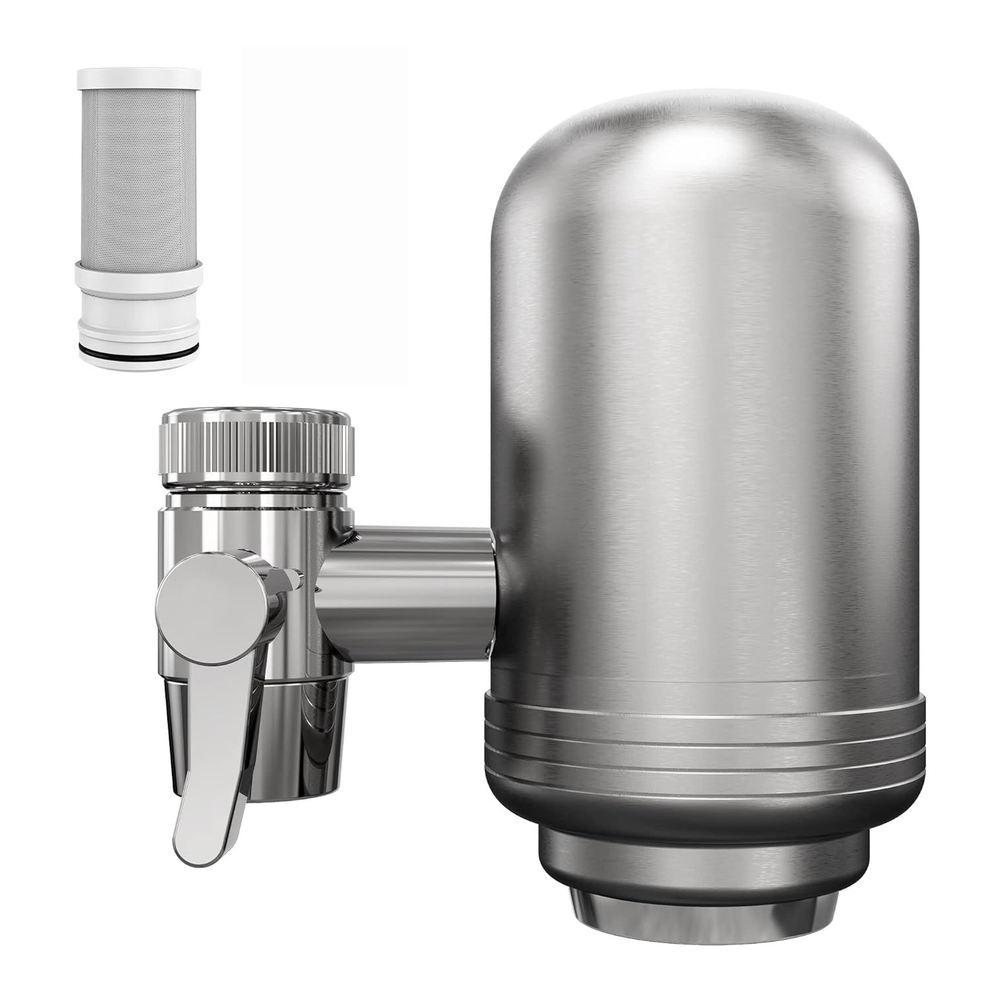
Stainless Steel Faucet Water Filter Easy Install Tap Filter
- Filter Material: Activated Carbon Fiber (Superior absorption)
- Flow Rate: 2 L/min (0.5 GPM) - Zero waiting for pitchers to fill
- Working Pressure: 15–100 psi
- Installation Type: Faucet-Mounted (Takes 2 minutes)
- Power Requirement: None (Zero electricity costs)
- Suitable For: Kitchens, Apartments, Rentals, Dorms, RVs
If you own your home, do not buy a countertop unit. Upgrade immediately to High-Flow RO Systems mounted under your sink to retain your counter space and secure infinite, automated purified water. For cutting-edge sustainability, you might also explore the F20 Atmospheric Water Generator, which extracts pure drinking water directly from the ambient air.
Frequently Asked Questions (FAQ)
Authoritative References & Industry Standards
To ensure your water purification decisions are grounded in scientific reality, we base our assessments on data provided by the following organizations:
- Environmental Protection Agency (EPA): Federal guidelines and research on the effectiveness of point-of-use reverse osmosis in mitigating lead, arsenic, and emerging contaminants like PFAS. EPA Drinking Water Requirements
- NSF International: The leading independent certification body testing point-of-use water filtration systems against ANSI standards (NSF/ANSI 53 for health effects and NSF/ANSI 58 specifically for reverse osmosis). NSF Water Quality Standards
- Water Quality Association (WQA): The premier trade association representing the residential water treatment industry, providing rigorous Gold Seal certifications and independent lab testing protocols. WQA Certification Programs