


Can RO Remove Microplastics? What Homeowners Need to Know
Microplastics in drinking water have become a practical concern for homeowners choosing a water filtration system. If you want to reduce plastic particles in the water you drink every day, reverse osmosis (RO) is one of the technologies worth considering. However, the right buying decision depends on the membrane, the complete filtration system, maintenance, and the specific performance claims a manufacturer can support.

- Can RO remove microplastics? Yes, RO membranes can physically reject many microplastic particles.
- Is removal guaranteed? No. Actual performance depends on the complete system and the particles being measured.
- What should you buy? Choose a well-documented system with a suitable membrane, clear maintenance instructions, and credible performance evidence.
- Is ultrafiltration the same as RO? No. They use different membrane processes and should not be treated as interchangeable.
- Does a low TDS reading prove microplastic removal? No. A TDS meter cannot directly measure microplastic particles.
1. Can RO Remove Microplastics from Drinking Water?
Yes. Reverse osmosis is a membrane-based water treatment process that can reject many microplastic particles. Microplastics are plastic particles generally defined as smaller than 5 millimeters, although the term covers a wide range of particle sizes, shapes, and materials. They may enter water through environmental pollution, the breakdown of larger plastic items, and other sources.
The important distinction is between a technology's physical capability and a specific product's verified performance. RO membranes are designed to separate water from a broad range of contaminants. Their separation mechanism makes them suitable for reducing many particles, including microplastics that are larger than the effective passage pathways of an intact membrane. However, the label “reverse osmosis” alone does not tell you the percentage of microplastics a particular unit removes under real household conditions.
Particle shape also matters. Microplastics can appear as fibers, fragments, films, or irregular particles. A test that measures one size range or particle type may not represent every particle that could occur in a household water supply. The smallest particles, often discussed as nanoplastics, present additional measurement and performance questions.
From a buying perspective, we recommend treating microplastic reduction as one performance requirement among several. Consider the system's documented membrane performance, filter replacement schedule, water source, and any other contaminants you need to address. If microplastic removal is your primary goal, ask the manufacturer for test data that specifically covers microplastic particles rather than relying only on general claims about water purity.
2. How Does Reverse Osmosis Remove Microplastics?
Reverse osmosis uses pressure to push water through a semipermeable membrane. Water that passes through becomes the treated water, while many rejected substances remain in the concentrated stream that is separated from the product water.
Step 1: Pre-filtration protects the membrane
Many residential RO systems use sediment and carbon pre-filters. Depending on their design, these stages help capture suspended material and reduce chlorine or other substances that may affect downstream components. Pre-filtration also helps protect the RO membrane from premature fouling. It is not a substitute for the membrane, and the exact role of each stage depends on the product.
Step 2: The RO membrane separates water from contaminants
Pressure drives water through the membrane. Many particles and a broad range of dissolved substances are rejected rather than passing into the treated stream. This makes RO useful for applications where users want more than basic taste-and-odor filtration.
Step 3: Post-treatment and storage affect the final result
Some systems include post-carbon filtration, remineralization, a storage tank, or other components. These may affect taste, convenience, or other aspects of water treatment, but their presence should not be interpreted as proof of microplastic removal. The system needs to be assessed as a complete unit, including seals, tubing, storage, and the recommended maintenance procedure.
For more background on system choices, compare Puflow reverse osmosis systems for home and countertop RO systems. Compare the actual specifications and claims for each model rather than assuming that all configurations provide identical filtration.
3. Why RO Is a Strong Option for Microplastic Reduction
It uses a physical separation process
RO is not simply a taste-improvement filter. It separates water from many substances through a membrane process. That physical separation makes it relevant when the concern involves particles as well as certain dissolved contaminants. The degree of reduction still depends on the membrane and the system's condition.
It can address more than one water-quality concern
Households rarely choose a filter for a single reason. Depending on the model and its verified claims, an RO system may also reduce total dissolved solids and selected contaminants such as certain metals, salts, or other substances. These capabilities are not universal: verify each contaminant claim separately. NSF explains that NSF/ANSI 58 covers RO system requirements and specific performance claims, but certification to a standard does not mean a system removes every contaminant.
It can be installed where drinking water is used
Point-of-use RO systems are often installed under a kitchen sink or placed on a countertop. Treating drinking and cooking water at the point of use can be a practical option for households that do not need whole-house treatment. An under-sink model may suit a household that wants a dedicated filtered-water faucet, while a countertop model can be useful for renters or people who prefer not to modify plumbing.
It makes routine maintenance part of a defined process
A system with a clear replacement schedule gives users a practical way to maintain performance. Filters and membranes do not last indefinitely. Follow the manufacturer's service intervals and replacement instructions, especially if flow slows, the taste changes, or the system has been unused for an extended period.
4. What RO Cannot Guarantee About Microplastics
RO is a strong technology to consider, but responsible buying requires understanding its limitations.
- It does not guarantee zero particles. No broad technology label is proof that every particle has been removed from every sample.
- Not every system has microplastic-specific test data. A manufacturer's claim about TDS reduction or another contaminant does not automatically establish a microplastic removal rate.
- Very small particles are harder to evaluate. Results depend partly on the particle-size range and the analytical methods used in testing.
- Maintenance matters. Worn components, incorrect installation, damaged seals, or neglected filter changes can compromise system performance.
- RO creates a reject-water stream. Conventional systems send some feed water to a drain or otherwise separate it from the treated water. Check the product's recovery and efficiency information before purchasing.
There is also a broader health context. The World Health Organization has noted that evidence on microplastics in drinking water and their potential health effects has limitations, particularly for the smallest particles. Reducing exposure may be a reasonable water-quality preference, but claims that microplastics inevitably cause a particular disease go beyond what the available evidence can establish.
5. RO vs. Ultrafiltration vs. Carbon Filters: Which Should You Choose?
These technologies solve overlapping but different problems. The right option depends on the contaminants of concern, your water supply, the level of treatment you want, and how much maintenance you are prepared to do.
| Technology | Microplastic considerations | Other common uses | Best fit | Key limitation |
|---|---|---|---|---|
| Reverse osmosis (RO) | Can reject many particles; verify product-specific microplastic data. | Reduction of TDS and selected dissolved contaminants, depending on certification and model. | Households seeking broad point-of-use water treatment. | Higher complexity, maintenance needs, and reject water compared with simpler filters. |
| Ultrafiltration (UF) | Can retain particles larger than the effective membrane cutoff; performance depends on pore size and system integrity. | Particle and turbidity reduction; some systems are designed for microbial barriers. | Users who want particle filtration without RO's dissolved-solids reduction. | Does not generally provide the same dissolved-solids reduction as RO. |
| Activated carbon | Particle reduction depends on the filter construction and any separate membrane stage. | Commonly used to improve taste and odor and reduce specific chemicals when appropriately designed. | Users whose primary concern is chlorine taste or a specific certified chemical reduction claim. | Do not assume carbon alone removes microplastics or dissolved contaminants broadly. |
| Basic sediment filter | Can capture particles larger than its effective filtration rating. | Protecting downstream filters and reducing visible sediment. | Pre-filtration or water with sediment concerns. | Not a complete drinking-water treatment solution for dissolved contaminants. |
For homeowners who specifically want broad contaminant reduction, RO is often the more versatile starting point. For someone whose main goal is reducing visible sediment or improving taste, a simpler filter may be enough. Do not pay for RO merely because it sounds more advanced: first identify the water-quality issue you actually need to solve.
If you are comparing non-RO alternatives, review portable and non-electric water filtration options. These can be convenient in situations where power or permanent installation is impractical, but product-specific claims still need to match your intended use.
6. Benefits, Limitations, and Cost-Benefit Considerations
| Pros | Cons |
|---|---|
| Can reduce many microplastic particles when the membrane and system are functioning properly. | Microplastic-specific removal performance is not established by the RO label alone. |
| Can reduce TDS and selected additional contaminants when the particular system is designed and verified for them. | Not every model has the same contaminant-reduction claims or certifications. |
| Point-of-use systems can provide treated water where it is used most. | Under-sink models may require plumbing work and cabinet space. |
| Replacement schedules give homeowners a manageable maintenance routine. | Filters and membranes add recurring costs and must be replaced on schedule. |
| Can reduce reliance on bottled water for households comfortable drinking their treated tap water. | Conventional RO systems can waste some feed water and may operate more slowly than simple filters. |
What is the real cost of an RO system?
The purchase price is only part of the cost. Consider the initial unit, installation, replacement filters, membrane replacement, water use, and any service calls. A lower-priced system can become expensive if replacement cartridges are costly or hard to source. Conversely, a system with a higher upfront price may be reasonable if its verified performance, replacement availability, and expected service life match your needs.
For a useful comparison, calculate the expected annual ownership cost:
Annual ownership cost = annualized purchase and installation cost + replacement filters and membrane + estimated service and water costs.
Then compare that figure with what you currently spend on bottled water or other treatment methods. Do not assume an RO system automatically saves money: the result depends on household consumption, local water costs, maintenance, and how much bottled water you would otherwise buy.
7. How to Choose an RO System for Microplastics
Start with the water source
Municipal tap water and private well water present different assessment needs. If you use municipal water, review the utility's water-quality report and identify any concerns relevant to your home. If you use a private well, testing is especially important because its quality can vary by location and over time. A filter should be selected to address the contaminants actually present, not an assumed problem.
Ask for microplastic-specific evidence
When microplastic reduction is the priority, ask the manufacturer four questions:
- Has the complete system been tested specifically for microplastic reduction?
- What particle sizes, shapes, and materials were included in the test?
- What test method and operating conditions were used?
- Are the results from an independent laboratory, and do they apply to the model being sold?
A precise answer is more valuable than a broad claim such as “advanced filtration.” If a seller provides only a membrane pore-size number, ask how that figure relates to measured performance in the finished system. Nominal pore size, molecular separation, and real-world removal percentage are not interchangeable measures.
Check certification carefully
Look for applicable third-party certification and confirm exactly which claims are covered. NSF/ANSI 58 is an important standard for residential RO drinking-water systems, including TDS reduction and optional claims for specified contaminants. However, the existence of an RO certification does not automatically establish a microplastic-specific reduction rate. Check the exact model and claim rather than relying on a logo alone.
Choose an installation style you will maintain
Under-sink systems suit many permanent homes and households with steady daily use. Countertop systems may be more convenient for renters, small kitchens, or users who want simpler setup. Higher-flow models may be useful where demand is greater, but advertised output depends on operating conditions and should not be confused with guaranteed output under every household's water pressure and temperature.
Explore under-sink RO systems and high-flow water filtration systems if those installation styles fit your household. Compare flow rate, membrane specifications, filter availability, installation requirements, and maintenance costs before choosing a model.
Check replacement-filter availability before buying
A filtration system is only useful if you can maintain it. Confirm which cartridges are compatible, how often they should be replaced, whether the membrane is replaceable, and what the recommended service procedure involves. Puflow's replacement filter collection is a practical starting point for checking ongoing filter options, but confirm compatibility with your selected model before ordering.
8. Where the Puflow M8-2 Under-Sink Filter Fits
Not every household needs RO. The Puflow M8-2 is described as an under-sink ultrafiltration system, which makes it a different category from a reverse osmosis purifier. It is relevant for shoppers who are considering particle filtration without assuming they need RO's dissolved-solids reduction.
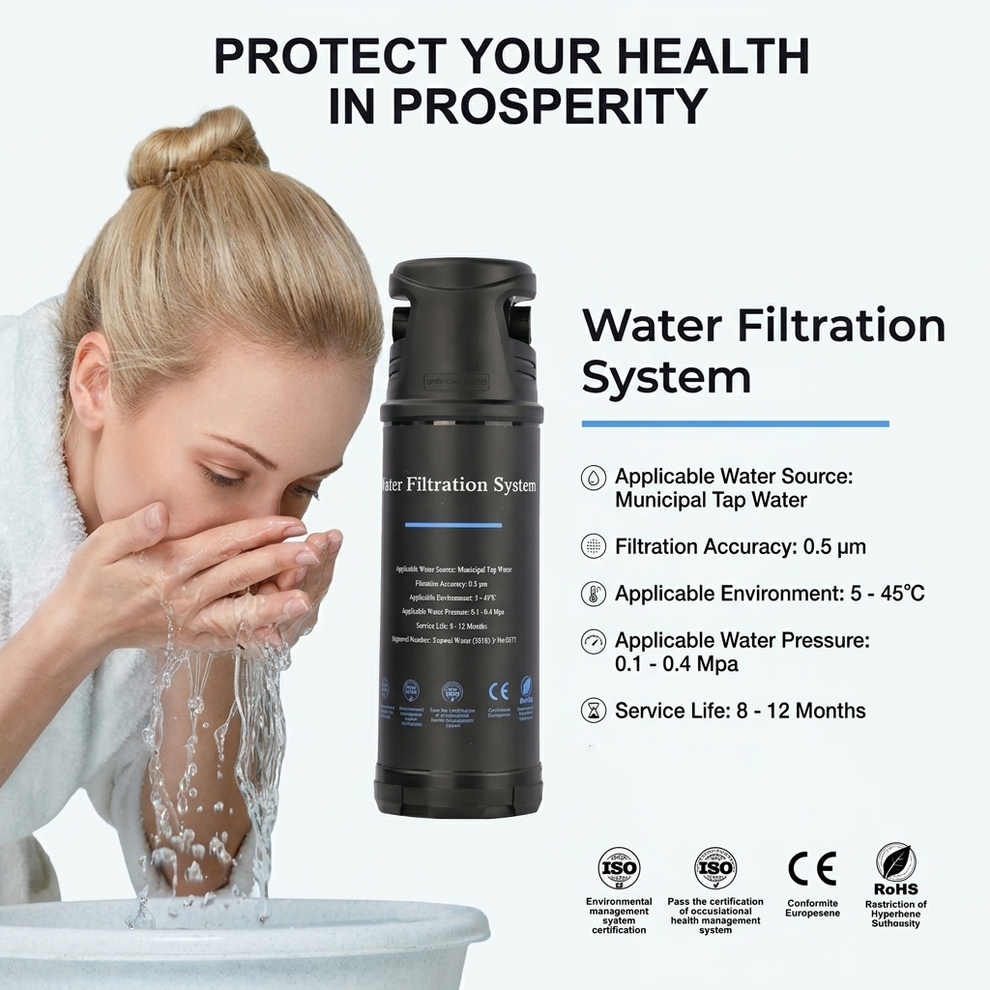
Puflow M8-2 Under Sink Water Filter System
The listed specifications describe a non-electric under-sink ultrafiltration unit for municipal tap water. Its stated filtration accuracy is 0.01 micrometers, with a listed flow rate of up to 400 liters per hour.
- Filtration accuracy: 0.01 μm, as listed by the product.
- Flow rate: Up to 400 L/h, subject to operating conditions.
- Working pressure: 0.1–0.4 MPa.
- Power: No electricity required.
- Installation: Under sink; connector size listed as 3/8 inch or 1/2 inch.
Our practical recommendation: consider the M8-2 if you want an under-sink ultrafiltration option and its documented capabilities match your water-quality needs. Its listed 0.01 μm filtration accuracy should not, by itself, be treated as proof of a specific microplastic-removal percentage. Ask for test evidence covering microplastic particle sizes and the complete system. If you specifically need RO's dissolved-solids reduction, compare it with a true RO model instead.
For homes that have multiple water-quality goals, the best solution may involve more than one treatment stage. However, adding stages without identifying a real need can increase cost and maintenance without delivering a meaningful benefit. Match the technology to the problem first.
9. Common Mistakes When Buying a Filter for Microplastics
Mistake 1: Treating all “micron” numbers as equivalent
A micron rating is useful only when you understand what the manufacturer means by it and how it was tested. A nominal rating, an absolute rating, and a membrane's stated filtration accuracy may describe different things. Do not compare numbers from different technologies as if they were measured under identical conditions.
Mistake 2: Assuming a TDS meter detects plastic particles
A TDS meter cannot confirm whether microplastics are present or absent. It measures dissolved ionic substances indirectly through conductivity. Use a relevant laboratory method if you need a microplastic-specific assessment; do not use a consumer TDS reading as a substitute.
Mistake 3: Assuming certification means removal of everything
Certification applies to defined standards and claims. Confirm the precise standard, model, and contaminant reduction claims. If the question is specifically about microplastics, look for direct evidence on that question rather than inferring performance from an unrelated certification.
Mistake 4: Forgetting that maintenance is part of performance
Even a well-designed system requires proper installation and maintenance. Follow the instructions for filter changes, membrane service, flushing, and sanitization where applicable. If the product has been sitting unused, consult its instructions before returning it to service.
Mistake 5: Buying more treatment than you need
RO can be an excellent fit when a household wants broader reduction of selected dissolved contaminants as well as particle reduction. If your only concern is taste or a specific contaminant already addressed by a simpler certified filter, a more complex system may not be worth the extra cost. Choose based on your water report, priorities, and willingness to maintain the unit.
10. Expert Recommendation: Is RO Worth It for Microplastics?
For households specifically concerned about microplastics and seeking broad point-of-use treatment, reverse osmosis is a sensible technology to shortlist. Its membrane separation process can reject many particles, and it may address other water-quality concerns when the chosen model is designed and verified for those claims.
We recommend buying based on evidence rather than marketing language. Prioritize a system with clear specifications, an accessible maintenance plan, replacement parts, and performance documentation relevant to your concerns. If the manufacturer cannot provide microplastic-specific test results, treat the expected reduction as unquantified rather than assuming a particular percentage.
In most household situations, the decision comes down to three questions:
- What do you need to reduce? Use a water report or suitable testing to identify the relevant issues.
- Which technology addresses those issues? Choose RO for broad membrane treatment when its additional capabilities are useful; consider UF or carbon filtration when their more limited purpose matches the need.
- Can you maintain the system correctly? Confirm the ongoing costs, replacement schedule, installation requirements, and availability of compatible cartridges.
Puflow offers different water-treatment categories, including countertop systems and under-sink systems. Use those options as a starting point for comparison, not as a substitute for reviewing the technical evidence for the specific model.
Bottom Line
Can RO remove microplastics? Yes, a properly functioning RO membrane can reject many microplastic particles. But no responsible buying decision should assume that every RO system removes all microplastics or nanoplastics, or that a general filtration rating proves a particular removal percentage.
Choose a system with credible performance evidence, maintain it as directed, and distinguish RO from ultrafiltration. If microplastic reduction is your main objective, request test data that directly addresses the particle sizes and conditions relevant to your drinking water.
Frequently Asked Questions
1. Can RO remove 100% of microplastics?
Do not assume 100% removal. RO can reject many microplastic particles, but actual results depend on the membrane, particle size and shape, system integrity, and testing method. A complete-removal claim should be supported by clearly described test data.
2. Does reverse osmosis remove nanoplastics?
RO membranes may reject some very small plastic particles, but the term “nanoplastics” covers an especially small and diverse range of particles. Performance cannot be inferred from the RO label alone. Look for testing that specifies the particle-size range and method used.
3. Is RO better than ultrafiltration for microplastics?
Both use membranes, but they are different technologies. RO provides broader separation that includes reduction of dissolved solids, while ultrafiltration is generally focused on retaining particles and other substances above its effective cutoff. Which is more appropriate depends on the required contaminant reduction and the performance evidence for the individual system.
4. Does a 0.01 μm filter remove all microplastics?
No. A stated 0.01 μm filtration accuracy is not, by itself, proof of complete microplastic removal. Ask whether the rating is nominal or absolute, how the system was tested, and whether the test covers the particle sizes and shapes that matter to you.
5. Can a TDS meter tell me whether my RO system removes microplastics?
No. A TDS meter estimates dissolved solids through electrical conductivity. Microplastic particles are not directly measured by that reading. Use the TDS meter only for what it can tell you, and rely on suitable testing for microplastic-specific claims.
6. Do carbon filters remove microplastics?
It depends on the filter's design and the particle sizes it can retain. Some filter constructions may reduce particles, but activated carbon is commonly used for taste, odor, and selected chemical reduction. Do not assume a carbon filter alone provides a verified microplastic reduction rate unless the manufacturer provides relevant evidence.
7. How often should I replace an RO filter?
Follow the replacement intervals specified for your exact system. Filter and membrane service life varies by design, incoming water quality, usage, and operating conditions. Check the manual for cartridge-specific schedules and replace parts with compatible components.
8. Should every home install an RO system for microplastics?
Not necessarily. RO is worth considering for households that want broad point-of-use treatment and are prepared to maintain the system. Other households may have different priorities or water-quality needs that a simpler filter addresses adequately. Base the decision on reliable water-quality information and verified product performance rather than fear-based claims.
References
- U.S. Environmental Protection Agency — Overview of Drinking Water Treatment Technologies. Explains reverse osmosis and nanofiltration as membrane separation processes.
- NSF — NSF/ANSI 58: Reverse Osmosis Drinking Water Treatment Systems. Describes the standard's scope and the contaminant-reduction claims covered by its testing framework.
- World Health Organization — Microplastics in Drinking-Water. Reviews evidence on microplastics in drinking water, treatment, and remaining research gaps.