


Can You Buy Reverse Osmosis Water at the Grocery Store? Where to Find It and What to Check
Yes, you can buy reverse osmosis water at many grocery stores, but you may not always find a bottle labeled specifically "RO water." In the United States, reverse osmosis water is commonly sold under the broader label "purified water." Some stores also offer refill stations that dispense water treated by reverse osmosis. The important step is checking how the water was treated rather than assuming every purified-water bottle uses the same process.
If you need RO water for everyday drinking, buying bottled water is convenient. If you use it regularly for a household, however, repeatedly purchasing gallon jugs or small bottles can become expensive and inconvenient. In that situation, a home filtration system may offer better long-term value—but only if you choose a system that actually uses reverse osmosis and meets your water-quality requirements.

Direct Answer: Can You Buy Reverse Osmosis Water at a Grocery Store?
Yes. Grocery stores, supermarkets, warehouse retailers, and some convenience stores sell bottled purified water that may have been treated through reverse osmosis. You may also find water refill machines that use RO filtration. Availability depends on the retailer, location, and product supplier.
Here is the distinction shoppers need to understand: reverse osmosis is a treatment process, while purified water is a product category. Under U.S. bottled-water labeling rules, water treated through reverse osmosis can be labeled "purified water" or "reverse osmosis water" when it meets the applicable definition. Distilled and deionized water can also fall under the purified-water category. Therefore, the word "purified" by itself does not prove that reverse osmosis was used. The FDA explains the different bottled-water categories and labeling terms.
- Grocery stores: Look in the bottled-water aisle for purified water or water specifically labeled reverse osmosis.
- Warehouse retailers: Check gallon jugs and multipacks of purified drinking water.
- Water refill stations: Ask whether the machine uses reverse osmosis and whether it has a current maintenance schedule.
- Water delivery services: Confirm the treatment process with the supplier before ordering.
- At home: An RO system can produce water on demand without repeatedly buying disposable bottles.
Our recommendation: For occasional use, grocery-store RO or purified water is convenient. For daily household consumption, compare the ongoing cost of bottled water with a properly maintained home filtration system.
Quick Summary Table: Buying Reverse Osmosis Water
| Buying Option | Can It Provide RO Water? | What to Check | Best For |
|---|---|---|---|
| Grocery-store bottled water | Yes, if the label or manufacturer confirms RO treatment | Look for "reverse osmosis" or ask the brand about its process | Occasional drinking and convenience |
| Purified water gallon jugs | Possibly; purification may use RO, distillation, or deionization | Do not assume all purified water is RO water | Households buying larger quantities |
| In-store refill station | Often, but the treatment method varies by machine | Ask about RO membranes, filter replacement, sanitation, and testing | Customers who bring reusable containers |
| Water delivery service | Yes, depending on the supplier | Request treatment details and water-quality information | Regular high-volume use |
| Countertop RO system | Yes, if it uses a genuine RO membrane | Performance claims, certification, filters, and maintenance | Renters and smaller kitchens |
| Under-sink RO system | Yes, if it is a genuine RO system | Membrane specifications, installation, waste-water ratio, and filter costs | Daily household drinking water |
Where Can You Buy Reverse Osmosis Water?
There are several places to look, but not every store stocks water that is explicitly identified as reverse osmosis water. Start with the bottled-water section, then check the store's refill station if one is available.
1. Grocery stores and supermarkets
Most large supermarkets carry multiple types of bottled water, including spring water, mineral water, distilled water, and purified drinking water. Look at the large gallon containers as well as smaller bottles. Some purified-water products use reverse osmosis, but the treatment process varies by brand.
Read the product description and label carefully. If the package only says "purified water," check the manufacturer's website or contact customer service to confirm whether the water was produced through reverse osmosis, distillation, or another approved process.
2. Warehouse clubs and bulk retailers
Warehouse retailers can be useful when you regularly buy water for a family, office, or event. Larger containers and multipacks may reduce the cost per gallon compared with buying individual bottles. However, bulk packaging does not tell you how the water was treated. Check the label just as carefully as you would at a supermarket.
3. Grocery-store water refill stations
Some supermarkets and retail locations have self-service water refill machines. These machines may use reverse osmosis, carbon filtration, sediment filtration, ultraviolet treatment, or a combination of technologies.
Do not assume that every refill machine produces RO water. Look for a treatment description on the machine, ask the operator, and check whether maintenance and sanitation information is available. A refill station is only as dependable as its filtration equipment and maintenance practices.
4. Water delivery companies
Water delivery providers may offer purified water in returnable or disposable containers. This can be convenient for offices, larger households, and customers who do not want to transport heavy water jugs. Before signing up, confirm the treatment method, delivery schedule, container deposit, and ongoing cost.
If you need RO water today, check the bottled-water aisle for a product that explicitly identifies reverse osmosis as its treatment process. If you cannot confirm the process from the package, ask the manufacturer. Do not treat "purified," "spring," "mineral," and "distilled" as interchangeable terms.
How to Identify Reverse Osmosis Water on a Grocery-Store Label
The label is the quickest way to distinguish RO water from other bottled-water types. Look for a treatment statement, not just a marketing phrase about purity or freshness.
Labels and descriptions worth looking for
- Reverse osmosis water: The clearest indication that the water was processed using an RO membrane.
- Purified water: May be produced through reverse osmosis, distillation, deionization, or another suitable process.
- Purified drinking water: A common bottled-water description, but it does not identify one specific purification method.
- Mineral-enhanced purified water: May have minerals added after treatment. Check the ingredient and product information.
What if the label only says "purified water"?
That label alone does not establish that the product is reverse osmosis water. Under FDA labeling rules, purified water can be produced through several methods. If you specifically want RO water, search the product's detailed description or contact the bottler.
Also distinguish between a treatment claim and a performance claim. A label stating that water was treated by reverse osmosis tells you the process used. It does not automatically provide a complete contaminant-reduction report or prove that every possible contaminant has been removed.
Reverse Osmosis Water vs. Purified Water: Are They the Same?
Not exactly. Reverse osmosis water is one type of purified water. Purified water is a broader category that can include water treated by reverse osmosis, distillation, deionization, or other suitable processes.
| Water Type | How It Is Produced | What to Know | Buying Advice |
|---|---|---|---|
| Reverse osmosis water | Water passes through a semipermeable membrane under pressure | Can reduce dissolved solids and specific contaminants, depending on the system | Choose it when you specifically want RO treatment |
| Distilled water | Water is evaporated and condensed | Leaves many dissolved substances behind during distillation | Useful where distilled water is specifically required |
| Deionized water | Ion-exchange materials remove dissolved ions | Not identical to RO; treatment scope differs | Check whether it is suitable for the intended use |
| Spring water | Collected from a qualifying natural underground source | Defined by its source, not by RO treatment | Choose it when you prefer source-based bottled water |
| Mineral water | Obtained from a qualifying underground source with naturally occurring minerals | Mineral content is part of its identity | Choose it when mineral composition is important to you |
From our perspective, the biggest shopping mistake is assuming that every bottle described as purified water is made by reverse osmosis. If the process matters to you, verify it directly. If your main concern is a particular contaminant, look for treatment-performance information rather than relying on the water category alone.
How Reverse Osmosis Water Filtration Works
Reverse osmosis is a membrane-based water treatment process. Pressure pushes water through a semipermeable membrane. The membrane allows water molecules to pass while reducing many dissolved substances and other contaminants. The separated concentrated water is carried away as reject water.
Residential RO systems commonly combine several treatment stages. A typical arrangement includes sediment filtration, activated carbon filtration, an RO membrane, and sometimes a final polishing filter. The exact configuration varies by system.
1. Sediment filtration
A sediment filter helps capture particles such as sand, rust, and suspended material. This stage protects downstream components and can help prevent premature membrane fouling.
2. Carbon filtration
Activated carbon is commonly used to reduce chlorine, taste, and odor compounds. This is particularly important in systems where the RO membrane requires protection from chlorine exposure. The exact carbon filter performance depends on its design and certified claims.
3. Reverse osmosis membrane
The RO membrane is the central separation stage. It reduces total dissolved solids and may reduce specific contaminants when the system has been tested and verified for those claims. Not every membrane or complete system has the same performance.
4. Post-filtration or polishing
Some systems include a final carbon filter or other treatment stage to improve taste and provide additional treatment. Some also include remineralization. These features are optional design choices, not proof that one system is automatically better than another.
The NSF/ANSI 58 standard is particularly relevant when evaluating residential RO systems. It covers areas such as material safety, structural integrity, TDS reduction, efficiency, recovery, and specified contaminant-reduction claims. Importantly, optional contaminant claims must be evaluated individually; an RO system should not be assumed to reduce every contaminant simply because it uses a membrane.
Benefits of Buying Reverse Osmosis Water at the Grocery Store
Convenient access without installing equipment
The most obvious advantage is convenience. You can buy a bottle or gallon jug without installing a system, arranging plumbing, or learning how to maintain filters. This makes grocery-store RO water practical for travel, temporary housing, emergencies, and occasional use.
Useful when you need a specific treatment process
If you prefer water treated through reverse osmosis, a clearly labeled product provides a straightforward option. You do not need to compare membrane specifications or calculate system recovery rates before making a small purchase.
No household filter maintenance
Bottled water shifts the responsibility for treatment equipment and bottling operations to the supplier. You still need to check packaging integrity, storage conditions, and the product's source information, but you do not have to replace an RO membrane or prefilters at home.
Easy to store and transport
Sealed bottles and gallon jugs are useful when you need drinking water away from home. They can be stored for planned use according to the product's storage instructions and expiration or best-by information, where provided.
Simple for occasional or low-volume consumption
If you only need a few gallons each month, buying bottled RO water may be more economical than purchasing and maintaining a complete home RO system. The calculation changes when consumption becomes regular and high-volume.
Limitations of Grocery-Store RO Water
Bottled RO water is convenient, but it is not automatically the best long-term solution for every household.
- Ongoing purchase cost: Repeatedly buying individual bottles or gallon jugs can become expensive compared with treating water at home.
- Packaging waste: Disposable containers create more packaging than a reusable household water system and refillable bottle arrangement.
- Transport and storage: Large quantities take up space and can be heavy to carry.
- Unclear treatment details: A generic purified-water label may not tell you whether RO was used.
- Limited product-specific information: A retail label may not provide the detailed contaminant-reduction performance data available for a certified treatment system.
- Mineral content varies: Some purified waters have minerals added back, while others do not. Check the label if mineral composition matters to you.
Another common misconception is that RO water is automatically healthier than every other safe drinking-water option. Reverse osmosis is a treatment technology, not a universal health ranking. Whether it is worth buying depends on your source water, the contaminants you want to reduce, your taste preferences, and the performance of the treatment process.
Who Should Buy RO Water at the Grocery Store?
People who need water occasionally
If you only need RO water for a short trip, temporary accommodation, or occasional household use, buying bottled water is sensible. There is little reason to install equipment for a very small and irregular demand.
Renters who cannot modify plumbing
Renters may not be able to install an under-sink system. Bottled water or a suitable countertop unit can provide an easier option, depending on available space and the property owner's requirements.
Households comparing filtration options
Buying a few gallons of RO water can help you decide whether you like the taste before investing in a home system. It is a practical way to test your preference without committing to equipment.
Travelers and emergency planners
Sealed bottled water is easy to carry and store. For emergency planning, follow local public-health guidance and use commercially sealed drinking water from a reliable supplier.
Who Does Not Need to Buy Bottled RO Water Regularly?
If your municipal tap water meets your needs and you do not have a specific treatment concern, buying RO water may provide little practical benefit. A household that already has a properly maintained filtration system may also have no reason to purchase bottled water routinely.
Likewise, people who prefer the mineral taste of spring or mineral water may not enjoy the taste profile of some RO products. The best choice should reflect your actual water-quality needs and preferences, not a belief that one water label is universally superior.
Bottled RO Water vs. a Home Reverse Osmosis System
If you drink RO water every day, the more important decision is whether to keep buying it or produce it at home. Bottled water has a lower initial commitment. A home system requires an upfront purchase and ongoing maintenance but can be more convenient for sustained use.
| Factor | Bottled RO Water | Home RO System |
|---|---|---|
| Initial cost | Low; pay as you buy | Higher; equipment and installation may be required |
| Ongoing cost | Repeated purchases and delivery or transport | Replacement filters, membrane, and water use |
| Convenience | Easy to buy but requires carrying and storage | Water available at home after installation |
| Maintenance | Managed by bottler; consumer checks packaging and storage | Owner must replace filters and maintain the system |
| Plastic packaging | Depends on bottle and jug packaging | Can reduce reliance on single-use bottles |
| Water-quality information | Depends on supplier disclosures and label | Can be evaluated through system certifications and performance data |
| Best use case | Occasional use, travel, temporary housing | Regular household drinking-water demand |
Cost-Benefit Analysis: Is Buying RO Water Cheaper Than Filtering It at Home?
The answer depends on how much water your household consumes. A person who buys a few gallons per month may spend less by purchasing bottled water than by buying and maintaining a home system. A family that drinks several gallons every day may find a home system more economical over time.
To compare fairly, calculate your annual bottled-water spending and compare it with the total annual cost of home filtration. Include the equipment purchase, installation, replacement filters, membrane replacement, and the water used during filtration. Do not compare bottled-water price with the price of a single replacement filter and ignore the rest of the system.
Example calculation framework
| Cost Item | Bottled RO Water | Home RO System |
|---|---|---|
| Initial purchase | First bottles or jugs | System and installation |
| Monthly expense | Water purchased each month | Usually lower routine expense, plus maintenance allowance |
| Annual maintenance | Not normally handled by consumer | Prefilters, membrane when due, and sanitation as required |
| Convenience cost | Shopping, carrying, and storage | Filter changes and occasional system checks |
| Environmental consideration | Container use and delivery or transport | Reject water and replacement filter waste |
For most households that consume RO water every day, we recommend calculating the break-even point before committing to repeated bottled purchases. A home system is not automatically cheaper in every situation, but it can reduce the need to transport and store water over the long term.
How to Choose a Home Water Filtration System Instead of Buying Bottled RO Water
Do not buy a home filter simply because the product description says "advanced purification." First identify what you want to reduce in your water. Then select a treatment technology with performance data that supports that goal.
Choose a genuine RO system when dissolved contaminants are the concern
If you want to reduce total dissolved solids or specific dissolved contaminants, a properly designed RO system may be appropriate. Check the complete system's certification and contaminant-reduction claims. NSF/ANSI 58 is the key standard to investigate for residential reverse osmosis drinking-water systems.
For kitchens with limited space, compare countertop RO systems. If you want a more permanent installation, review under-sink water filtration systems and their installation requirements.
Consider flow rate and daily household demand
Flow rate matters when multiple people use the system or when you fill larger containers frequently. Compare the stated production rate, storage arrangement, and actual dispensing performance. A system that is adequate for one person may feel slow in a busy family kitchen.
For households with higher water demand, explore high-flow water filtration systems. For customers who cannot connect a system to household plumbing or electricity, portable non-electric water filtration options may be more practical, depending on the source water and the treatment claims.
Check replacement filter availability
A home filtration system is only as dependable as its maintenance. Before buying, confirm how often each filter needs replacement, whether replacement cartridges are readily available, and what the ongoing cost will be.
Review the available replacement water filters and make sure the model you choose has a clear maintenance schedule. Do not wait until taste changes or flow becomes very slow before checking filter condition.
Puflow M8-2 Under-Sink Water Filter: Is It an Alternative to Grocery-Store RO Water?
For households considering an alternative to buying bottled water, it is important to distinguish reverse osmosis from ultrafiltration. Puflow's M8-2 Under Sink Water Filter System is an ultrafiltration product, not a reverse osmosis system. It may suit a different set of household filtration needs, but it should not be purchased as a direct substitute when the specific requirement is RO treatment or reduction of dissolved solids.
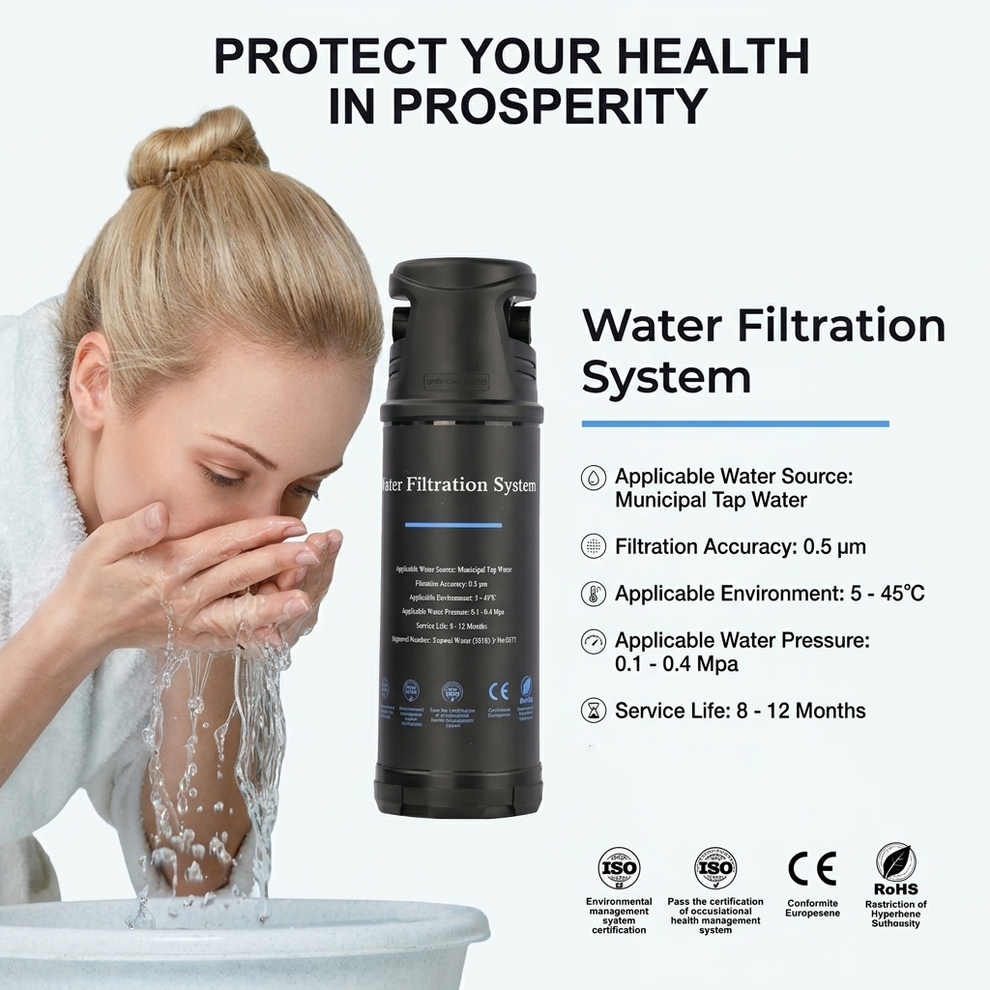
Puflow M8-2 Under-Sink Water Filter System
Filtration technology: Ultrafiltration
Stated filtration accuracy: 0.01 μm
Maximum stated flow rate: Up to 400 L/h
Working pressure: 0.1–0.4 MPa
Applicable water source: Municipal tap water
Operating temperature: 5°C–45°C (41°F–113°F)
Connector size: 3/8" or 1/2"
Installation: Under sink
Power requirement: None
What makes ultrafiltration different from reverse osmosis?
Ultrafiltration uses a membrane with a different separation range and operating principle from RO. It can be designed to reduce suspended particles and certain microorganisms, depending on the membrane and complete system. It does not generally provide the same dissolved-solids reduction as reverse osmosis.
The M8-2's stated 0.01 μm filtration accuracy and high flow rate make it a product worth evaluating for households that want a non-electric under-sink filtration option for municipal tap water. However, the stated pore-size figure alone does not establish performance against every contaminant. Buyers should request the system's specific test data and verified reduction claims.
Choose a genuine RO system if your goal is reverse osmosis treatment or a verified reduction in specified dissolved contaminants. Consider the M8-2 if ultrafiltration is suitable for your water-quality needs and you value a non-electric, high-flow under-sink design. These technologies solve different problems.
Common Mistakes When Buying Reverse Osmosis Water
- Assuming all purified water is RO water. Purified water can be produced by several methods. Verify the treatment process if RO is specifically what you want.
- Confusing spring water with RO water. Spring water is defined by its source, while RO water is identified by its treatment process.
- Assuming low TDS means completely contaminant-free water. TDS is a measurement of dissolved substances, not a complete safety test for every possible contaminant.
- Believing every refill station uses reverse osmosis. Ask the operator about its treatment stages and maintenance practices.
- Ignoring added minerals. Some purified waters have minerals added after treatment. Check the ingredient statement if you want to know what is in the finished product.
- Buying a home filter without checking its technology. Ultrafiltration, activated carbon, distillation, and reverse osmosis are not interchangeable.
- Forgetting replacement-filter costs. A low-priced system may become expensive if cartridges are costly or difficult to source.
- Assuming one certification covers every contaminant. Check the exact standard and individual reduction claims for the system.
Pros and Cons of Buying RO Water at the Grocery Store
| Pros | Cons |
|---|---|
| Easy to purchase without installing equipment | Repeated purchases can become expensive |
| Useful for travel and temporary situations | Heavy bottles and jugs require transport and storage |
| No household membrane or filter maintenance | Treatment details may be unclear on generic purified-water labels |
| Available in different container sizes | Disposable packaging creates additional waste |
| Practical for low-volume or occasional use | Less convenient for households consuming large volumes daily |
| Can help consumers test their preference for RO water | Does not provide the same control as selecting and maintaining a home treatment system |
Expert Recommendation: Should You Buy RO Water or Install a Home Filter?
Our recommendation depends on how often you need RO water and why you want it.
For occasional use: Buy bottled water that explicitly identifies reverse osmosis as its treatment process. It is convenient and avoids the expense of installing equipment for a small amount of water.
For daily household use: Compare the annual cost of bottled water with a home filtration system. If you specifically want RO treatment, choose a genuine RO system with clear performance specifications and accessible replacement filters.
For renters or small kitchens: A countertop system may be easier to install than an under-sink model. Confirm that the product uses an RO membrane if reverse osmosis is your requirement.
For households using municipal tap water: Identify the contaminants you want to reduce before choosing a technology. An ultrafiltration system such as Puflow's M8-2 may be suitable for some filtration needs, but it is not an RO substitute. If dissolved-solids reduction is the priority, compare genuine RO systems instead.
For buyers focused on long-term value: Include filter replacement, membrane replacement, installation, water use, and maintenance in your cost calculation. A well-matched system with available replacement cartridges is a better investment than a low-priced unit with unclear performance claims.
Yes, you can buy reverse osmosis water at many grocery stores, usually by looking for bottled water labeled "reverse osmosis" or checking whether a purified-water product uses RO treatment. It is a good convenience option, but frequent buyers should compare the cost and practicality of producing water at home. The best decision is based on verified treatment performance, your water source, and how much water your household actually uses.
Frequently Asked Questions About Buying Reverse Osmosis Water at the Grocery Store
1. Can you buy reverse osmosis water at Walmart or a grocery store?
Many large retailers sell purified bottled water, and some products may be treated through reverse osmosis. Product availability and treatment methods vary by location and brand. Check the label or manufacturer's product information to confirm that RO was used.
2. Is purified water the same as reverse osmosis water?
No. Reverse osmosis water is one type of purified water. Purified water may also be produced through distillation, deionization, or another suitable process. A purified-water label alone does not prove that reverse osmosis was used.
3. How do I know if bottled water is reverse osmosis water?
Look for "reverse osmosis water" or a treatment statement on the label. If the bottle only says "purified water," check the manufacturer's website or contact its customer service department to confirm the treatment method.
4. Do grocery-store water refill machines use reverse osmosis?
Some do, but not all. Refill machines can use different combinations of sediment filters, carbon filters, RO membranes, and other treatment stages. Ask the operator to identify the treatment process and explain its maintenance schedule.
5. Is RO water better than spring water?
Neither is automatically better for every consumer. RO water is defined by its treatment process, while spring water is defined by its source. Compare water-quality information, taste, mineral content, and your specific needs before choosing.
6. Does reverse osmosis remove minerals from water?
Reverse osmosis reduces many dissolved substances, including minerals that contribute to total dissolved solids. The amount removed depends on the membrane and system performance. Some bottled and home RO products add minerals back after treatment.
7. Is bottled RO water safe to drink every day?
Commercially bottled RO water that complies with applicable drinking-water requirements can be used as drinking water. Check the product's source, labeling, packaging condition, and storage instructions. Individual dietary or medical concerns should be discussed with a qualified healthcare professional.
8. Is buying bottled RO water cheaper than installing a home RO system?
Bottled RO water usually has a lower initial commitment, while a home RO system has equipment and maintenance costs. For occasional use, bottled water may be more economical. For high-volume daily use, a home system may offer better long-term value. Calculate the full annual cost before deciding.
9. Can an ultrafiltration system replace reverse osmosis?
Not when the specific requirement is reverse osmosis or comparable reduction of dissolved solids. Ultrafiltration and RO use different membrane processes and have different treatment capabilities. Choose according to the contaminants you need to reduce and the system's verified performance data.
10. What is the difference between RO and distilled water?
RO uses pressure and a semipermeable membrane to separate water from many dissolved substances. Distillation heats water into vapor and then condenses it. Both processes can produce purified water, but they use different treatment methods.
References
- U.S. Food and Drug Administration (FDA) – Regulation of Bottled Water. Explains bottled-water categories and how purified water may be produced through reverse osmosis, distillation, deionization, and other suitable processes.
- California Department of Public Health – Water FAQs. Provides definitions for bottled water, vended water, and purified water, including reverse osmosis water.
- NSF – NSF/ANSI 58: Reverse Osmosis Drinking Water Treatment Systems. Describes the standard's scope and performance claims for residential point-of-use RO systems.
Bottled-water availability and treatment methods vary by retailer, brand, and location. Always verify the product label and supplier information. Home filtration performance depends on the complete system, installation, water conditions, and maintenance schedule.