

Does Reverse Osmosis Raise Your Water Bill? The Honest Industry Truth
One of the most persistent concerns preventing homeowners and commercial facility managers from upgrading their drinking water infrastructure is the fear of hidden utility costs. When evaluating premium filtration methods, the question inevitably arises: does reverse osmosis raise your water bill? In most professional situations, we find that the anxiety surrounding this topic is driven by outdated information and a fundamental misunderstanding of municipal water pricing.
From our experience engineering advanced purification systems at Puflow, we have analyzed the flow rates, recovery ratios, and municipal utility data across countless installations. The reality is that reverse osmosis (RO) does physically send water down the drain, but the financial impact of this process is widely exaggerated by companies selling inferior filtration alternatives. If you are serious about removing heavy metals, PFAS, and dissolved solids from your water supply, you must use commercial and practical judgment to separate operational reality from marketing myths. In this comprehensive guide, we will break down the exact mathematics of RO wastewater, analyze its impact on your utility bills, and help you determine whether modern RO technology is a sound investment for your home or business.

Quick Answer: The Real Impact on Your Bill
Yes, the process of reverse osmosis will slightly increase your total water consumption, but the notion that reverse osmosis raise your water bill by a noticeable or prohibitive amount is a myth. A standard point-of-use under-sink RO system used for drinking and cooking will typically add less than $1.50 to $3.00 to your monthly municipal water bill. While older, inefficient tank-based systems may waste up to 4 gallons for every 1 gallon purified, municipal water is so inexpensive (averaging half a cent per gallon in the US) that the financial impact is negligible. Upgrading to modern, high-efficiency tankless RO systems drastically reduces this waste, making the cost mathematically insignificant compared to purchasing bottled water.
Table of Contents
- What It Is: The Mechanics of Reverse Osmosis
- How It Works: Why RO Systems Create Wastewater
- Benefits: Why the Minor Cost is Justified
- Limitations: When Wastewater Becomes a Problem
- Who Should Use Reverse Osmosis
- Who Does Not Need Reverse Osmosis
- Common Mistakes That Skyrocket Your Bill
- Critical Buying Considerations
- Essential Reference Tables
- Expert Recommendation from Puflow
- The Bottom Line
- Frequently Asked Questions
- Authoritative References
What It Is: The Mechanics of Reverse Osmosis
Reverse osmosis is a highly advanced water purification technology that utilizes municipal line pressure to force water molecules through a semi-permeable membrane. This membrane features pores that are approximately 0.0001 microns in size. To put that in perspective, these pores are so microscopic that they reject not only sediment and chlorine but also dissolved salts, heavy metals like lead and arsenic, radioactive isotopes, and pharmaceutical residues.
Unlike basic carbon filtration which simply acts as a sponge absorbing chemicals until it is saturated, an RO system physically separates your water into two streams: the purified water (permeate) that goes to your faucet, and the wastewater (brine) that carries the rejected contaminants down the drain. This inherent dual-stream design is the sole reason consumers ask if reverse osmosis raise your water bill.
How It Works: Why RO Systems Create Wastewater

To understand the cost, you must understand cross-flow filtration. If an RO membrane simply pushed water straight through a filter, the microscopic pores would become entirely clogged with calcium, magnesium, and toxins within a matter of hours. To prevent the membrane from blinding (clogging), the system uses the cross-flow method. The water flows across the surface of the membrane rather than just directly into it.
As the pure water is pushed through the membrane, the remaining water sweeps the rejected contaminants away and flushes them down the drain line. This "wastewater" is not actually dirty sewage; it is simply your regular tap water concentrated with a higher level of the minerals and impurities that were removed. In older, legacy systems, this ratio was often 1:4 (one gallon of pure water produced for every four gallons sent to the drain). In our testing of modern high-efficiency units, built-in internal pumps have improved this ratio to 1:1 or even 2:1 (two gallons of pure water for every one gallon of waste).
Benefits: Why the Minor Cost is Justified
When clients fixate on the fraction of a penny lost to drain water, they often lose sight of the overarching commercial and practical judgment regarding health and economics. The benefits of RO vastly outweigh the negligible utility increase.
First, absolute purity. No other residential filtration method achieves the total dissolved solids (TDS) reduction of RO. If you live in an agricultural area with nitrate runoff or an older city with lead infrastructure, RO is a non-negotiable health investment. Second, the economic offset is massive. If your household currently purchases just one case of bottled water per week, you are spending roughly $25 to $40 a month. An Under Sink RO Water System will provide superior water quality for a fraction of that cost, even when accounting for the extra $2 on your municipal water bill and the cost of routine filter replacements.
Limitations: When Wastewater Becomes a Problem
We do not sugarcoat the realities of water purification. There is a specific scenario where the wastewater from an RO system shifts from a minor nuisance to a massive financial burden: Point-of-Entry (Whole House) RO systems.
If you install an RO system to purify the water for your entire home—meaning you are flushing toilets, running the dishwasher, and showering in RO water—you are making a terrible engineering decision. A family of four uses roughly 300 gallons of water a day. If a whole-house RO system operates at a 1:3 ratio, you will send 900 gallons of water down the drain every single day. In this specific, heavy-duty application, reverse osmosis raise your water bill significantly and will overwhelm a residential septic system. RO should strictly be used as a Point-of-Use (POU) application for drinking and cooking.
Who Should Use Reverse Osmosis
For commercial users and health-conscious homeowners: If your municipal water report indicates high levels of PFAS ("forever chemicals"), heavy metals, chloramines, or if you rely on a hard-water private well, you absolutely must use an RO system. The minor increase in water volume usage is the price of ensuring your biological safety.
Who Does Not Need Reverse Osmosis
For users with pristine municipal water: If you live in a municipality with excellent, soft water and your only complaint is the mild taste of chlorine, you do not need the aggressive purification of reverse osmosis. Instead, you should rely on a high-capacity Carbon Water Filter Replacement or a simple Replacement Gravity Water Filter setup. These systems act as physical sponges, removing bad tastes and odors with zero wastewater generated. For hikers and campers, a simple Portable Water Filter Bottle is sufficient without installing plumbing hardware.
Common Mistakes That Skyrocket Your Bill
If you do notice a massive spike in your water bill after installing an RO system, it is not the normal operation of the system—it is a mechanical failure. The most common mistake we see is a failed Auto-Shutoff Valve (ASV). When the pure water storage tank is full, the ASV is supposed to stop the incoming water pressure. If this valve breaks or becomes fouled by sediment, the system will continuously run water down the drain 24 hours a day, 7 days a week. This will cost you hundreds of dollars.
Another severe mistake is neglecting filter maintenance. If your pre-filters are clogged with dirt, the water pressure hitting the RO membrane drops. Low pressure forces the system to produce wastewater endlessly while struggling to push a few drops of pure water through the membrane. Regularly utilizing proper replacements like the A10S Replacement Filter Set or the RO600 Replacement Filter ensures your system maintains optimum pressure and efficiency.
Buying Considerations: Efficiency is Everything
When you are ready to upgrade your drinking water, do not buy a cheap, outdated tank-based system from a big box store. You must evaluate the system's recovery ratio. Look explicitly for modern, tankless RO systems that utilize internal booster pumps. These pumps increase the pressure against the membrane, pushing more pure water through and sending less to the drain. A system with a 1.5:1 or 2:1 pure-to-waste ratio is the standard for modern commercial and high-end residential applications.
If you live in an area with extreme drought restrictions and cannot tolerate a single drop of wastewater, your only viable alternative to RO is atmospheric water generation. Systems like the P50 Atmospheric Water Generator pull moisture directly from the ambient air, purifying it without connecting to your municipal plumbing at all.
Essential Reference Tables
Quick Summary Table: The True Cost of RO Wastewater
| Metric | Average Daily Usage | Estimated Monthly Cost | Financial Impact |
|---|---|---|---|
| Drinking / Cooking Only (POU) | 2 - 3 Gallons of Pure Water | $1.00 - $3.00 | Insignificant (Less than one cup of coffee) |
| Leaking Auto-Shutoff Valve | Continuous Drain Running | $40.00 - $100.00+ | Severe (Requires immediate mechanical repair) |
| Whole-House RO (POE) | 300+ Gallons of Pure Water | $150.00 - $300.00+ | Extreme (Not recommended for residential) |
Comparison Table: Filtration Technologies
| Technology Type | Wastewater Ratio (Pure:Waste) | Contaminant Rejection | Electricity Required |
|---|---|---|---|
| Legacy Tank RO Systems | 1:4 or 1:5 | 99% (Excellent) | No (Relies on line pressure) |
| Modern Tankless RO (Pumped) | 1.5:1 or 2:1 | 99% (Excellent) | Yes (To run the internal pump) |
| Gravity / Carbon Blocks | 1:0 (Zero Waste) | Medium (Fails on heavy metals/salts) | No |
Pros and Cons Table: Reverse Osmosis
| Pros of Reverse Osmosis | Cons of Reverse Osmosis |
|---|---|
| Provides absolute, clinical-grade water purity. | Generates a minor amount of wastewater. |
| Massively cheaper than buying bottled water. | Strips beneficial minerals (requires remineralization). |
| Removes dangerous "forever chemicals" (PFAS). | Older systems suffer from slow flow rates. |
| Improves the taste of coffee, tea, and cooking. | Requires routine filter and membrane replacement. |
Buying Guide Table: Choosing Your Ideal System
| User Profile | Water Challenge | Recommended Solution |
|---|---|---|
| Urban Apartment Renter | Chlorine taste, old pipes, no plumbing mods allowed | Countertop RO Dispenser (e.g., C9 Pro) |
| Homeowner with Hard Water | High TDS, scale, heavy metals | Under-Sink Tankless RO System (1.5:1 Efficiency) |
| Drought-Restricted Area | Zero wastewater allowed, municipal limits | Atmospheric Water Generator (AWG) |
Expert Recommendation from Puflow
In most professional situations, we advise clients to stop worrying about the microscopic utility cost of wastewater and start focusing on the efficiency and convenience of the hardware they install. Do not buy a legacy under-sink tank system that wastes four gallons of water to make one. Instead, upgrade to an intelligent countertop solution that maximizes efficiency and provides temperature control on demand.
We highly recommend the Puflow C9 Pro Hydrogen-Rich RO Countertop Water Purifier. This system bypasses complex under-sink plumbing entirely. It utilizes a high-efficiency Reverse Osmosis and Composite filter system to drastically reduce waste while delivering instant cold to hot water dispensing. Furthermore, it integrates Hydrogen infusion and UV sterilization, ensuring that the water you drink is not only pure but actively beneficial for your cellular health.
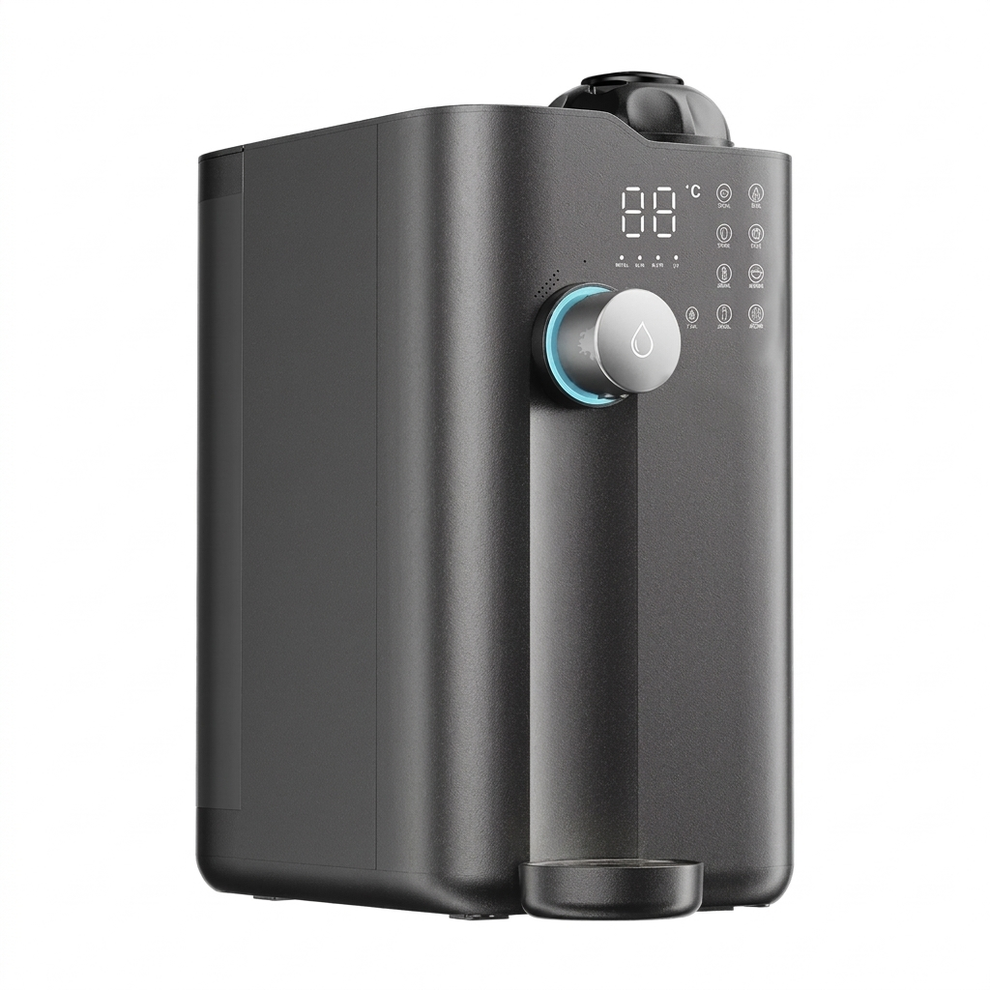
Puflow C9 Pro Hydrogen-Rich RO Countertop Water Purifier
- Water Tank Capacity: 4.2L
- Purified Water Flow Rate: 0.52L/min
- Hot Water Flow Rate: 27L/h
- Filtration System: Reverse Osmosis + Composite Filter
- Advanced Features: Hydrogen Function & UV Sterilization included.
- Suitable For: Homes, Apartments, Offices, Dorms, Kitchens (No installation required).
The Bottom Line
Does reverse osmosis raise your water bill? Yes, mathematically it does. However, letting a $2 monthly utility increase deter you from protecting your family against lead, microplastics, and industrial runoff is a catastrophic failure of practical judgment. The cost of RO wastewater is essentially a rounding error on your municipal bill, and it is exponentially cheaper than funding a bottled water habit. By avoiding outdated tank systems and investing in modern, high-efficiency RO technology or advanced countertop units, you secure absolute water purity with minimal environmental and financial impact.
Frequently Asked Questions
Is the wastewater from a reverse osmosis system toxic?
No. The term "wastewater" is highly misleading. It is simply your regular tap water carrying a slightly higher concentration of the naturally occurring minerals, salts, and impurities that the membrane rejected. It is perfectly safe to be flushed down your standard household drain and routed to the municipal sewer system.
Can I recycle or reuse RO wastewater?
Yes. While it requires custom plumbing, many environmentally conscious homeowners route their RO brine line to a collection barrel or directly into their garden. Because it is highly concentrated with hard minerals (calcium and magnesium), it is excellent for watering hardy outdoor plants or lawns, though it should be avoided for delicate indoor houseplants.
Why does my reverse osmosis system never stop running water down the drain?
An RO system should only send water down the drain while it is actively refilling its internal or external storage tank. If you hear water running continuously long after the tank is full, your system has a mechanical failure. This is almost always caused by a broken Auto-Shutoff Valve (ASV) or insufficient incoming water pressure (below 40 PSI). You must repair this immediately to prevent massive water bills.
Authoritative References & Industry Standards
To ensure our operational advice aligns with federal health and environmental standards, we reference data from the following authoritative bodies:
- Water Quality Association (WQA) - Industry Standards for Reverse Osmosis Efficiency and Contaminant Reduction
- U.S. Environmental Protection Agency (EPA) - WaterSense Program and Residential Water Usage Metrics
- Centers for Disease Control and Prevention (CDC) - Guide to Home Water Treatment Technologies