


Reverse Osmosis Cleaning Cost 2026: An Expert Guide to Membrane Maintenance
If you operate a water purification system, you already know that ignoring maintenance is the fastest way to destroy your equipment. Whether you manage a massive industrial bottling plant or simply want clean drinking water for your family, the membranes inside your system are the literal gatekeepers of your health and production quality. Over time, these microscopic pores become choked with biological growth, mineral scale, and organic foulants. The industry frequently debates the financial tipping point between cleaning a membrane and throwing it in the trash.
Many property owners and facility managers approach membrane maintenance blindly, either wasting thousands of dollars prematurely replacing membranes that could easily be restored, or spending endless labor hours attempting to clean consumer-grade filters that were designed to be disposable. In this comprehensive guide, we strip away the marketing jargon to give you the exact financial realities of the reverse osmosis cleaning cost in 2026. We will define precisely what you should pay, when you should pay it, and when you are better off replacing the entire unit.

Quick Answer: What You Need to Know
The reverse osmosis cleaning cost in 2026 is entirely dictated by the scale of your operation. For residential homeowners using traditional under-sink units, chemical cleaning is rarely cost-effective; you simply replace the fouled filters and sanitize the storage tank for roughly $100 to $250 annually. However, for commercial and industrial applications, professional Clean-In-Place (CIP) membrane cleaning costs between $800 and $2,500 per cycle, depending on chemical dosing requirements and labor. From our experience, commercial users must initiate chemical cleaning the moment permeate flow drops by 10% to 15%. Waiting longer compresses the foulant into the membrane, rendering cleaning useless and forcing a complete membrane replacement that can easily exceed $10,000.
Table of Contents
- What is Reverse Osmosis Membrane Cleaning?
- How Chemical Cleaning Works
- The True Financial Benefits of Routine Cleaning
- Limitations: When Cleaning Will Fail
- Who Should Use Professional Cleaning (And Who Shouldn't)
- 2026 Cost Breakdown: Residential vs. Commercial
- Common Costly Mistakes Operators Make
- Buying Considerations for Upgrading
- The Puflow Expert Recommendation
- Frequently Asked Questions
What is Reverse Osmosis Membrane Cleaning?
Reverse osmosis membrane cleaning, often referred to in the commercial sector as Clean-In-Place (CIP), is the highly controlled process of circulating specialized chemical solutions through the membrane housings to dissolve and flush out accumulated foulants. Unlike standard pre-filters which trap large sediment particles and are routinely thrown away, an RO membrane is a sophisticated, semi-permeable spiral-wound structure that rejects dissolved solids at a molecular level.
As water is forced through the membrane under extreme high pressure, impurities are left behind on the membrane surface. While the system flushes a portion of these contaminants down the drain as concentrate (wastewater), microscopic layers of scale, silica, and bio-slime inevitably build up over time. If you want to understand the baseline difference between the water entering your system and the purified output, read our detailed breakdown on RO Water vs Tap Water. Professional cleaning effectively resets the membrane's surface tension, recovering lost flow rates and restoring salt rejection percentages back to factory specifications.
How Chemical Cleaning Works

In most professional situations, the cleaning process is not a simple flush of bleach or vinegar. It is a calculated chemical attack tailored specifically to the type of foulant choking your system. Proper cleaning requires heating the chemical solution to precise temperatures, regulating flow velocity to avoid telescoping the membrane elements, and alternating between acidic and alkaline cycles.
The Acidic Phase (Low pH): This step utilizes acids (such as citric acid or specialized hydrochloric blends) to dissolve inorganic scale, such as calcium carbonate, magnesium, and heavy metals like iron. This is highly critical if your facility processes hard well water without adequate pretreatment.
The Alkaline Phase (High pH): Following the acid wash, high-pH caustic solutions are circulated to emulsify and lift biological fouling, organic matter, and silt. Bacterial slime is incredibly resilient; it creates a biofilm that acts like glue on the membrane surface, significantly increasing the differential pressure.
For commercial users, the CIP skid connects directly to the RO array, allowing the chemicals to circulate for several hours without removing the heavy membranes from their pressure vessels. For residential users looking for the Best Reverse Osmosis System for Home, these intense chemical processes are largely irrelevant. Modern residential systems are designed for quick-change, disposable filter cartridges rather than rigorous chemical restoration.
The True Financial Benefits of Routine Cleaning
For heavy-duty applications, the financial argument for routine membrane cleaning is undeniable. The primary benefit is capital preservation. A single industrial 8-inch RO membrane element costs between $500 and $1,200. A standard commercial array may utilize anywhere from 6 to 24 of these elements. A full replacement can easily cost $15,000 in parts alone.
- Restored Energy Efficiency: Fouled membranes require the high-pressure booster pumps to work significantly harder to push water through the blocked pores. Cleaning the membranes drops the required operating pressure, instantly reducing your electrical consumption.
- Extended Lifespan: Routine chemical cleaning can extend the viable life of a commercial membrane from a mere 2 years up to 5 or even 7 years.
- Improved Product Quality: As membranes foul, their salt rejection capabilities drop, meaning more dissolved solids slip into your permeate water. Cleaning restores the purity of your output, which is absolutely vital if you operate in the food, beverage, or pharmaceutical sectors.
Limitations: When Cleaning Will Fail
We must be transparent: chemical cleaning is not a magic solution for abused equipment. There is a definitive point of no return. We strongly recommend immediate membrane replacement rather than wasting money on chemical cleaning under the following conditions:
- Chlorine Damage: Thin-film composite (TFC) membranes are hyper-sensitive to free chlorine. If your carbon pre-filters failed and allowed municipal chlorine to reach the RO membrane, the structural polymer will literally burn and disintegrate. No amount of cleaning will fix oxidative damage.
- Compacted Fouling: If you ignored the warning signs and allowed the normalized permeate flow to drop by more than 20% before attempting to clean, the foulants have likely compacted deeply into the membrane fibers. The cleaning chemicals will simply channel around the blockage rather than penetrating it.
- Physical Telescoping: If extreme differential pressure caused the membrane layers to physically slide or warp (known as telescoping), the structural integrity of the element is compromised.
Who Should Use Professional Cleaning (And Who Shouldn't)
For Commercial Users: Breweries, hydroponic farms, car washes, and manufacturing facilities running systems producing over 1,000 Gallons Per Day (GPD) absolutely must utilize CIP chemical cleaning protocols. Incorporating a $1,500 annual cleaning budget saves tens of thousands in premature High-Flow RO Systems replacement costs.
For Residential Homeowners: We explicitly advise against attempting complex chemical cleanings on domestic units. The labor and chemical costs far exceed the price of simply buying new filters. If you are concerned about maintaining water purity without the hassle of sanitizing complex storage tanks and tubing, we highly recommend transitioning to modern Countertop RO Systems which feature self-contained, easily swappable filter modules.
2026 Cost Breakdown: Residential vs. Commercial
Quick Summary Table: Maintenance Cost Disparity
| System Type | Average Annual Maintenance Strategy | Estimated Cost (2026) | Is Chemical CIP Needed? |
|---|---|---|---|
| Residential Under-Sink | Replace pre-filters every 6-12 months; replace membrane every 2-3 years. DIY sanitization of tank. | $100 - $250 / year | No. Disposable cartridges. |
| Tankless / Countertop | Annual cartridge swap. Zero professional plumbing labor required. | $80 - $180 / year | No. Built-in UV sterilization handles biology. |
| Light Commercial (500-2,000 GPD) | Routine pre-filter changes, annual system sanitization, basic CIP if fouling occurs. | $500 - $1,200 / year | Situational. Often cheaper to replace membranes if labor costs are high. |
| Heavy Industrial (10,000+ GPD) | Mandatory bi-annual or quarterly multi-stage chemical CIP cleaning, daily antiscalant dosing. | $2,500 - $6,000+ / year | Absolutely Mandatory. Protects $20k+ capital investments. |
Common Costly Mistakes Operators Make
In our testing and field experience, we see facility managers burn through operational budgets by making the exact same errors year after year. The most egregious mistake is treating membrane cleaning as a reactive emergency rather than a scheduled preventative measure. If you wait until your high-pressure pumps are screaming and your production output has halved, you are too late.
The second major mistake is blindly applying the wrong chemistry. Using a high-pH caustic cleaner on a membrane that is heavily fouled with calcium scale will instantly fuse the scale into an impenetrable block of cement. You must conduct a thorough water analysis to understand exactly what is in your feed water before deciding on a cleaning regimen. For instance, if you are relying on an Under Sink Reverse Osmosis System with Remineralization, you must ensure your pre-filters are adequately handling the raw tap water before it ever touches the RO membrane.
Buying Considerations for Upgrading
If you are frustrated by the constant plumbing leaks, the tedious tank sanitization routines, and the hidden maintenance costs of traditional RO systems, it is time to evaluate modern alternatives. The residential market has shifted violently away from bulky, difficult-to-clean under-sink tanks toward sleek, tankless countertop solutions.
Comparison Table: Traditional RO vs. Modern Tankless Solutions
| Feature | Traditional Under-Sink RO (With Tank) | Modern Tankless Countertop RO |
|---|---|---|
| Installation Cost | $150 - $400 (Plumber required) | $0 (Plug and play) |
| Cleaning Complexity | High. Requires manual bleaching of storage tank to prevent biofilm. | Zero. Integrated UV light prevents bacterial growth automatically. |
| Filter Replacement | Messy. Requires specialized wrenches and shutting off main water valves. | 3-second twist-and-pull modular cartridges. |
| Water Temperature | Ambient cold only. | Instant hot, warm, and chilled water dispensing. |
The Puflow Expert Recommendation
From our experience at Puflow: If you are managing a commercial facility, you must track your normalized permeate flow daily and budget for professional chemical CIP cleaning the moment you see a 10% drop in performance. Do not hesitate. However, if you are a residential homeowner looking to escape the relentless cycle of hidden plumbing fees, expensive maintenance calls, and the hygienic risks of dirty RO storage tanks, you need to abandon the under-sink model entirely.
We recommend upgrading to a premium, zero-installation countertop unit. It completely eliminates the concept of "cleaning costs" by utilizing highly advanced, self-contained filter modules and built-in UV sterilization. You get superior water quality without the infrastructure nightmare.
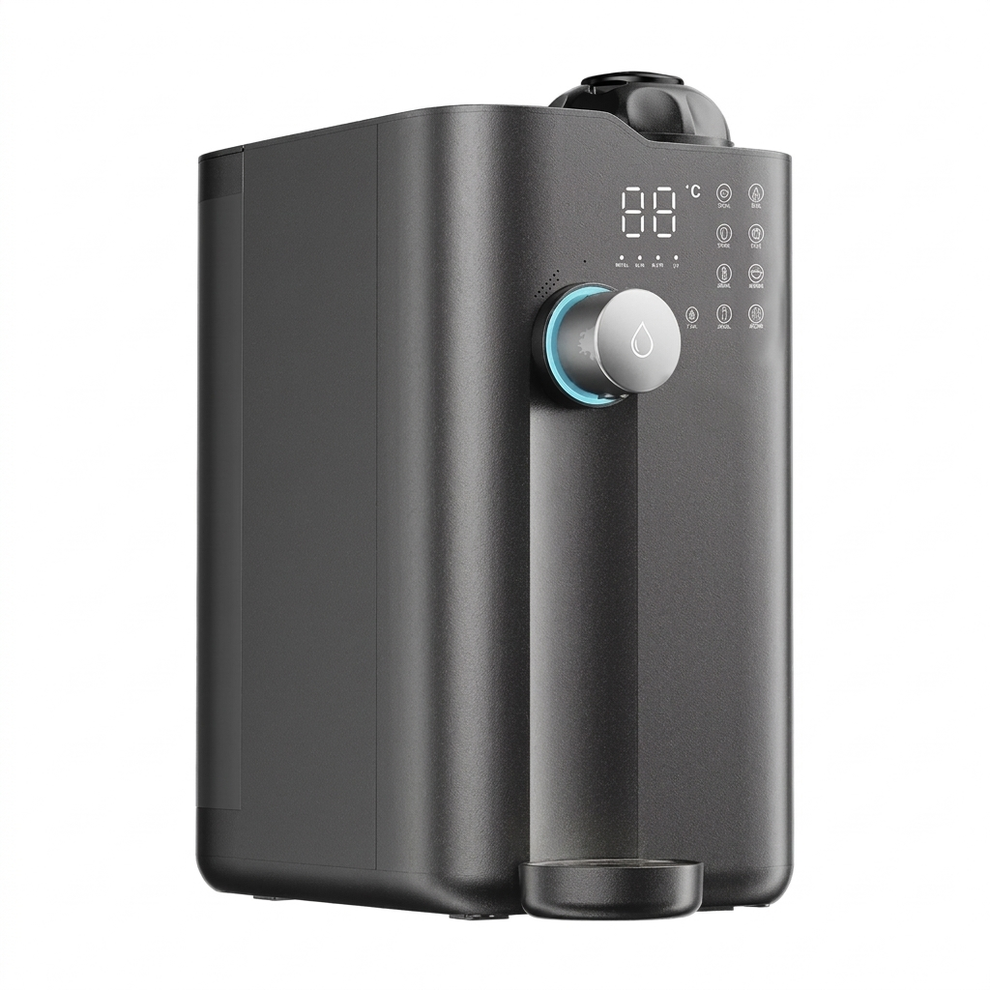
Puflow C9 Pro Hydrogen-Rich RO Countertop Water Purifier
Stop paying plumbers to sanitize your under-sink tanks. The C9 Pro is an absolute powerhouse that requires zero installation, connects to no plumbing, and features integrated UV sterilization to ensure your water remains biologically flawless without manual chemical cleaning. It delivers purified, hydrogen-rich water at customized temperatures instantly.
When you utilize a self-contained system like the C9 Pro, your only maintenance is occasionally ordering Replacement Filters. Furthermore, if you are seeking the NSF Certified Reverse Osmosis System standards for contaminant removal, a premium countertop model delivers laboratory-grade purification on your kitchen island.
Frequently Asked Questions
Can I use bleach or vinegar to clean my home reverse osmosis membrane?
No. Never expose a Thin-Film Composite (TFC) reverse osmosis membrane to bleach (chlorine), as it will immediately destroy the chemical structure of the membrane and render it useless. While vinegar (acetic acid) can technically dissolve mild scale, it is not strong enough to effectively restore a heavily fouled membrane. For residential units, it is always more cost-effective to simply replace the membrane cartridge.
How often should commercial RO membranes be chemically cleaned?
Commercial membranes should generally be cleaned every 3 to 6 months. However, the exact timing should not be based on a calendar. You must clean the membranes when the normalized permeate flow drops by 10% to 15%, or when the differential pressure across the system increases by 15% from initial startup baseline metrics.
Does cleaning an RO membrane restore it to 100% efficiency?
A highly successful professional chemical cleaning can restore a membrane to roughly 90% to 95% of its original factory performance. However, repeated cleanings over several years will eventually result in diminished returns due to irreversible compaction and physical degradation of the membrane layers.
What is the difference between replacing filters and cleaning a membrane?
Replacing filters refers to swapping out the cheap, sacrificial pre-filters (sediment and carbon blocks) that protect the main RO membrane. Cleaning a membrane refers to the rigorous chemical circulation process used in commercial settings to dissolve scale and biology from the expensive central RO element itself without discarding it.
Authoritative References & Industry Standards
To ensure your maintenance protocols align with rigorous safety and industrial standards, we highly recommend consulting the following authoritative bodies regarding membrane sanitation and water quality:
- United States Environmental Protection Agency (EPA) - National Primary Drinking Water Regulations and Treatment Techniques
- American Water Works Association (AWWA) - Best Practices for Membrane Filtration and Desalination Maintenance
- Water Quality Association (WQA) - Professional Certification and Reverse Osmosis Operation Standards