


10 Critical Factors That Affect RO Water Filter System Flow Rate
Nothing is more frustrating than turning on a dedicated drinking water faucet only to be met with an agonizingly slow trickle. Homeowners and facility operators frequently assume that a drop in faucet dispensing speed means the unit is defective. In reality, a reverse osmosis system is a pressure-driven thermodynamic separation process, not a standard unrestricted pipeline. The volumetric output of pure permeate water is governed by hydraulic pressures, temperature differentials, membrane crossflow dynamics, and mechanical resistance throughout the filter manifold.

Diagnosing delivery bottlenecks requires looking beyond basic product marketing claims. While a system might carry an engineering rating of 75 or 600 gallons per day (GPD), that number reflects optimal laboratory testing conditions: 60 PSI of incoming water pressure, 77 degrees Fahrenheit (25 degrees Celsius) water temperature, and clean municipal tap water. In real residential and commercial installations, multiple physical and environmental factors directly affect RO water filter system flow rate. Pinpointing the root cause prevents throwing money at unnecessary membrane replacements while restoring full dispensing volume to your kitchen or commercial line.
Quick Answer: What Controls Your RO System Flow Rate?
The primary variables that affect RO water filter system flow rate are incoming feed water pressure (requiring at least 40 to 60 PSI), feed water temperature (flow drops by roughly 1.5% to 2% for every degree Fahrenheit below 77°F), and pre-filter fouling from sediment and chlorine. On traditional tank-based setups, an incorrect pressurized storage tank bladder pressure (which should sit at 7 to 8 PSI when completely empty) causes more than 70% of reported low-flow complaints. For tankless setups, flow rate depends directly on the rated membrane capacity and the health of the internal electric booster pump. If your system trickles, checking incoming line pressure, checking pre-filters, and checking tank pressure solves the issue in most situations.
Table of Contents
- How Reverse Osmosis Physics Dictate Permeate Velocity
- Quick Summary: The 10 Factors Affecting Flow Rate
- In-Depth Analysis: 10 Critical Flow Rate Variables
- Tank-Based vs. Tankless High-Flow Performance Comparison
- Pros and Cons of High-Flow RO Configurations
- Who Needs High-Flow Upgrades vs. Who Can Use Standard Systems
- Plumbing-Free Alternative: Big Flow 2 Stainless Steel Gravity Filter
- Common Mistakes Homeowners Make When Diagnosing Low Flow
- Crucial Buying Considerations for Optimal Flow
- Expert Recommendation: Sourcing and Sizing Verdict
- Frequently Asked Questions (FAQ)
- Authoritative References
How Reverse Osmosis Physics Dictate Permeate Velocity
Reverse osmosis works by forcing pressurized water through a semi-permeable thin-film composite (TFC) membrane featuring pores roughly 0.0001 microns in diameter. To overcome natural osmotic pressure—the physical tendency of pure water to dilute saline or mineralized water—the supply line must exert substantial mechanical force. As water molecules are driven through the membrane sheet, dissolved solids, heavy metals, and microplastics are stripped away and sent down the drain as brine reject water.
The velocity at which purified water passes through the membrane material is termed flux rate. Flux rate is not static. It responds instantaneously to fluid viscosity, net driving pressure, and the concentration gradient of dissolved minerals at the membrane surface. When water cools, its viscosity rises, making it physically harder to squeeze through sub-nanometer pores. When municipal pressure drops, net driving pressure diminishes, causing product water production to grind to a halt. Understanding these interactions reveals why your system's performance shifts between summer and winter or morning and evening.
Quick Summary: The 10 Factors Affecting Flow Rate
The table below outlines the primary operating parameters that determine the delivery speed of your reverse osmosis filtration setup:
| Variable Factor | Optimal Operating Benchmark | Impact on Flow Rate When Out of Spec | Corrective Action |
|---|---|---|---|
| 1. Feed Water Pressure | 50 to 80 PSI (3.4 to 5.5 bar) | Severe flow reduction below 40 PSI; zero flow below 30 PSI | Install an external or integrated electric booster pump |
| 2. Feed Water Temperature | 77°F (25°C) standardized rating | Production decreases ~1.5% to 2% per 1°F drop in temperature | Account for winter viscosity; size up membrane capacity |
| 3. Total Dissolved Solids (TDS) | < 500 PPM feed water | High TDS increases osmotic backpressure, slowing permeation | Deploy dedicated anti-scalant pre-treatment or flush valves |
| 4. Sediment Pre-Filter Loading | < 5 PSI pressure drop across filter | Trapped particulates choke feed pressure before the membrane | Replace melt-blown polypropylene pre-filters every 3–6 months |
| 5. Carbon Block Exhaustion | Unrestricted dynamic pass-through | Particulate fines and biological slime block carbon pores | Replace CTO/GAC carbon blocks every 6 months |
| 6. Membrane Scaling & Biofouling | Clean polyamide sheet surface | Mineral crystallization clogs 0.0001-micron pores permanently | Replace TFC membrane; install auto-flush solenoids |
| 7. Storage Tank Air Pre-Charge | 7 to 8 PSI (measured completely empty) | Incorrect bladder pressure causes weak delivery or low storage capacity | Calibrate bladder with a digital tire gauge while tank is drained |
| 8. Tubing Diameter & Line Run | 3/8-inch post-filter line to faucet | Standard 1/4-inch tubing creates substantial friction loss over distance | Upgrade output line and faucet stem to 3/8-inch tubing |
| 9. Flow Restrictor & Brine Ratio | Matched specifically to membrane GPD | Clogged restrictor causes scaling; oversized unit bleeds pressure | Clear or replace the capillary/inline wastewater flow restrictor |
| 10. Post-Filter Remineralization | High-porosity, loose calcite/corosex bed | Compacted mineral beds restrict water right before the faucet | Replace remineralization and post-carbon polishing cartridges annually |
In-Depth Analysis: 10 Critical Flow Rate Variables
1. Feed Water Pressure
Feed water pressure is the single most critical driver of reverse osmosis output. A TFC membrane does not operate by simple sieve filtration; it requires net driving pressure exceeding the solution's osmotic pressure to drive water molecules through the synthetic matrix. In our testing, operating a residential membrane at 35 PSI drops pure water production by more than 50% compared to its rated 60 PSI baseline. If your supply runs below 40 PSI—common in rural homes on private wells or upper-floor apartments—the system will produce an excessive volume of waste water while barely filling the storage reservoir. In most professional situations, installing an electric booster pump is mandatory if municipal street pressure cannot maintain at least 50 PSI under load.
2. Water Temperature and Viscosity Shifts
Water temperature changes how water behaves physically at the microscopic level. As water drops from its standard laboratory test temperature of 77°F (25°C) down to 45°F (7°C) during winter months, water density and viscosity increase. This higher viscous drag makes it significantly harder for water to pass through the tight polymer matrix of the membrane. From our experience, winter flow rates on unheated municipal lines consistently drop by 30% to 50% without any mechanical fault present in the system. When calculating household water needs, seasonal temperature swings must be factored into your daily consumption estimates.
3. Total Dissolved Solids (TDS) and Osmotic Backpressure
The mineral content of your incoming tap water creates direct physical resistance. Every 100 parts per million (PPM) of Total Dissolved Solids creates roughly 1 PSI of osmotic backpressure that your supply line must overcome before filtration can begin. If you are filtering well water running at 1,200 PPM TDS, your incoming pressure is immediately depleted by roughly 12 PSI of natural osmotic resistance. This leaves far less net pressure available to push clean water through the membrane sheet, resulting in lower flow and accelerated surface scaling.
4. Sediment Pre-Filter Loading
The primary job of a 5-micron or 1-micron spun polypropylene sediment filter is to trap rust, silt, sand, and pipe scale before they strike the delicate RO membrane. However, as this depth cartridge traps particulate matter, its internal pore spaces close up. This progressive clogging creates an increasing pressure drop across the filter housing. A neglected sediment filter can easily rob the system of 15 to 25 PSI of line pressure before water ever reaches the membrane intake port, drastically reducing output. Inspecting and swapping Replacement Filters on a strict maintenance calendar preserves core system pressure.
5. Carbon Block Adsorption Exhaustion
Standard municipal water supplies contain chlorine or chloramines added as chemical disinfectants. Because chlorine irreversibly degrades thin-film composite polyamide membranes through oxidative chemical attack, activated carbon pre-filters are installed upstream of the membrane. Over time, these carbon blocks become coated with fine organic particulates and sediment dust. When a carbon block chokes, it starves the RO membrane of incoming water volume, slashing the system's dynamic operating pressure and leaving the faucet sputtering.
6. Membrane Scaling, Fouling, and Degradation
Even with functional pre-filtration, reverse osmosis membranes suffer from long-term surface scaling and organic fouling. Calcium carbonate, magnesium sulfate, and silica precipitate out of the rejected brine stream, forming an impenetrable crystalline crust across the raw side of the membrane sheet. This surface scaling blocks water passage, permanently reducing membrane flux. If your local supply features severe water hardness without a dedicated water softener upstream, standard membranes will suffer irreversible flow decay within 12 to 18 months.
7. Pressurized Storage Tank Bladder Pressure
In traditional tank-based setups, pure water flows from the membrane at a slow, continuous rate of ounces per minute, collecting inside a pressurized steel or composite tank containing a heavy rubber bladder. As water fills the tank, it compresses an air cushion beneath the bladder. When you open the countertop faucet, that compressed air pushes water up to the sink. If the tank's internal air pre-charge drops below its required 7 to 8 PSI (measured when the tank is empty of water), the bladder cannot push water out efficiently, yielding a brief two-second surge followed by an agonizing trickle. Conversely, over-pressurizing the bladder to 15 or 20 PSI creates excessive backpressure that stops the membrane from filling the tank completely.
8. Tubing Diameter, Line Length, and Friction Losses
Fluid dynamics dictate that water flowing through narrow channels experiences wall friction that saps dynamic pressure. Traditional residential RO systems rely heavily on standard 1/4-inch outer diameter polyethylene tubing. If you route this thin 1/4-inch line across 25 feet to reach a refrigerator icemaker or wet bar faucet, line friction substantially cuts dispensing speed. Upgrading the post-filter delivery line, auto-shutoff valve, and faucet shank to 3/8-inch high-flow tubing increases dispensing volume by up to 200%, eliminating long waits when filling large pots or carafes.
9. Clogged or Mismatched Flow Restrictors
Every reverse osmosis system incorporates a specialized flow restrictor installed on the brine waste line. This tiny component creates critical backpressure inside the membrane housing, forcing water molecules through the membrane pores instead of allowing all water to rush straight out the drain port. If this flow restrictor becomes plugged with debris, brine water cannot exit, rapidly concentrating minerals across the membrane surface until it fouls solid. Conversely, if an oversized flow restrictor is installed, water escapes freely down the drain, preventing the system from building the hydrostatic pressure required to produce clean drinking water.
10. Post-Filter Remineralization and Polishing Cartridges
Because pure reverse osmosis water is stripped of minerals, it emerges slightly acidic and aggressive. Many modern setups incorporate inline remineralization cartridges packed with calcium carbonate, calcite, and magnesium media to balance pH, followed by a post-carbon polishing filter. If these mineral media beds compact, settle, or collect fine dust, they create a restrictive physical barrier directly upstream of the faucet spout. When troubleshooting dispensing problems on an otherwise pressurized tank, checking the differential pressure across your inline remineralization cartridge quickly identifies clogged polishing stages.
Tank-Based vs. Tankless High-Flow Performance Comparison
Choosing between a classic tank reservoir system and a modern tankless direct-flow unit is one of the most important decisions when outfitting a home filtration setup:
| Evaluation Metric | Standard Tank-Based RO (50–100 GPD) | Tankless Direct-Flow RO (600–1000 GPD) | Non-Electric Gravity Systems |
|---|---|---|---|
| Immediate Faucet Flow Rate | High (0.8 to 1.5 GPM, while tank bladder is full) | Continuous (0.4 to 0.7 GPM, non-stop flow) | Moderate (Up to 4 Gallons Per Hour) |
| Sustained Delivery Capacity | Limited to tank volume (typically 2 to 3.2 gallons) | Unlimited (Filters on demand continuously) | Limited to upper holding chamber capacity |
| Electrical Dependency | None required (if mechanical line pressure > 50 PSI) | Mandatory (Requires 110V/220V for internal booster pump) | None (Operates 100% via natural gravity) |
| Under-Sink Footprint | Large (Bulky holding tank occupies cabinet space) | Slim (Integrated manifold, no tank required) | Countertop only (Zero plumbing footprint) |
| Wastewater Efficiency | Higher waste (3:1 to 4:1 drain-to-pure ratio typical) | High efficiency (1.5:1 to 1:1 drain-to-pure ratio) | Zero wastewater (100% of water is filtered) |
Pros and Cons of High-Flow RO Configurations
Upgrading to higher-capacity configurations yields significant performance improvements, but buyers must evaluate both sides of the operational coin:
| System Configuration | Operational Advantages (Pros) | System Limitations & Drawbacks (Cons) |
|---|---|---|
|
High-Flow Tankless Systems (Direct-Flow 600GPD+) |
|
|
| Standard Tank Systems with 3/8" Tubing |
|
|
Who Needs High-Flow Upgrades vs. Who Can Use Standard Systems
In our experience outfitting residential properties and commercial kitchens, matching equipment capacity to your daily household dynamics avoids both overspending and daily frustration.
Who Needs High-Flow RO Systems:
- Large Families and Cooking Enthusiasts: If your household routinely draws gallons of water back-to-back for boiling pasta, brewing stocks, and filling water bottles, standard 50 GPD tank systems will constantly run dry. Invest in our robust High-Flow RO Systems to ensure water is ready without delays.
- Homes with Sub-40 PSI Water Pressure: Properties on gravity-fed spring systems or low-yield domestic wells cannot run passive RO systems effectively. Systems with integrated pumps solve this baseline limitation.
- Dedicated Appliance Feeds: If you plan to split pure water lines between your sink, a high-capacity refrigerator icemaker, and an espresso machine, explore our commercial-grade Under-Sink RO Systems to prevent line pressure drops across fixtures.
Who Does Not Need Complex High-Flow Systems:
- Single or Dual-Occupant Apartments: If your clean water consumption is limited to a few drinking glasses and a morning coffee pot, standard residential systems or compact Countertop RO Systems deliver plenty of volume.
- Off-Grid Cabins and Campers: When power is limited or plumbing access is unavailable, complex multi-stage electric units are impractical. Turn instead to rugged Portable & Non-Electric filtration systems that operate without line pressure.
Plumbing-Free Alternative: Big Flow 2 Stainless Steel Gravity Filter
When municipal plumbing infrastructure is unreliable, or when you need high-volume water filtration without line pressure or electrical hookups, reverse osmosis is not the only answer. For off-grid homesteads, emergency preparedness, or rented apartments, Puflow offers a high-capacity gravity system that delivers exceptional flow without pipe cutting.
Big Flow 2 Stainless Steel Gravity Water Filter (8.5L)
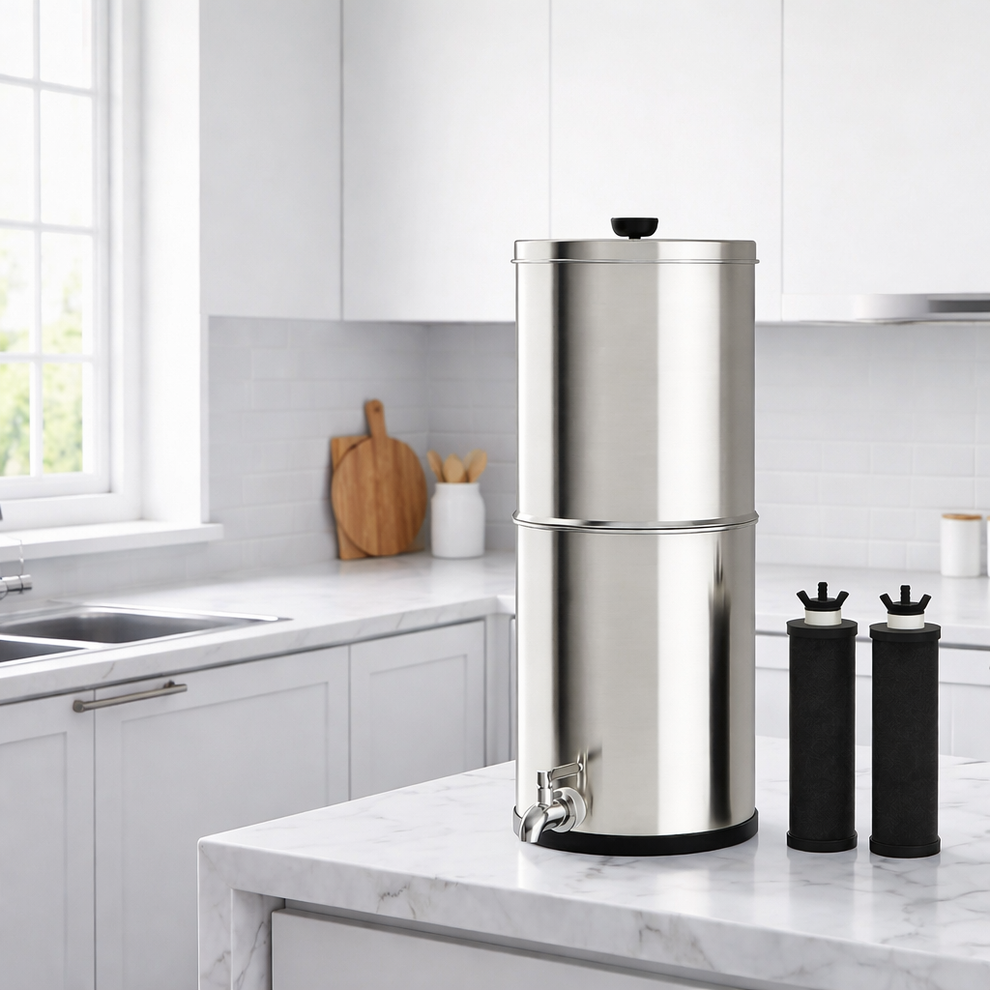
Constructed from polished food-grade 304 stainless steel, the Big Flow 2 Gravity System eliminates all dependencies on municipal water pressure, storage tank bladders, and electrical outlets. Utilizing high-efficiency micro-porous filtration elements, this freestanding countertop system filters tap, well, or untreated freshwater, removing suspended solids, sediment, fluoride, and common chemical contaminants while delivering continuous flow for the entire family.
View complete technical details on the Big Flow 2 Stainless Steel Gravity Water Filter 8.5L product page, or browse our latest advances in the New Arrival reverse osmosis system for home catalog.
Common Mistakes Homeowners Make When Diagnosing Low Flow
From our experience fielding customer support tickets, property owners frequently misdiagnose flow rate bottlenecks, spending money on parts they do not need while ignoring the real culprit:
- Replacing the Expensive Membrane First: When flow drops, people often assume the RO membrane is ruined. In reality, a clogged $10 sediment pre-filter is usually starving the membrane of pressure, or the storage tank has simply lost its air cushion. Always check pre-filter pressure and tank bladder PSI before buying a new membrane.
- Checking Tank Pressure While It Contains Water: Grabbing a tire gauge and measuring the air valve while the storage tank is heavy and full yields a completely false reading. The hydrostatic water pressure inside compresses the bladder, showing an artificially high number. You must disconnect the tank, open the valve to empty all water, and calibrate the bladder only when the tank is empty.
- Using Unmatched Flow Restrictors: Swapping a 50 GPD membrane for a high-output 100 GPD membrane without upgrading the corresponding drain-line flow restrictor causes severe scaling. The smaller restrictor cannot flush enough brine volume to keep the larger membrane clean, causing the new filter to foul within months.
- Ignoring Microplastic and Sediment Buildup: High sediment levels rapidly plug initial pre-stages. To understand how advanced filtration stages isolate microscopic contaminants, review our analysis of the Best Water Filter for Microplastics.
Crucial Buying Considerations for Optimal Flow
Before purchasing or upgrading an under-sink drinking water system, verify these technical specifications to ensure long-term flow satisfaction:
- True Dynamic Working Pressure: Test your cold water line pressure with a thread-on brass pressure gauge while another faucet is running. If pressure reads below 45 PSI, choose a system featuring a factory-integrated, self-priming electric booster pump.
- Certification Standards: Insist on models that have undergone rigorous material extraction and structural integrity verification. Explore our technical report covering NSF Certified Reverse Osmosis System designs to ensure dependable build quality.
- Tubing Geometry and Fitting Tolerances: Choose systems that utilize 3/8-inch tubing from the final stage to the faucet. Pushing water through a 3/8-inch line delivers more than double the volume per minute of standard 1/4-inch lines at identical pressures.
- Total Purified Water Demand: Consider how your purified water will be used across the home. Review our breakdown of RO Water vs Tap Water to size your system appropriately for daily consumption.
Expert Recommendation: Sourcing and Sizing Verdict
We recommend stopping the practice of tolerating weak faucet trickles. If your traditional tank-based system is underperforming, take 10 minutes to drain the storage tank completely and calibrate the internal bladder to exactly 7.5 PSI using a bicycle pump and digital gauge. If your pre-filters have been in service for more than six months, replace them immediately to restore line pressure to the membrane core.
For homeowners looking to purchase a new system, we recommend stepping up to a modern 600 GPD or 800 GPD tankless direct-flow system. These systems eliminate the floor-space demands and bladder failure issues of traditional tanks, using internal booster pumps to ensure continuous dispensing speeds of 0.5 to 0.7 gallons per minute regardless of seasonal incoming water conditions. For renters, travelers, or emergency planners who need filtration without plumbing changes, high-capacity gravity platforms like the Big Flow 2 Stainless Steel offer dependable, off-grid purification that never slows down due to electrical failures. Browse our full lineup in the All products reverse osmosis system for home catalog or explore specialized off-grid units like the Atmospheric Water Generator collection.
Frequently Asked Questions (FAQ)
Why did my RO system flow rate suddenly drop to a slow trickle?
A sudden drop in flow rate is usually caused by one of three issues: a clogged sediment or carbon pre-filter that is starving the membrane of pressure, a drop in municipal water pressure, or a depleted air charge in your storage tank's bladder. If the tank feels heavy with water but little comes out of the faucet, the tank's internal air pressure has likely escaped.
How much does cold water temperature affect reverse osmosis output?
Water temperature significantly impacts reverse osmosis production. Standard membranes are rated at 77°F (25°C). For every 1°F drop in water temperature, membrane production decreases by roughly 1.5% to 2%. During winter months when tap water can drop into the 40°F to 50°F range, your system may produce only half of its rated daily volume.
What should the air pressure be in an empty RO storage tank?
The proper air pre-charge for a residential reverse osmosis pressure tank is 7 to 8 PSI when the tank is completely empty of water. To check or adjust pressure, turn off the water supply, open the drinking faucet until all water drains out, and use a low-pressure tire gauge on the Schrader valve located on the tank body.
Can I add a booster pump to increase my RO flow rate?
Yes. Adding an electric booster pump is the most effective way to increase flow rate and water production if your incoming supply pressure is below 50 PSI. Booster pumps raise water pressure into the ideal 65 to 80 PSI range, dramatically speeding up membrane production while cutting down on wastewater generation.
How does tubing size affect the water speed at my RO faucet?
Standard 1/4-inch tubing introduces significant fluid friction that restricts water flow, especially over longer distances. Upgrading the line between the storage tank, post-filter, and faucet to 3/8-inch tubing roughly doubles the delivery volume at the faucet, filling glasses and pots twice as fast.