


10 Reasons Homeowners Choose RO Water Filters for Drinking Water
Homeowners choose reverse osmosis (RO) water filters because they want more control over the quality of the water they drink and cook with. A properly selected RO system can reduce a range of dissolved contaminants, improve water taste, and provide treated water directly at a kitchen tap. For households concerned about specific contaminants in their tap water, it can be a worthwhile upgrade.
But an RO system is not automatically the right answer for every home. It uses water to produce filtered water, needs periodic filter and membrane replacement, and does not remove every possible contaminant under every operating condition. The sensible approach is to identify what is in your water, check which reduction claims are independently certified, and choose a system that fits your household's daily demand.

Quick Answer: Why Choose RO Water Filters for Drinking Water?
RO water filters for drinking water use pressure to push water through a semi-permeable membrane. The membrane separates a portion of dissolved substances from the treated water, while pre-filters and post-filters in many systems handle sediment, chlorine, taste, and odor.
- What they do: Reduce selected dissolved contaminants and other substances, depending on the system's design and verified performance claims.
- How they work: Water passes through pre-filtration, an RO membrane, and often post-filtration before reaching a storage tank or dedicated faucet.
- Main benefits: Targeted contaminant reduction, improved taste, convenient drinking water, and less dependence on bottled water.
- Limitations: Water is sent to drain, filters need replacement, and not every RO system has the same certified reduction claims.
- Best for: Homeowners whose water test or utility report identifies contaminants that a properly certified RO system can reduce.
- Not essential for: Households with water that already meets their needs and no specific contaminant concern that justifies RO treatment.
- Our recommendation: Test or review your water first, then choose an RO system based on verified contaminant claims, water efficiency, capacity, and replacement-filter cost.
Quick Summary: Are RO Water Filters Worth It?
| Homeowner priority | How RO can help | What to check before buying |
|---|---|---|
| Reduce dissolved contaminants | An RO membrane can reduce selected dissolved substances. | Confirm the exact contaminant reduction claim and certification for the model. |
| Improve drinking-water taste | RO and carbon filtration can reduce certain substances affecting taste and odor. | Check the pre-filter and post-filter configuration. |
| Reduce reliance on bottled water | A point-of-use system provides treated water at home. | Compare installation, filter, membrane, and maintenance costs. |
| Supply drinking and cooking water | A dedicated faucet can serve drinking, coffee, tea, and food preparation. | Choose a capacity suited to household demand. |
| Address a known water concern | Some RO systems have verified reduction claims for specific contaminants. | Match the certification to the contaminant identified in the water report. |
| Save kitchen space | Tankless designs can reduce under-sink storage requirements. | Check dimensions, power needs, flow rate, and service access. |
| Keep maintenance manageable | Modern systems can use replaceable filter cartridges. | Check replacement intervals, cartridge availability, and ongoing costs. |
What Are RO Water Filters for Drinking Water?
Reverse osmosis is a water treatment process that uses pressure to move water through a semi-permeable membrane. The membrane allows water molecules to pass while rejecting a portion of dissolved substances. The treated water is called permeate. The concentrated stream containing rejected substances is discharged as wastewater or concentrate.
Residential RO systems are usually point-of-use products. That means they treat water for a specific outlet, commonly a dedicated kitchen faucet, rather than treating every tap in the house. This arrangement makes sense because households generally need their most carefully treated water for drinking, cooking, and beverage preparation—not for flushing toilets or watering the garden.
Most home systems combine several filtration stages. A sediment filter may capture particles, while activated carbon can reduce chlorine and certain organic compounds that affect taste or odor. The RO membrane handles much of the dissolved-contaminant reduction. Some systems then use a final carbon filter to improve the taste of stored or delivered water.
How does an RO filter work in everyday use?
When you open the RO faucet, treated water is delivered from a storage tank or produced by a tankless system. In a tank-based design, water is filtered gradually and stored for later use. In a tankless design, the system produces water on demand, subject to its rated flow and operating conditions.
Both designs can work well. The right choice depends on your available space, peak water demand, installation conditions, and preference for stored versus on-demand water. Puflow explains the practical differences in its guide to tankless RO vs. tank-based RO systems.
10 Reasons Homeowners Choose RO Water Filters for Drinking Water
1. They Can Reduce a Range of Dissolved Contaminants
The strongest reason to consider RO is its ability to reduce certain dissolved substances that ordinary sediment filters are not designed to remove. Depending on the system and its verified performance claims, reverse osmosis may reduce substances such as lead, arsenic, nitrate, fluoride, and some dissolved salts.
This is particularly relevant when a water quality report identifies a specific concern. A basic carbon pitcher may improve taste, but that does not mean it is certified to reduce every dissolved contaminant. RO is worth considering when the target contaminant is included in the performance claims for the exact system you plan to buy.
Our advice: Do not buy an RO system because its packaging says "removes impurities." Identify the contaminant first and look for a documented reduction claim that covers it.
2. They Can Improve Taste and Odor
Water can be safe to drink and still have a taste or smell that makes people reluctant to drink it. Chlorine, certain dissolved substances, and other water characteristics can affect the sensory experience. Many RO systems include activated carbon stages that help reduce chlorine taste and odor, while the membrane reduces selected dissolved substances.
For homeowners who dislike the taste of their tap water, this can be a meaningful everyday improvement. It can also make water more appealing for coffee, tea, and cooking. However, taste is not a reliable safety test. Clear, pleasant-tasting water is not necessarily free of contaminants, and unpleasant-tasting water is not automatically unsafe.
3. They Provide Convenient Drinking Water at Home
A point-of-use RO system gives the household a dedicated source of treated water. Instead of repeatedly buying bottled water or filling containers from a store, you can use the kitchen faucet for drinking, cooking, and preparing beverages.
This convenience matters most in homes where several people drink filtered water every day. A system with suitable capacity can reduce the number of shopping trips and the need to store cases of bottled water. For a small household that drinks little water at home, the convenience benefit may be less significant.
4. They Can Reduce Dependence on Bottled Water
Regular bottled-water purchases create recurring costs and require storage space. A home RO system shifts much of that spending into an initial equipment purchase, installation, and ongoing filter replacement.
The financial case depends on actual household consumption. A family buying several cases every week may have a stronger reason to compare an RO system's total ownership cost with bottled water. A household that buys a few bottles occasionally may not recover the equipment cost quickly.
When comparing costs, include the purchase price, professional installation if needed, replacement filters, membrane replacement, water use, and any electricity required. Do not compare the system price with bottled-water prices while ignoring maintenance.
5. They Support Drinking and Cooking in One Place
Filtered water is not only for filling a glass. Many homeowners use it for coffee makers, kettles, cooking rice, preparing soups, washing produce, and making ice. A dedicated RO faucet can make it easier to use the same treated water for several kitchen tasks.
This is a practical advantage over relying on small countertop pitchers that need frequent refilling. It is also a reason to think carefully about capacity. A household that uses filtered water for cooking as well as drinking may need a higher production rate or a storage arrangement that can meet peak demand.
6. They Offer a Targeted Alternative to Whole-House Treatment
Whole-house filtration treats water entering the property, including water used for showers, laundry, and cleaning. That can be appropriate for certain water problems, but it may be unnecessary if the main concern is drinking-water quality at the kitchen sink.
A point-of-use RO system concentrates treatment where it is most valuable to the household. This can reduce the size and cost of a treatment project compared with installing a large system for every water outlet. It is not a substitute for whole-house treatment when the problem affects plumbing, bathing, appliances, or the entire supply.
7. They Can Be Selected to Address Specific Water Quality Concerns
Homeowners do not all have the same water. Municipal supplies differ by location, and private wells can vary significantly from one property to another. An RO system should therefore be selected around the water source and the contaminants that need attention.
For municipal customers, start with the utility's annual Consumer Confidence Report. For private wells, use an accredited laboratory and test for contaminants relevant to the property's location and well conditions. A general-purpose RO system is not a replacement for testing.
The CDC also advises buyers to check the specific substances a filter is certified to reduce rather than relying only on broad marketing language. This is one of the most important buying habits for any home water treatment product.
8. Modern Designs Offer More Installation Choices
Traditional tank-based systems use a storage tank under the sink. Tankless RO systems remove that separate tank and produce treated water when needed. This can free up cabinet space, which is valuable in smaller kitchens or homes with limited under-sink storage.
However, tankless does not automatically mean better. Tankless models may need electricity and have specific flow-rate and pressure requirements. Tank-based systems may be a better fit where stored water is preferred or where the installation conditions suit a conventional configuration.
For homeowners who want to compare a modern under-sink option, Puflow's A10S 800G Tankless RO System is one product to review alongside the available under-sink RO systems. Check the product specifications, installation requirements, and replacement-filter details before deciding.
9. Filter Replacement Makes Long-Term Maintenance More Manageable
RO systems are not maintenance-free, but their service needs are predictable when the manufacturer provides clear replacement intervals and compatible cartridges. Sediment and carbon pre-filters protect the membrane and should be changed according to the manufacturer's schedule and actual water conditions. The membrane itself generally has a different service life from the pre-filters.
This is a major buying consideration. A low-priced system can become frustrating if replacement cartridges are difficult to find, expensive, or complicated to install. Before purchasing, check the availability and cost of replacement filters and confirm which cartridges fit the exact model.
10. They Give Homeowners More Control Over Their Drinking-Water Setup
For many households, the appeal of RO is not one single contaminant or feature. It is the ability to choose a treatment method, review its performance claims, maintain the equipment, and have a dedicated source of drinking water at home.
That control is useful when the household has a clear water-quality objective. It is less valuable when the buyer has not identified a problem and is simply assuming that more filtration must be better. Good water treatment begins with evidence, not the number of stages printed on a product box.
How Does a Home RO Water Filter Work?
Although individual models differ, a typical residential RO system uses several stages to prepare water before and after it reaches the membrane.
| Stage | Purpose | What homeowners should know |
|---|---|---|
| Sediment pre-filter | Captures suspended particles such as dirt, rust, and sediment. | Helps protect downstream filters and the RO membrane. |
| Carbon pre-filter | Reduces chlorine taste and odor and selected organic compounds. | Important because chlorine can damage some RO membranes. |
| RO membrane | Separates water from a portion of dissolved substances. | Performance depends on water pressure, temperature, feed-water quality, and membrane condition. |
| Post-carbon filter | Provides final taste and odor treatment in many systems. | Must be replaced according to the manufacturer's instructions. |
| Storage tank or direct-flow delivery | Stores treated water or supplies it on demand. | Tank size and production rate affect how much water is available at peak use. |
The system also produces a concentrate stream. That water carries away substances rejected by the membrane. The amount discharged depends on system design, feed-water conditions, pressure, and operating settings. This is why water efficiency should be part of the purchase decision rather than an afterthought.
What Can RO Water Filters Remove from Drinking Water?
Reverse osmosis can reduce a range of contaminants, but the exact performance varies by model. Some systems are tested for specific substances, while others may only make a general TDS-reduction claim. Buyers should never assume that every RO system removes every contaminant to the same level.
| Contaminant or water characteristic | Can RO reduce it? | What to verify |
|---|---|---|
| Lead | Some certified RO systems can reduce lead. | Model-specific lead reduction certification. |
| Arsenic | Some RO systems can reduce certain forms of arsenic. | Specific arsenic claim and test conditions; arsenic form matters. |
| Nitrate and nitrite | Some RO systems have reduction claims. | Verify the exact nitrate/nitrite performance claim. |
| Fluoride | Some RO systems can reduce fluoride. | Check for a verified fluoride reduction claim. |
| Dissolved salts and TDS | RO commonly reduces total dissolved solids. | Check the system's TDS reduction performance and understand what TDS does and does not tell you. |
| Chlorine taste and odor | Usually addressed by carbon filtration stages in an RO system. | Check the carbon filter's performance claims and replacement schedule. |
| Bacteria and viruses | RO membranes can provide a barrier to many microorganisms. | Do not assume the system makes unsafe water microbiologically safe without a suitable validated treatment design. |
A key misconception is that a low TDS reading proves water is safe. TDS measures the combined concentration of dissolved substances, not the identity or health significance of each one. A low reading does not confirm that all relevant contaminants have been removed, and a higher reading does not automatically mean the water is unsafe.
For this reason, choose a system based on contaminant-specific certification and water testing—not a single TDS number or a broad claim such as "99% pure water."
RO vs. Other Home Water Filtration Options
RO is not the only way to treat drinking water. Carbon filters, gravity filters, ultrafiltration, and distillation each have different strengths. The right technology depends on the water problem and how much treatment the household actually needs.
| System type | How it works | Typical strengths | Main limitations | Best use case |
|---|---|---|---|---|
| Reverse osmosis | Pressure pushes water through a semi-permeable membrane. | Can reduce selected dissolved contaminants and TDS. | Produces reject water; requires filter and membrane maintenance. | Homes with a specific dissolved-contaminant reduction objective. |
| Activated carbon | Water passes through adsorptive carbon media. | Can improve chlorine taste and odor and reduce selected organic compounds. | Does not broadly remove dissolved salts and metals unless specifically designed and certified. | Homes mainly concerned about taste, odor, or selected certified contaminants. |
| Gravity filtration | Water moves through filter media under gravity. | No plumbing connection or electricity required for many designs. | Performance depends on the filter elements; not equivalent to RO for dissolved-contaminant reduction. | Portable use, flexible placement, or households avoiding plumbing installation. |
| Ultrafiltration | Water passes through a membrane with larger pores than RO. | Can reduce particles and many microorganisms, depending on the membrane. | Generally does not remove dissolved salts in the same way as RO. | Water sources where microbial or particulate filtration is the main objective. |
| Distillation | Water is evaporated and condensed, leaving many impurities behind. | Can remove many dissolved substances and microorganisms. | Typically slower and energy-intensive for household drinking-water volumes. | Specific applications where distillation is suitable and production speed is less important. |
For a household concerned about dissolved contaminants, RO is often the more relevant option than a basic carbon filter. For a household whose only complaint is chlorine taste, a certified carbon filter may be simpler and less wasteful. The most expensive or technically complex system is not automatically the best one.
Homeowners comparing non-electric options can review Puflow's portable and non-electric filtration collection. These products serve a different use case from a conventional plumbed RO system and should be evaluated against the specific contaminants they are designed and certified to reduce.
Pros and Cons of RO Water Filters for Drinking Water
| Pros | Cons |
|---|---|
| Can reduce a range of dissolved contaminants when the model has the relevant verified claims. | Does not remove every possible contaminant in every installation. |
| Can improve taste when combined with suitable carbon filtration. | May remove minerals that contribute to water's taste. |
| Provides a convenient source of treated water at a kitchen faucet. | Requires installation space and may need a drain and power connection. |
| Can reduce repeated bottled-water purchases for high-use households. | Has ongoing filter, membrane, and maintenance costs. |
| Offers tank-based and tankless configurations. | Produces reject water during operation. |
| Can be selected around a specific water-quality concern. | Requires proper testing and careful selection to avoid buying unnecessary treatment. |
Our view is straightforward: RO is worth considering when it solves a documented water-quality problem or meaningfully improves a household's drinking-water routine. It is harder to justify when the buyer has no identified concern, does not want ongoing maintenance, or expects a filter to make any water source automatically safe.
Limitations Homeowners Should Understand Before Buying an RO System
RO systems produce wastewater
RO separates treated water from a concentrate stream. Some water is therefore discharged during filtration. The ratio of treated water to reject water varies widely with the system, water pressure, temperature, feed-water quality, and operating conditions.
The U.S. EPA has highlighted water efficiency as an important factor when evaluating point-of-use RO systems. Its WaterSense work focuses on encouraging more efficient products. If water conservation matters in your household, compare the system's independently verified efficiency or recovery information rather than relying on a generic marketing number.
Filters and membranes need maintenance
Pre-filters, post-filters, and membranes do not last forever. Their service life depends on product specifications and the quality of the incoming water. Delaying replacement can reduce performance and may affect the protection provided to the membrane.
Before buying, check the price and availability of every replacement cartridge. A system with inexpensive initial pricing but costly proprietary filters may be more expensive over several years than a model with a higher purchase price and manageable maintenance costs.
Not every contaminant is covered by every model
NSF/ANSI 58 is the key performance standard associated with residential RO systems. It addresses areas such as material safety, structural integrity, TDS reduction, efficiency, recovery, and contaminant reduction claims. Importantly, individual contaminant claims are not automatically included just because a product is described as an RO system.
Look for the exact model in the certification database and confirm the substances for which it has a verified reduction claim. A certification mark should not be treated as proof that the system reduces every contaminant a homeowner might be concerned about.
RO is not always the best treatment for private-well water
Private wells can contain microbial contaminants, nitrates, arsenic, metals, and other substances. A homeowner should test the water before selecting equipment. Depending on the results, treatment may need to include disinfection, sediment management, or another process before or alongside RO.
If the well is microbiologically unsafe, do not assume that installing a standard under-sink RO unit alone resolves the problem. Follow local health department guidance and use a treatment system designed for the identified risk.
Some systems need electricity and plumbing
Many conventional under-sink systems use water pressure and plumbing connections; tankless models may also require electrical power to operate a pump or controls. Check the installation manual before purchase. If you rent, move frequently, or cannot modify plumbing, a countertop or gravity-fed alternative may be more practical.
How to Choose RO Water Filters for Drinking Water
Do not begin with the number of filtration stages or the highest advertised gallon-per-day rating. Begin with your water report, then compare products against the contaminants and household usage that matter.
1. Identify what is in your water
If you use municipal water, review the latest Consumer Confidence Report from your water utility. If you use a private well, arrange appropriate laboratory testing. A test gives you a reason to choose one technology over another and helps avoid paying for filtration you do not need.
2. Check certification and exact contaminant claims
Look for a complete-system certification to NSF/ANSI 58 where applicable. Then check the exact model and its listed reduction claims. If your concern is fluoride, lead, nitrate, arsenic, or another specific substance, confirm that the model is certified or independently verified for that substance.
Do not confuse component certification with certification of the complete system. A membrane or individual cartridge may have a claim that does not automatically apply to the assembled product under your home's operating conditions.
3. Choose tank-based or tankless based on use
Tank-based systems store filtered water, which can help meet short periods of higher demand. Tankless systems produce water on demand and can free up cabinet space, but their rated production capacity and actual delivery rate should be checked carefully.
For a busy household that fills multiple bottles, cooks with filtered water, and makes drinks throughout the day, capacity matters. For a smaller household with modest use, a compact system may be sufficient.
4. Compare flow rate and daily production
Manufacturers may advertise production capacity in gallons per day. That figure is usually measured under specified test conditions and should not be interpreted as a guarantee of the exact amount delivered in every home. Water pressure, temperature, and incoming-water quality affect actual performance.
Ask how quickly the system can provide water at the faucet, not just what its headline capacity says. If the product includes a tank, check its usable capacity as well as the membrane's rated output.
5. Calculate total ownership cost
Compare the initial system price with the expected cost of pre-filters, post-filters, membrane replacement, installation, and water use. Check whether replacement cartridges are readily available and whether the product documentation clearly explains how to change them.
For homeowners who currently buy bottled water every week, calculate the likely annual spending and compare it with the complete cost of owning an RO system. Use realistic consumption figures rather than assuming every bottle purchase will disappear.
6. Check installation requirements
Measure the cabinet space, confirm access to a cold-water line and suitable drain connection, and check whether an electrical outlet is needed. If the kitchen has a garbage disposal, water softener, or limited plumbing access, consider how the installation will be routed.
7. Review the replacement-filter supply
A water filter is only useful when it is maintained. Check the replacement schedule, cartridge cost, availability, and whether the system has a clear indicator or reminder for service. A convenient filter replacement process makes it more likely that the system will be maintained correctly.
RO Water Filter Maintenance: What Homeowners Need to Do
Maintenance is not complicated, but it should be planned. Follow the schedule supplied for your exact model rather than applying one generic replacement interval to every system.
| Component | Maintenance task | Why it matters |
|---|---|---|
| Sediment pre-filter | Replace at the specified interval or sooner if water conditions require it. | Prevents particles from overloading later stages. |
| Carbon pre-filter | Replace according to the manufacturer's schedule. | Maintains chlorine and taste/odor treatment and protects compatible membranes. |
| RO membrane | Monitor performance and replace according to the specified service life. | Maintains the system's dissolved-contaminant reduction performance. |
| Post-filter | Replace at the recommended interval. | Maintains final taste and odor performance. |
| Storage tank and faucet | Sanitize and inspect as directed by the manufacturer. | Helps maintain hygienic operation and reliable delivery. |
| Tubing and fittings | Inspect periodically for leaks or damage. | Prevents water damage and loss of pressure. |
After replacing a filter or membrane, follow the manufacturer's flushing instructions. If the water develops an unusual taste, the system produces much less water than usual, or a leak appears, investigate rather than waiting for the next scheduled service date.
Homeowners can review Puflow's replacement filter collection when planning long-term maintenance. Always match the cartridge to the exact system model before ordering.
Puflow Water Filtration Options for Different Home Needs
Puflow offers several water filtration categories for different household situations. The important distinction is that not every product is an RO system. A gravity filter, a conventional under-sink filter, and an RO unit use different treatment methods and should not be treated as interchangeable.
For homeowners who want an under-sink RO setup
An under-sink system is a practical choice when you want a dedicated drinking-water faucet and have suitable plumbing access. Puflow's Under-Sink RO Systems category is a starting point for comparing installation styles and product specifications.
The A10S 800G Tankless RO System is one option to evaluate if you prefer a tankless configuration. Before choosing it, review the model's documented contaminant claims, production rate, installation requirements, electrical needs, and compatible replacement filters. Do not assume a capacity figure alone proves better performance.
For homeowners who prefer a non-electric gravity filter
Some households prefer a system that does not require plumbing or electricity. Gravity filtration can suit flexible placement, emergency preparation, RV use, or situations where a fixed under-sink installation is impractical. However, gravity filtration is not equivalent to reverse osmosis, particularly for dissolved-contaminant reduction. Check the exact filter element's verified claims against your water concerns.
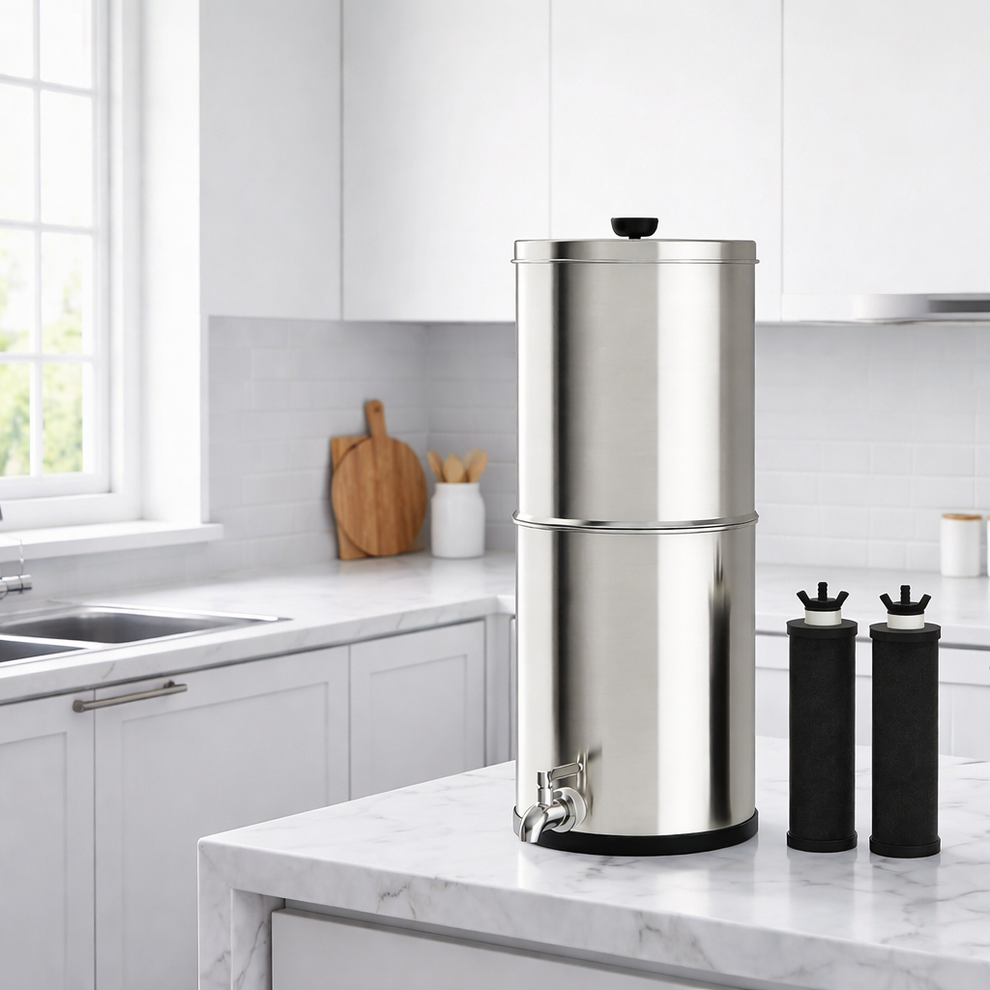
Big Flow 2 Stainless Steel Gravity Water Filter 8.5L
A non-electric gravity filtration option for households that want a portable, plumbing-free setup. It is a different treatment category from a conventional RO system, so compare its specific filter performance claims with the contaminants you need to address.
Capacity: 2.25 gallons (8.5L)
Filter life: Up to 6,000 gallons, subject to the stated product conditions
Flow rate: Up to 4 gallons per hour
Material: 304 stainless steel
Power: None
Installation: No plumbing required
Intended settings: Home, apartment, RV, camping, and emergency preparation
For a smaller gravity filtration setup, compare the Gravity Water Filter 3.8L. If you need a larger gravity option, review the Big Flow 3 Gravity Water Filter.
For higher household water demand
Households with several people using filtered water throughout the day should pay close attention to production rate and available supply. Puflow's High-Flow RO Systems category is relevant when comparing higher-capacity configurations. Confirm the actual operating conditions and delivery rate for the model rather than relying on a headline rating alone.
For buyers comparing countertop systems
Not every home can accommodate an under-sink installation. Countertop systems may be useful for renters, small kitchens, or people who want a less permanent setup. Puflow's guide to the best countertop RO water purifiers can help buyers understand the differences between countertop configurations. Check the product's current specifications and certification details before purchase.
Who Should Use RO Water Filters for Drinking Water?
RO is most useful when it addresses a clear household need. It is not a mandatory upgrade for every property, and the right choice depends on the source water, treatment objective, and willingness to maintain the equipment.
RO is worth considering for:
- Homeowners whose water report identifies contaminants that a particular RO system is certified to reduce.
- Households that want a dedicated source of treated drinking and cooking water.
- Families that regularly purchase bottled water and want to compare the long-term cost of home filtration.
- People who dislike the taste or odor of their tap water and want a system with suitable carbon filtration.
- Homeowners who can accommodate installation and are prepared to replace filters on schedule.
RO may not be necessary for:
- Households with satisfactory water quality and no specific contaminant-reduction objective.
- People who only need basic chlorine taste and odor improvement and could use a suitable certified carbon filter.
- Renters who cannot install plumbing equipment and do not want a countertop alternative.
- Households unwilling to manage filter replacement, membrane service, and wastewater.
- People who expect a generic RO system to solve every private-well or microbiological water problem without testing.
Expert Recommendation: Choose RO Based on Water Quality, Not Marketing Claims
For homeowners with a documented dissolved-contaminant concern, a properly selected RO system can be a worthwhile investment. It offers a practical point-of-use treatment method and can reduce a range of substances when the exact model has verified performance for those contaminants.
However, we do not recommend buying an RO system simply because it has more filtration stages, a higher advertised gallon-per-day number, or a dramatic TDS reduction claim. Those details do not prove that the system addresses the water issue that matters to your household.
Use this decision process before purchasing:
- Review your water: Obtain your municipal water report or arrange appropriate private-well testing.
- Identify the target: List the contaminants or water characteristics you want to address.
- Verify the system: Check NSF/ANSI 58 certification and the exact model's reduction claims.
- Compare configurations: Choose tank-based or tankless based on available space, demand, and installation conditions.
- Calculate ownership cost: Include filters, membrane replacement, installation, and water efficiency.
- Plan maintenance: Make sure replacement cartridges are available and practical to install.
For most homeowners, the best RO water filter is not the one with the most impressive advertisement. It is the one that is independently verified for the contaminants in the home's water, delivers enough treated water for daily use, and can be maintained without unnecessary cost or complexity.
Frequently Asked Questions About RO Water Filters for Drinking Water
1. Are RO water filters good for drinking water?
RO water filters can be a good option when a household wants to reduce specific dissolved contaminants and the selected system has verified performance for those substances. The best choice depends on the incoming water quality, certification, maintenance requirements, and household demand.
2. What does reverse osmosis remove from drinking water?
Depending on the model and its verified claims, RO can reduce substances such as lead, arsenic, nitrate, fluoride, and dissolved salts. Some systems also include carbon filtration to reduce chlorine taste and odor. Check the exact model's contaminant reduction claims.
3. Does an RO water filter remove all contaminants?
No. No single RO system should be assumed to remove every contaminant. Performance varies by model, membrane condition, water chemistry, and operating conditions. Use water testing and model-specific certification to confirm whether a system addresses your concern.
4. Is RO water safe to drink every day?
Water treated by a properly installed and maintained RO system can be suitable for everyday drinking when the system is appropriate for the source water and used according to its instructions. If you have a medical or dietary concern about mineral intake, discuss your water choice with a qualified healthcare professional.
5. Does reverse osmosis remove healthy minerals?
RO can reduce dissolved minerals such as calcium and magnesium along with other dissolved substances. Whether this matters nutritionally depends on a person's overall diet and circumstances. Do not assume that mineral removal makes water unsafe, or that a remineralization stage is automatically necessary.
6. Is RO better than a carbon water filter?
Neither is universally better. RO is generally more relevant when the goal is reducing selected dissolved contaminants. Carbon filtration is often suitable for improving chlorine taste and odor and reducing certain other substances when certified for them. Choose based on the water problem rather than the technology label.
7. Do RO water filters waste water?
Yes. RO systems produce a concentrate or reject-water stream as part of the separation process. The amount varies by system design and operating conditions. Compare verified water-efficiency or recovery information if water conservation is important to your household.
8. How often should RO filters be replaced?
Replacement intervals vary by model, filter type, and incoming water quality. Follow the manufacturer's schedule for sediment filters, carbon filters, post-filters, and the RO membrane. Replace cartridges sooner if the manufacturer recommends it based on water conditions or performance indicators.
9. Is a tankless RO system better than a tank-based system?
Tankless systems can save under-sink space and produce water on demand. Tank-based systems store treated water and may suit households that prefer a reserve. Compare actual flow rate, daily production, pressure requirements, electricity needs, and installation space before deciding.
10. Do I need an RO system if I have city water?
Not necessarily. Municipal water is treated and monitored, but water quality can vary by location and building plumbing. Review your utility's Consumer Confidence Report and consider testing if you have a specific concern. Install RO when its verified capabilities match a real household need.
11. Can an RO filter make well water safe to drink?
Not automatically. Private-well water should be tested for relevant chemical and microbiological contaminants. Depending on the results, treatment may require disinfection or other processes in addition to RO. Select equipment based on laboratory findings and local health guidance.
12. What should I look for when buying an RO water filter?
Check complete-system certification, contaminant-specific reduction claims, production rate, water efficiency, installation requirements, replacement-filter cost, membrane service life, and product support. Choose the model that meets your water-quality objective and household usage rather than buying on stage count alone.
References
- Centers for Disease Control and Prevention: About Choosing Home Water Filters — guidance on filter selection, contaminant reduction, and understanding NSF standards.
- NSF: NSF/ANSI 58 — Reverse Osmosis Drinking Water Treatment Systems — information about RO system testing, material safety, TDS reduction, efficiency, recovery, and optional contaminant claims.
- U.S. Environmental Protection Agency: Point-of-Use Reverse Osmosis Systems — explanation of RO operation, concentrate water, and water-efficiency considerations.
Water treatment performance depends on the exact system, its certification, installation, incoming water quality, and maintenance. Always consult current product documentation and relevant water testing before making a treatment decision.