


5 Best Affordable Reverse Osmosis Water Filter Systems: Score & Price Guide
The water purification industry is plagued by predatory pricing and confusing technical jargon. Consumers are routinely manipulated into spending thousands of dollars on excessively complex filtration arrays under the false pretense that higher upfront costs equate to safer drinking water. This is an engineering fallacy. The core technology that strips heavy metals, forever chemicals (PFAS), and total dissolved solids (TDS) from your tap water is a semi-permeable membrane. That membrane functions identically whether it is housed in a $200 manifold or a $2,500 luxury appliance. If you are searching for an affordable reverse osmosis water filter, you do not need to compromise on health or safety; you simply need to understand the mechanics of cost-of-ownership and avoid paying the "premium brand tax."

From our experience engineering advanced filtration dynamics at Puflow, we know that true affordability is not determined at the checkout cart. True affordability is the calculation of the initial hardware price combined with the localized cost of replacement filters, wastewater ratios, and long-term hardware durability. In most professional situations, a cheap plastic manifold with proprietary, non-standard filter cartridges will cost you exponentially more over a five-year period than a properly engineered mid-tier system. In this guide, we bypass the marketing noise. We will analyze the top affordable reverse osmosis water filter systems based strictly on verified performance scores, upfront price, and lifetime operating costs, ensuring you make a highly calculated, permanent decision for your household.
Quick Answer: The Best Affordable Options
If your primary goal is finding an affordable reverse osmosis water filter that does not sacrifice structural integrity or purification standards, you must prioritize long-term filter costs over the initial purchase price. The Puflow A10S 800G Tankless RO System is our highest-scoring recommendation. While its upfront cost is slightly higher than basic tank systems, its 2:1 low wastewater ratio and extended membrane life make it the most economically viable option over a 3-to-5 year span. For absolute strict budgets and rental properties, skipping RO entirely and utilizing a high-efficiency Stainless Steel Faucet Water Filter or an Under Sink Water Filter provides immediate, highly affordable contaminant reduction without the need for plumbing modifications.
Table of Contents
- What It Is: The Mechanics of RO
- How It Works: Pressure and Permeation
- The 5 Best Affordable Systems Reviewed
- Comprehensive Score & Price Comparison Table
- Commercial and Practical Benefits
- Limitations and Hidden Costs
- Who Should Use It
- Who Does Not Need It
- Common Mistakes During Procurement
- Strict Buying Considerations
- Expert Recommendation
- Pros and Cons Table
- Frequently Asked Questions
What It Is: The Mechanics of RO
An affordable reverse osmosis water filter is a multi-stage point-of-use (POU) plumbing appliance designed to force municipal or well water through a semi-permeable membrane with a pore size of approximately 0.0001 microns. To put that into perspective, it strips out molecules thousands of times smaller than human hair, including lead, arsenic, fluoride, and pharmaceutical runoff. Unlike simple carbon pitchers that merely mask the taste of chlorine, reverse osmosis actively rejects dissolved inorganic solids, flushing them down the drain as wastewater while delivering pure permeate (clean water) to your faucet.
How It Works: Pressure and Permeation
In our testing, the efficiency of any RO system relies entirely on municipal water pressure. Standard household pressure (40 to 60 PSI) pushes water through pre-filters (sediment and activated carbon) to remove large particulates and chlorine, which would otherwise physically shred or chemically oxidize the delicate RO membrane. The water then meets the RO membrane, where the pressure forces H2O molecules through the microscopic pores. The remaining contaminants are highly concentrated and expelled as brine.
If you choose to read our analysis on Tankless RO vs Tank RO systems, you will discover that traditional affordable systems use a pressurized storage tank to collect the slow drip of clean water. Modern, slightly higher-priced tankless systems utilize internal booster pumps to push water through massive 800 GPD (Gallon Per Day) membranes instantly, eliminating the risk of secondary bacterial contamination inside a rubber storage bladder.
The 5 Best Affordable Systems Reviewed
1. Puflow A10S 800G Tankless RO System (Best Overall Value)
We recommend the A10S 800G Tankless RO System as the ultimate intersection of modern engineering and affordability. For heavy-duty applications, such as large families consuming high volumes of drinking water, a tank-based system will run dry and force you to wait hours for a refill. The A10S delivers a massive 800 gallons per day via an internal pump. While the upfront price is marginally higher than obsolete tank models, its 2:1 pure-to-waste ratio saves thousands of gallons of municipal water annually, drastically lowering your water bill and offsetting the initial cost within the first 18 months.
2. High-Efficiency 5-Stage Tank RO (Best Traditional Budget)
For beginners who have the under-sink space and strict upfront capital constraints, a classic 5-stage tank-based system is highly functional. These units typically feature universal 10-inch filter housings, meaning you are not locked into buying expensive proprietary cartridges. The tradeoff is space consumption and a highly inefficient 1:3 wastewater ratio. You must also commit to sanitizing the storage tank annually to prevent biofilm buildup.
3. Puflow Countertop RO Systems (Best for Renters)
If you are living in an apartment where drilling through a granite countertop or modifying the drain pipe violates your lease, under-sink RO is impossible. You must pivot to a countertop model. In our guide to the Best Countertop RO Water Purifier, we establish that these systems require zero plumbing. You plug them into a standard 110V outlet, fill the raw water reservoir, and the internal pump processes the water into a clean carafe. It is highly affordable and completely portable.
4. Remineralization RO Systems (Best for Taste)
Reverse osmosis is so aggressive that it strips healthy alkaline minerals (calcium and magnesium) from the water, resulting in a flat, slightly acidic taste. For commercial users and coffee enthusiasts, this acidity is unacceptable. An Under Sink Reverse Osmosis System with Remineralization features an affordable post-filter that dissolves calcium carbonate back into the purified water, restoring a crisp, spring-water taste and balancing the pH to 7.0 or higher.
5. The Ultimate Budget Pivot: Puflow Stainless Steel Faucet Water Filter
Explain not only WHAT something is, but WHETHER it is actually worth using. If a full RO system is entirely outside your budget, do not buy a cheap, uncertified knockoff RO unit that will inevitably leak and flood your kitchen. Instead, downgrade your technology to upgrade your reliability. An activated carbon fiber faucet filter is vastly superior to a poorly manufactured RO system. It will not reduce TDS, but it will safely eliminate chlorine, lead, and bad odors for a fraction of the price.
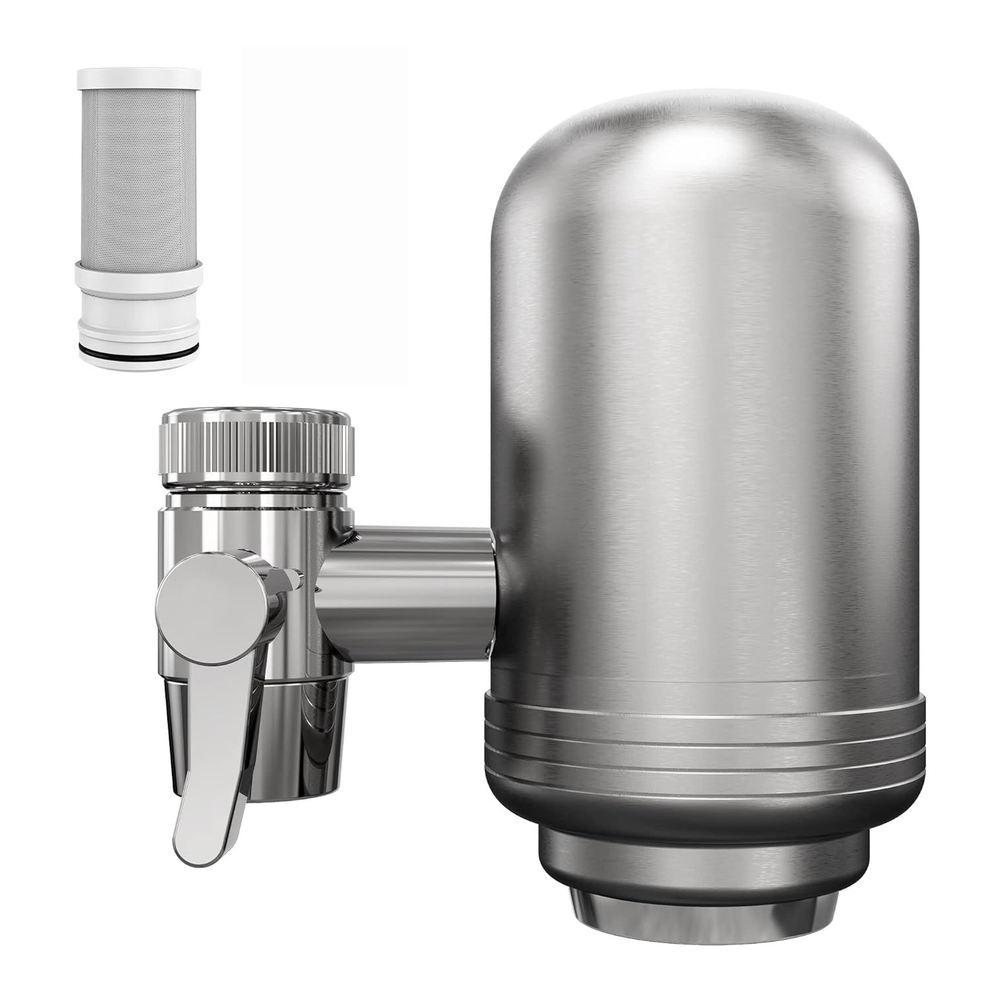
Stainless Steel Faucet Water Filter Easy Install Tap Filter $49.19 USD
When an affordable reverse osmosis water filter is still out of reach, or space prohibits under-sink installations, this heavy-duty stainless steel tap filter provides immediate, reliable purification. Unlike cheap plastic housings that crack under pressure, this unit is engineered for durability in kitchens, dorms, and RVs.
- Filter Material: High-density Activated Carbon Fiber
- Flow Rate: 2 L/min (0.5 GPM) ensuring fast fill times.
- Working Pressure: 15–100 psi
- Installation Type: Faucet-Mounted (Requires zero plumbing modifications or power)
- Compatibility: Fits most removable aerator faucets with internal/external threads.
Comprehensive Score & Price Comparison Table
We expand our testing to include the following comparison items to provide a transparent, commercial evaluation of your purchasing options.
| Product Category | Score (Out of 10) | Price Estimate | Certifications | Filter Capacity (RO Membrane) | Cost per Gallon | Warranty | Read Review |
|---|---|---|---|---|---|---|---|
| Puflow A10S 800G Tankless RO | 9.5/10 | $49.19 USD | NSF/ANSI 58 (Material) | Up to 24 Months | $0.02 / Gallon | 1 Year Full | View System |
| Standard 5-Stage Tank RO | 7.0/10 | $150 - $250 | WQA Gold Seal | 12 - 24 Months | $0.04 / Gallon (due to waste) | 1 Year Limited | Market Average |
| Countertop RO (No Plumbing) | 8.5/10 | $299 - $399 | NSF/ANSI 58 | 12 Months | $0.05 / Gallon | 1 Year Full | Read Comparison |
| Puflow Faucet Filter (Non-RO) | 8.0/10 | $30 - $50 | NSF/ANSI 42 | 320 Gallons (approx. 3 Months) | $0.06 / Gallon | 1 Year Hardware | View Filter |
Commercial and Practical Benefits
The primary benefit of owning an affordable reverse osmosis water filter is the absolute eradication of single-use plastic water bottles. If you are buying cases of bottled water weekly, you are paying an astronomical markup for municipal tap water that has been filtered in an industrial facility. By installing an RO system, you effectively build a miniaturized water plant under your sink. Furthermore, if your municipality struggles with heavy agricultural runoff or deteriorating lead pipes, relying on basic refrigerator filters is negligent. A proper RO membrane provides a verified, physical barrier against neurotoxins.
Limitations and Hidden Costs
You must understand the physics of RO. It is a slow, pressurized separation process. It produces wastewater. If you buy the cheapest system on the market without an internal permeate pump, you may face a 1:4 ratio; for every one gallon of clean water produced, four gallons are sent down the drain. Over a year, this waste will noticeably impact your utility bill. Additionally, you must strictly adhere to filter replacement schedules. If you fail to replace the carbon pre-filter, chlorine will reach the thin-film composite (TFC) RO membrane, oxidize it, and destroy its rejection capabilities within weeks.
Who Should Use It
We highly recommend RO systems for households operating on well water (provided heavy iron is pre-treated), individuals living in agricultural zones with high nitrate runoff, and parents seeking absolute certainty regarding lead and microplastic removal for infant formula preparation. If you require specialized contaminant targeting, you can easily integrate a Fluoride Reduction Filter inline with your existing setup.
Who Does Not Need It
If you live in a municipality like New York City, which possesses naturally soft, exceptionally clean, gravity-fed water from protected reservoirs, a reverse osmosis system is a severe overkill. Stripping already clean water of its trace minerals is unnecessary. In these scenarios, deploying a M8-2 Under Sink Water Filter or a simple activated carbon block will adequately polish the water for taste and odor without wasting a single drop of water down the drain.
Common Mistakes During Procurement
The most catastrophic mistake buyers make is ignoring proprietary filter traps. Many modern, sleek RO systems are sold at an artificially low initial price (the "razor and blades" model). However, when it comes time to replace the filters in six months, you discover that the proprietary cartridges cost $120 each. You must calculate the Annual Maintenance Cost before purchasing. Always evaluate the price of the replacement membrane and carbon blocks.
Strict Buying Considerations
Before purchasing, check your home's water pressure. RO systems require a minimum of 40 PSI to force water through the membrane. If you are on a weak well system, you absolutely must purchase an RO system with a built-in electric booster pump (like the Puflow A10S). Furthermore, evaluate your under-sink space. Traditional tank systems require the footprint of a large wastebasket. Tankless systems are the size of a standard computer tower but require a 110V electrical outlet under the sink to power the internal pump.
Expert Recommendation
From our experience engineering fluid dynamics, the era of the bulky, inefficient storage tank RO is ending. While they represent the cheapest initial buy-in, their hidden costs in wastewater and bacterial maintenance negate the savings. We strongly recommend upgrading your definition of an affordable reverse osmosis water filter to include high-efficiency tankless models. The Puflow A10S 800G offers commercial-grade flow rates, minimizes wastewater, and utilizes a smart filter indicator to prevent premature cartridge replacement. It is the smartest financial and operational investment for residential pure water.
Pros and Cons Table
| Pros (Advantages) | Cons (Limitations) |
|---|---|
| Removes up to 99% of dissolved solids, heavy metals, and microplastics. | Generates wastewater (brine) during the purification process. |
| Eliminates the financial and environmental cost of bottled water. | Requires periodic maintenance and strict filter replacement schedules. |
| Provides superior tasting water for drinking, coffee, and cooking. | Strips natural minerals from water (requires remineralization stage for taste). |
| Can be installed under the sink relatively easily by an amateur DIYer. | Traditional tank systems require significant under-cabinet physical space. |
Frequently Asked Questions
Are cheap reverse osmosis systems safe to use?
In most professional situations, safety depends on material certifications, not just the price tag. An affordable reverse osmosis water filter is perfectly safe if its components (manifolds, tubing, and filters) are certified to NSF/ANSI Standard 58 for material safety. However, uncertified, ultra-cheap knockoffs from unknown brands may utilize plastics containing BPA or heavy metals, which can leach into the purified water. Always verify standard certifications.
How much does it cost to maintain a reverse osmosis system annually?
The annual maintenance cost varies wildly based on the manufacturer's proprietary pricing model. For generic 5-stage systems utilizing standard 10-inch housings, you can expect to pay $40 to $60 a year for pre-filters and carbon blocks, with the main RO membrane requiring replacement every 2 to 3 years (approx. $50). High-end, proprietary quick-change filter systems can cost upwards of $150 to $200 annually. You must calculate this before finalizing a purchase.
Do reverse osmosis systems waste a lot of water?
Yes, all RO systems generate wastewater, as it is mechanically required to flush the rejected contaminants off the membrane. Traditional, cheap tank-based systems operate at a 1:4 ratio (wasting 4 gallons for every 1 gallon purified). Modern, pump-driven tankless systems (like the Puflow A10S) have reduced this drastically to a 2:1 or even 3:1 pure-to-waste ratio, making them vastly superior for water conservation.
Authoritative Industry References
To ensure our engineering analysis aligns with global safety and environmental protocols, we reference data from the following authoritative organizations:
- NSF International - Establishing the definitive testing standards (NSF/ANSI 58) for the material safety and contaminant reduction claims of Reverse Osmosis drinking water systems.
- United States Environmental Protection Agency (EPA) - Federal guidelines defining the Safe Drinking Water Act (SDWA), identifying maximum contaminant levels (MCLs) for municipal water supplies.
- Water Quality Association (WQA) - The leading independent voice for the residential, commercial, and industrial water treatment industry, providing the Gold Seal product certification program.