


5 Downsides of using reverse osmosis filters
Reverse osmosis (RO) is universally heralded as the gold standard of residential and commercial water purification. Walk into any big-box hardware store, and a salesperson will eagerly tell you that RO systems remove 99.9% of all total dissolved solids (TDS), heavy metals, and microplastics from your tap water. While that statement is scientifically accurate, it represents only half the truth. As professionals who design and test advanced water filtration architecture, we are stepping in to provide commercial and practical judgment.

From our experience, the failure to understand the downsides of using reverse osmosis filters results in homeowner frustration, skyrocketing utility bills, and premature system failure. RO is a highly aggressive filtration mechanism. It is not a magical, install-and-forget appliance. The extreme microscopic precision required to force water molecules through a semi-permeable membrane introduces specific mechanical and chemical trade-offs that consumers must be aware of before investing their capital.
Quick Answer: What are the Downsides of Using Reverse Osmosis Filters?
Before purchasing an RO system, you must account for these five inherent drawbacks:
- Excessive Wastewater Generation: Traditional systems can flush up to 4 gallons of reject brine water down the drain for every 1 gallon of purified water produced.
- Complete Mineral Stripping: RO membranes remove beneficial dietary minerals like calcium and magnesium, resulting in slightly acidic, flat-tasting water.
- Sluggish Flow Rates: Forcing water through a 0.0001-micron membrane is slow, often necessitating bulky storage tanks that can breed bacteria if not sanitized.
- Strict Maintenance Dependencies: Failure to replace carbon pre-filters on time will allow municipal chlorine to permanently destroy the expensive RO membrane.
- Space Consumption: Standard systems monopolize under-sink real estate, often requiring you to sacrifice your garbage disposal or cleaning supply storage.
Table of Contents
- What is Reverse Osmosis and How Does it Work?
- The 5 Major Downsides Explained in Detail
- The Undeniable Benefits (Why We Still Use RO)
- Who Should Use It & Who Does Not Need It
- Pros and Cons Table
- Common Mistakes in RO Maintenance
- Buying Considerations and Modern Solutions
- Technology Comparison Table
- Expert Recommendation
- Frequently Asked Questions (FAQ)
What is Reverse Osmosis and How Does it Work?
To comprehend the downsides, you must understand the physics of the system. Natural osmosis occurs when water moves from an area of low solute concentration to high solute concentration across a semi-permeable membrane. Reverse osmosis applies intense hydrodynamic pressure to reverse this natural flow. It forces contaminated tap water against a highly specialized membrane with pores as small as 0.0001 microns.
The water molecules are small enough to pass through this microscopic barrier, emerging as highly purified permeate water. The larger contaminant molecules—such as lead, arsenic, fluoride, viruses, and dissolved salts—are blocked. Because these contaminants cannot pass through, they accumulate on the intake side of the membrane. To prevent the membrane from immediately clogging, the system must continuously flush these concentrated contaminants down the drain as wastewater (reject water). This continuous flushing mechanism is the root cause of several of the major downsides of using reverse osmosis filters.
The 5 Major Downsides Explained in Detail
1. Severe Wastewater Generation
This is the most heavily criticized aspect of traditional RO technology. In most professional situations, older tank-based RO systems operate with a wastewater ratio of 4:1 or even 5:1. This means you are sending five gallons of water into the municipal sewer just to yield one gallon of drinking water. If you live in an area prone to drought or pay high metered water rates, this inefficiency is economically and environmentally unacceptable.
2. Demineralization and Altered pH
Reverse osmosis is an indiscriminate filtration process. It does not differentiate between toxic lead and beneficial calcium. By stripping 99% of all Total Dissolved Solids (TDS), the resulting water is "hungry." It absorbs carbon dioxide from the air, dropping its pH and rendering it slightly acidic. For commercial users brewing coffee or tea, this demineralized water yields a flat, uninspired extraction profile. If you rely on municipal water for trace minerals, this stripping effect is a distinct disadvantage.
3. Sluggish Flow Rates and Tank Dependencies
A standard residential RO membrane processes water at a rate of roughly 50 to 75 Gallons Per Day (GPD). That translates to a mere trickle at the faucet. To mask this agonizingly slow production, traditional systems pump the purified water into a pressurized butyl-bladder storage tank. While the tank provides instant pressure at the tap, it introduces a secondary issue: stagnant water. If the tank is not periodically sanitized, biofilm and bacteria can develop inside the bladder.
4. Rigorous Maintenance Costs
In our testing, an RO membrane will fail within weeks if exposed to standard municipal chlorine. Therefore, RO systems rely heavily on activated carbon pre-filters to remove chlorine before the water hits the membrane. If a homeowner forgets to change these pre-filters every 6 to 12 months, the chlorine breaches the defense line, oxidizing and destroying the RO membrane. The recurring cost of replacing sediment filters, carbon blocks, and the RO membrane adds a significant long-term financial burden.
5. Loss of Under-Sink Real Estate
The footprint of a traditional 5-stage RO system is massive. Between the multi-canister manifold, the 3-gallon pressurized storage tank, and the spaghetti-web of polyethylene tubing, you will lose the majority of your under-sink storage space. Furthermore, installing these systems requires drilling a dedicated hole in your countertop for the dispenser faucet and tapping directly into your PVC drain pipe.
The Undeniable Benefits (Why We Still Use RO)
If the downsides of using reverse osmosis filters are so severe, why is it the industry standard? Because when absolute purity is required, nothing else competes. For heavy-duty applications dealing with private well water contaminated by agricultural runoff (nitrates, pesticides) or municipal supplies tainted with "forever chemicals" (PFAS), lead, or high levels of fluoride, standard carbon filters are entirely inadequate. RO provides a literal barrier against heavy metal toxicity and viral pathogens. If health security is your primary metric, managing the downsides is a necessary trade-off.
Who Should Use It & Who Does Not Need It
Who should use it: We recommend reverse osmosis systems for households relying on unregulated private wells, homes in regions with aging municipal infrastructure (lead pipe risks), and consumers dealing with aggressively hard water or high TDS levels (above 300 ppm). If your water tests positive for complex chemical contaminants, RO is mandatory.
Who does not need it: For beginners who live in modern municipalities where the only major water complaint is the smell and taste of chlorine, an RO system is dramatic overkill. You will suffer all the wastewater downsides for a problem that a simple carbon block can solve. We highly recommend exploring the M8-2 Under Sink Water Filter for high-flow, zero-wastewater chlorine reduction, or opting for a Big Flow 3 Gravity Water Filter if you want a passive, zero-installation setup.
Pros and Cons Table
| The Advantages of RO | The Disadvantages of RO |
|---|---|
| Removes up to 99% of heavy metals (Lead, Arsenic). | Generates substantial wastewater (brine discharge). |
| Eliminates microplastics and forever chemicals (PFAS). | Strips beneficial dietary minerals (Calcium, Magnesium). |
| Provides bottled-water quality taste and clarity. | Slow production rates often require bulky storage tanks. |
| Highly effective at lowering extreme TDS levels. | Requires strict, recurring pre-filter replacement schedules. |
Common Mistakes in RO Maintenance
The most catastrophic mistake users make is ignoring the filter replacement schedule. As industry practitioners, we see countless destroyed RO membranes because the user tried to stretch a 6-month carbon pre-filter into 18 months of use. Once the carbon is exhausted, chlorine passes through and chemically burns the polyamide RO membrane, resulting in a sudden spike in TDS at the faucet.
Another frequent error is ignoring the specific fluoride removal limitations of aging membranes. If fluoride reduction is your primary goal, ensure your membrane is rated for it, or supplement your setup with dedicated media like the Fluoride Reduction Filter.
Buying Considerations and Modern Solutions
You do not have to accept the downsides of using reverse osmosis filters from a decade ago. The industry has evolved. If you decide that RO is necessary for your health, your buying strategy must focus on Direct Flow (Tankless) Technology.
By upgrading to a system with an internal booster pump and an oversized RO membrane (e.g., 600 GPD to 800 GPD), you completely eliminate the need for a dirty storage tank. These high-capacity membranes process water fast enough to provide direct flow to your faucet. More importantly, the internal pumps optimize the hydrodynamic pressure, improving the wastewater ratio from a dismal 4:1 down to a highly efficient 1.5:1. Understanding the Tankless RO vs Tank RO debate is the most critical step in your purchasing journey.
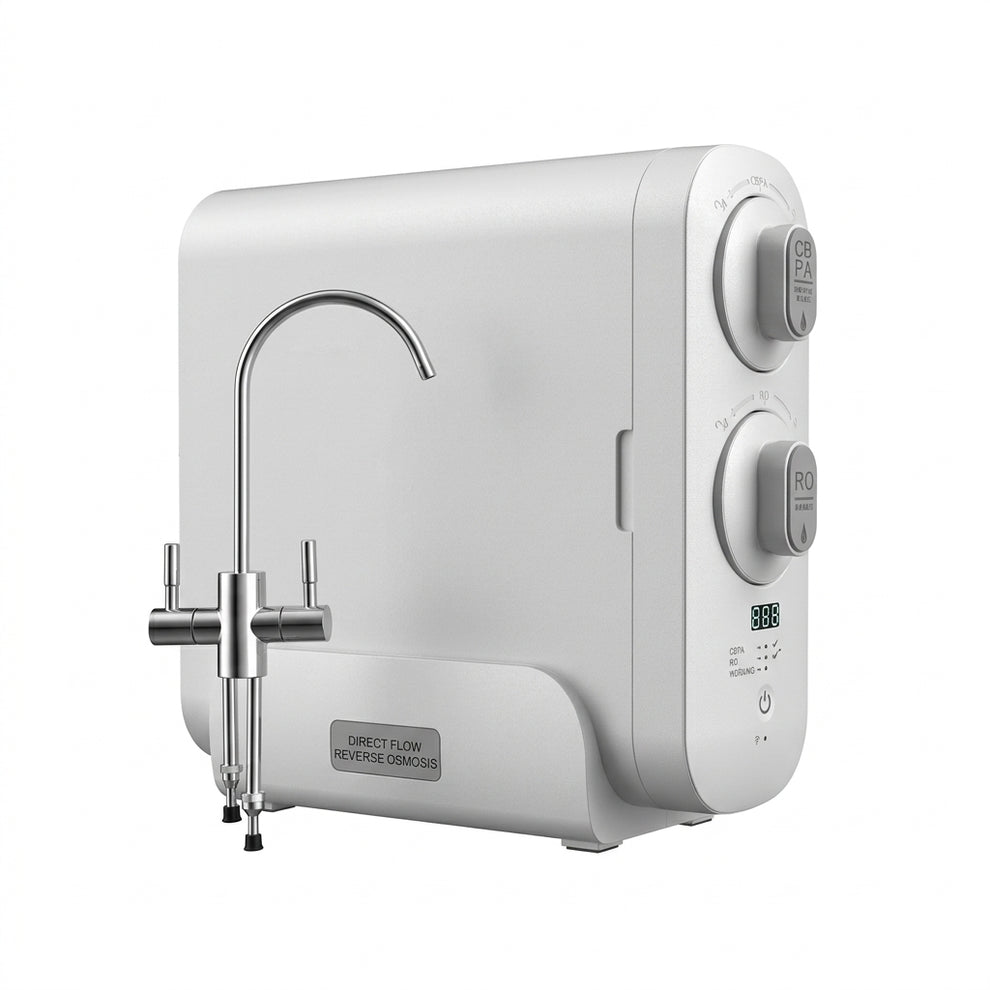
Under Sink RO System 600 GPD Direct Flow TDS Display
This system directly addresses the primary downsides of traditional RO. By utilizing a 600 GPD high-capacity membrane, it eliminates the need for a storage tank, reclaiming your under-sink space. The integrated booster pump achieves a highly efficient 1.5:1 wastewater ratio, drastically reducing environmental and financial waste.
Technology Comparison Table
| Filtration Technology | Wastewater Generated | Removes Heavy Metals? | Storage Tank Required? | Best Use Case |
|---|---|---|---|---|
| Traditional Tank RO | High (up to 4:1) | Yes (Excellent) | Yes | Legacy installations, budget-constrained buyers. |
| Tankless RO (e.g., A10S 800G) | Low (1.5:1 to 2:1) | Yes (Excellent) | No | Modern kitchens, eco-conscious consumers needing high purity. |
| Atmospheric Water Generator (e.g., F20 AWG) | Zero | N/A (Creates water from air) | Internal Reservoir | Off-grid living, severe municipal water contamination. |
| Multi-Stage Carbon (Under Sink) | Zero | Partial (Depends on media) | No | City water, chlorine removal, renters. |
Expert Recommendation
In most professional situations, we strongly advise against purchasing traditional, tank-based reverse osmosis systems. The excessive wastewater generation and the hygiene risks associated with aging butyl storage tanks make them an obsolete technology.
If your water chemistry dictates that you must use reverse osmosis to combat heavy metals or high TDS, we recommend investing exclusively in Direct Flow, Tankless RO systems like the Puflow 600 GPD or 800 GPD models. These modern units mitigate the primary downsides by slashing wastewater ratios, reclaiming your cabinet space, and providing real-time TDS monitoring. If you rent an apartment and cannot modify plumbing, you should evaluate the Best Countertop RO Water Purifier options to secure pure water without the installation hassle.