


8 Things to Compare When Choosing the Best RO Filter: An Expert Buying Guide
Choosing the best reverse osmosis (RO) water filter is not simply about buying the system with the highest GPD rating or the most filtration stages. A good RO system must reduce the contaminants that actually concern you, produce enough drinking water for your household, operate efficiently, and remain affordable to maintain. From our experience at Puflow, buyers who compare filtration performance, operating costs, water efficiency, and replacement requirements make much better long-term decisions than those who focus on specifications alone.
If you are researching how to compare when choosing the best RO filter, this guide explains the eight factors that deserve your attention before purchasing. We also compare different RO configurations, explain when an alternative filtration system makes more sense, and highlight the practical details that manufacturers do not always make obvious.

Quick Answer: What Should You Compare When Choosing the Best RO Filter?
The best RO filter should have independently verified contaminant reduction claims, sufficient daily production capacity, reasonable wastewater generation, affordable replacement filters, and a maintenance process you can realistically follow.
Our recommendation: Start with your water quality report, identify the contaminants you need to reduce, and then compare systems certified to the relevant requirements of NSF/ANSI 58. For most households, a properly specified under-sink RO system offers the strongest balance of filtration performance, convenience, and long-term value. Choose a countertop or portable system when installation flexibility matters more than maximum production capacity.
Quick Summary: Eight Factors to Compare
| Comparison Factor | What to Check | Our Recommendation |
|---|---|---|
| 1. Filtration performance | Contaminant-specific reduction claims and independent verification | Match certified claims to your water quality concerns. |
| 2. Filtration technology | RO membrane, prefilters, carbon postfilters, and additional stages | Prioritize proven performance over stage count. |
| 3. Production capacity | GPD rating, actual output, and household demand | Allow sufficient capacity for peak daily consumption. |
| 4. Water efficiency | Recovery rate and wastewater-to-product-water ratio | Compare independently tested efficiency figures. |
| 5. Installation and design | Dimensions, plumbing, electricity, and storage | Choose a configuration that fits your space. |
| 6. Filter replacement costs | Replacement prices, service intervals, and availability | Calculate total ownership costs over several years. |
| 7. Maintenance and usability | Filter access, monitoring, flushing, and servicing | Choose a system you can maintain consistently. |
| 8. Manufacturer support | Documentation, warranty, replacement parts, and technical support | Buy from a manufacturer with transparent product information. |
What Is an RO Water Filter and How Does It Work?
A reverse osmosis water filter is a drinking water treatment system that uses pressure to push water through a semipermeable membrane. The membrane allows water molecules to pass while restricting many dissolved substances and contaminants. The result is a treated water stream, commonly called permeate, and a separate wastewater stream containing concentrated rejected substances.
Most residential RO systems combine several filtration components rather than relying on the membrane alone. A typical configuration includes sediment filtration, activated carbon filtration, an RO membrane, and sometimes a final carbon polishing filter.
The Main Filtration Stages
- Sediment prefilter: Captures suspended particles such as sand, rust, and sediment that could interfere with downstream components.
- Carbon prefilter: Reduces chlorine, taste, and odor compounds. This stage can also help protect chlorine-sensitive RO membranes.
- RO membrane: Reduces dissolved solids and various contaminants, depending on the membrane and system's verified performance.
- Post-carbon filter: Helps improve the taste and odor of stored or freshly produced water.
- Optional additional treatment: May include specialized contaminant-reduction media, remineralization, or other technologies.
One important distinction: RO filtration does not automatically guarantee the removal of every contaminant. Actual performance depends on the system design, water conditions, membrane condition, and verified reduction claims.
For homeowners who want a broader understanding of filtration options, our guide to the best water filters for microplastics explains why filtration technology and product-specific performance matter more than marketing descriptions.
1. Compare Filtration Performance and Certifications
Filtration performance should be the first comparison when choosing the best RO filter. A system with an impressive appearance, multiple stages, or a high production rating is not necessarily the right choice if it cannot demonstrate reduction of the contaminants found in your water.
Start by obtaining your local water quality report if you use municipal water. If you rely on a private well, consider an appropriate laboratory water test. Identify the substances that matter before evaluating products.
Why NSF/ANSI 58 Matters
NSF/ANSI 58 is the principal U.S. standard specifically addressing reverse osmosis drinking water treatment systems. It covers important aspects including materials safety, structural integrity, total dissolved solids (TDS) reduction, system efficiency, recovery ratings, and applicable contaminant-reduction claims.
However, certification to NSF/ANSI 58 should not be interpreted as proof that a system removes every possible contaminant. The specific reduction claims matter. For example, a system may have a verified TDS reduction claim without having verified reduction claims for every heavy metal or chemical of interest.
From our experience, the most useful buying question is not simply whether a manufacturer displays an NSF logo. Ask which exact model has been certified, which standard applies, and which contaminants are included in the certification or performance documentation.
What Should You Check?
- Is the complete system independently certified, or only an individual component?
- Does the documentation identify the exact model number?
- Are the contaminants you care about specifically listed?
- Are reduction claims supported by recognized testing?
- Does the manufacturer provide clear replacement and operating instructions?
2. Compare Filtration Stages and RO Membrane Technology
The number of filtration stages is one of the most heavily marketed features in the water filtration industry. Some products advertise five-stage, seven-stage, or even more advanced configurations. However, a higher stage count does not automatically mean better water quality.
For most residential applications, a well-designed sediment-carbon-membrane configuration is a sensible starting point. Additional stages should solve a specific problem rather than exist simply to make the product specifications look more impressive.
RO Membrane Quality
The RO membrane is the central component responsible for rejecting many dissolved substances. When comparing systems, look at membrane performance, operating pressure requirements, rated production conditions, and replacement availability.
Two membranes with similar nominal capacities can perform differently under different water temperatures, inlet pressures, and feed-water conditions. A manufacturer should explain the conditions behind its production and rejection figures.
When Are Additional Stages Worth Paying For?
Additional filtration stages can be worthwhile when they have a clear purpose:
- Extra carbon filtration: Useful when additional chlorine, taste, or odor treatment is required.
- Fluoride reduction media: Relevant when fluoride reduction is a priority and the product has an appropriate verified performance claim.
- Remineralization: Can change taste and mineral composition after RO treatment. It should be considered a preference or treatment-design decision, not an automatic health requirement.
- Specialized contaminant media: Useful when a specific substance requires treatment beyond the standard configuration.
For buyers specifically concerned about fluoride, consider whether an RO system or a dedicated fluoride-reduction solution better matches the intended application. Puflow offers a fluoride reduction filter as a specialized filtration option. Always check its documented compatibility and performance claims before selecting it for a particular water source.
3. Compare RO Production Capacity and Flow Rate
Production capacity determines how much filtered water a system can theoretically produce over a specified period. It is commonly expressed in gallons per day (GPD).
For example, an 800 GPD tankless RO system has a higher nominal production rating than a 400 GPD model. That does not mean it will always deliver twice as much usable water in your kitchen. Actual output is influenced by water pressure, temperature, feed-water quality, membrane condition, and system design.
How Much RO Capacity Do You Need?
Consider household size and usage patterns rather than purchasing the highest available capacity.
- One or two people: A modest-capacity system may be sufficient if daily drinking and cooking requirements are limited.
- Three to four people: A medium- or higher-capacity system offers more flexibility, particularly when several people use filtered water throughout the day.
- Large households: Higher-production systems can reduce waiting time and improve convenience during peak usage.
- Commercial kitchens and offices: Calculate peak hourly demand, not just average daily consumption.
Tankless vs. Tank-Based RO Systems
Tankless RO systems produce water on demand and generally require less storage space. They are attractive for modern kitchens where cabinet space is limited. Tank-based systems store previously filtered water, providing a reserve that can be useful when immediate demand exceeds the membrane's production rate.
For buyers looking for a high-capacity configuration, the Puflow A10S 800G Tankless RO System is an option worth evaluating. Compare its actual operating specifications, installation requirements, and replacement filter costs against your household's needs before making a decision.
Our recommendation is to leave a reasonable capacity margin rather than buying a system that only meets your average consumption under ideal conditions.
4. Compare Water Efficiency and Wastewater Production
Water efficiency is an important factor that many buyers overlook. Conventional RO filtration separates incoming water into treated water and a concentrated reject stream. Some of the incoming water therefore does not become drinking water.
The amount of wastewater depends on membrane performance, inlet pressure, water temperature, feed-water composition, flow restrictors, and system design.
Understand the Recovery Rate
Recovery rate measures the proportion of feed water converted into treated product water.
Recovery rate = Product water volume ÷ Feed water volume × 100%
For example, if a system receives 10 gallons of feed water and produces 3 gallons of treated water, its recovery rate is 30%. The remaining 7 gallons leave through the reject stream.
This is why two RO systems with similar filtration capabilities can have noticeably different operating costs and water consumption.
What Is a Good Water Efficiency Rating?
There is no single recovery rate that suits every application. A higher recovery rate can reduce wastewater, but it must be achieved without compromising reliable operation or contaminant reduction. Extremely aggressive recovery targets may increase scaling and membrane maintenance concerns when feed water contains high concentrations of hardness minerals or dissolved solids.
For commercial users, we recommend comparing independently tested recovery figures under clearly stated conditions. For household buyers, compare the wastewater generated per gallon of purified water and calculate the likely annual consumption.
Also remember that advertised efficiency figures should not be compared blindly. Make sure the systems were tested using comparable water conditions and performance criteria.
5. Compare Installation Types and System Design
The best RO filter is not necessarily the one with the most advanced technology. It is the one that fits your home, plumbing arrangement, available space, and daily routine.
Before purchasing, check whether the product requires a dedicated faucet, drain connection, electricity, water pressure within a specified range, or a particular amount of cabinet clearance.
Common RO System Configurations
- Under-sink RO systems: Installed beneath a kitchen sink and connected to the water supply. They are a strong choice for permanent household drinking-water treatment.
- Countertop RO systems: Designed for users who want a more accessible installation with limited plumbing modifications. They are useful for apartments and rental properties, depending on the model.
- Tankless RO systems: Produce water on demand and reduce the space required for a conventional storage tank.
- Portable water treatment systems: Designed for travel, temporary living arrangements, and situations where permanent plumbing connections are impractical. Confirm the specific technology and contaminant claims because not every portable filter is an RO system.
For a permanent kitchen installation, explore under-sink water filtration systems. If you prefer an easier setup, compare the available countertop water filtration systems.
For users who need filtration without a conventional electrical or plumbing setup, Puflow also provides portable and non-electric water filtration options.
Do Not Ignore Water Pressure and Power Requirements
Some RO systems require electricity to operate a booster pump, electronic controls, or other functions. Others use existing water pressure or alternative operating mechanisms.
Check minimum and maximum inlet pressure, power requirements, connection dimensions, and installation instructions before ordering. A system that does not match your plumbing conditions may require additional equipment or professional installation.
6. Compare Replacement Filter Costs and Total Ownership Costs
The initial purchase price is only one part of the cost of owning an RO water filter. Prefilters, carbon filters, membranes, replacement fittings, and occasional servicing all contribute to the long-term expense.
A low-priced system can become expensive if replacement cartridges are difficult to source or need frequent replacement. Conversely, a more expensive system may provide better value if it has accessible replacement parts and predictable maintenance costs.
Calculate the Real Cost of Ownership
Use the following approach when comparing products:
Total ownership cost = Initial purchase price + Replacement filters + Maintenance + Installation + Estimated operating costs
For example, imagine two systems:
- System A costs less initially but requires several expensive replacement cartridges each year.
- System B costs more initially but has affordable replacement filters and a longer documented service interval.
System B may become the more economical option over three to five years. The actual result depends on filter prices, water quality, consumption, and replacement frequency.
Questions to Ask Before Buying
- How much does a complete replacement filter set cost?
- How often must the sediment and carbon filters be replaced?
- What is the recommended membrane replacement interval?
- Are replacement cartridges available individually?
- Can the owner replace the filters without professional assistance?
- Are the replacement products easy to identify by model number?
Do not rely on a filter-life claim without understanding its assumptions. Actual cartridge life can vary significantly with water quality and usage. A system processing heavily contaminated or high-sediment water may require more frequent service than one treating relatively clean municipal water.
7. Compare Maintenance Requirements and Daily Convenience
Even the best RO filter will not deliver consistent performance if it is poorly maintained. Filter replacement, membrane care, system sanitation, and correct installation all affect long-term operation.
Before choosing a system, evaluate how easy it is to access the cartridges and whether the manufacturer provides clear instructions for flushing and replacing them.
What Makes an RO System Easy to Maintain?
- Clearly labeled filter cartridges.
- Accessible replacement components.
- Simple cartridge locking or connection mechanisms.
- Visible maintenance instructions.
- Replacement reminders or monitoring features where appropriate.
- Reliable availability of compatible replacement parts.
Some advanced systems provide filter-life indicators, leak detection, or electronic monitoring. These features can improve convenience, but they should not replace the manufacturer's maintenance schedule.
For most households, straightforward cartridge replacement is more valuable than a large number of electronic features that add complexity without improving the actual filtration performance.
Why Filter Replacement Matters
Prefilters protect the membrane from particles and certain chemical exposures. If they become exhausted, downstream components may experience additional stress. Carbon filters also have finite adsorption capacity and should not be used indefinitely.
We recommend keeping a record of installation dates, filter replacements, and any noticeable changes in water taste or flow. Follow the manufacturer's recommended replacement schedule and investigate unexpected changes rather than assuming the system is still performing normally.
8. Compare Manufacturers, Warranty, and After-Sales Support
The manufacturer behind an RO filter matters just as much as the equipment itself. Water treatment is an ongoing process, and the availability of replacement parts and technical assistance directly affects the usefulness of your purchase.
A manufacturer should provide enough information for customers to understand how the product works, what it can reduce, how it should be installed, and how it should be maintained.
How to Evaluate an RO Filter Manufacturer
Look for the following indicators:
- Transparent technical specifications: Production capacity, operating pressure, filtration stages, dimensions, and applicable performance claims should be clearly documented.
- Product documentation: Installation guides, filter replacement instructions, and maintenance schedules should be available.
- Warranty coverage: Understand which components are covered, how long coverage lasts, and what exclusions apply.
- Replacement filter supply: Confirm that compatible cartridges and membranes will remain available.
- Responsive support: The manufacturer should be able to answer technical questions and help resolve installation or operating issues.
- Consistent product quality: Manufacturing controls and quality documentation are important when evaluating long-term reliability.
Why Manufacturer Transparency Matters
For commercial users, the decision involves more than one household purchase. Product consistency, technical documentation, supply continuity, and service arrangements can influence operational costs across multiple installations.
At Puflow, we believe that water filtration products should be evaluated through practical performance, application suitability, and ease of maintenance. Buyers should be able to understand what they are purchasing rather than relying on broad marketing promises.
If you need a larger-capacity configuration, explore high-flow water filtration systems and compare their actual output and maintenance requirements with your intended application.
RO Filter Comparison: Which System Type Is Right for You?
Once you understand the eight purchasing factors, the next step is comparing the main system configurations. Each type solves a different problem. Choosing the wrong configuration can lead to unnecessary installation costs or insufficient water production.
| System Type | Installation | Main Advantage | Main Limitation | Best For |
|---|---|---|---|---|
| Under-sink RO | Plumbing connection | Dedicated household drinking water treatment | Requires installation space and plumbing | Permanent home use |
| Tankless RO | Plumbing and usually electricity | On-demand production and compact storage design | Requires compatible water pressure and power | Modern kitchens and higher daily demand |
| Tank-based RO | Plumbing connection | Stored treated water available for peak demand | Requires storage space and tank maintenance | Households needing a reserve supply |
| Countertop RO | Model-dependent, often minimal plumbing | Flexible installation | Counter space and model-specific capacity limits | Apartments and rental properties |
| Gravity water filter | No plumbing or electricity in suitable models | Simple operation and portability | Different contaminant reduction capabilities from RO | Camping, temporary use, and alternative filtration needs |
| Portable water filter | Portable setup | Convenient for travel and outdoor use | Limited capacity and technology-dependent performance | Travel and outdoor activities |
For most permanent residential installations, we recommend starting with an under-sink or tankless RO system. If you live in a rental property or move frequently, a countertop configuration may offer better practical value.
RO Filter Pros and Cons: Is Reverse Osmosis Worth It?
Reverse osmosis is a powerful drinking water treatment technology, but it is not automatically the best solution for every household. Buyers should understand both the benefits and the compromises before investing.
Advantages
- Reduces TDS and various dissolved contaminants.
- Can reduce specific metals, salts, and other substances when appropriately designed and verified.
- Multiple filtration stages provide complementary treatment.
- Suitable for dedicated drinking and cooking water applications.
- Available in under-sink, tankless, and countertop configurations.
- Can improve taste and reduce certain unwanted odors.
Limitations
- Generates a reject-water stream.
- Requires regular filter and membrane maintenance.
- Some systems require electricity and plumbing modifications.
- Initial and replacement costs can be higher than simpler filters.
- May remove minerals that contribute to water taste.
- Performance depends on feed-water conditions and correct maintenance.
In most professional situations, RO is worth the investment when there is a clear reason to reduce dissolved contaminants and the system is properly matched to the water supply. If your only concern is chlorine taste in otherwise compliant municipal water, a simpler carbon filtration system may provide better value.
When a Gravity Water Filter Is a Better Alternative to RO
One mistake buyers make is assuming that reverse osmosis is always the superior option. It is an effective technology, but it is not necessarily the most practical choice for camping, RV use, temporary accommodation, or households that want a filtration system without electricity or plumbing.
Gravity water filters use gravity to move water through filtration media. They do not require the same pressurized membrane process used in conventional RO systems. Their contaminant reduction capabilities depend on the specific filter elements installed.
For people who prioritize portability, simple operation, and independence from plumbing connections, a gravity filtration system may be worth considering.
Puflow Big Flow 2 Stainless Steel Gravity Water Filter 8.5L
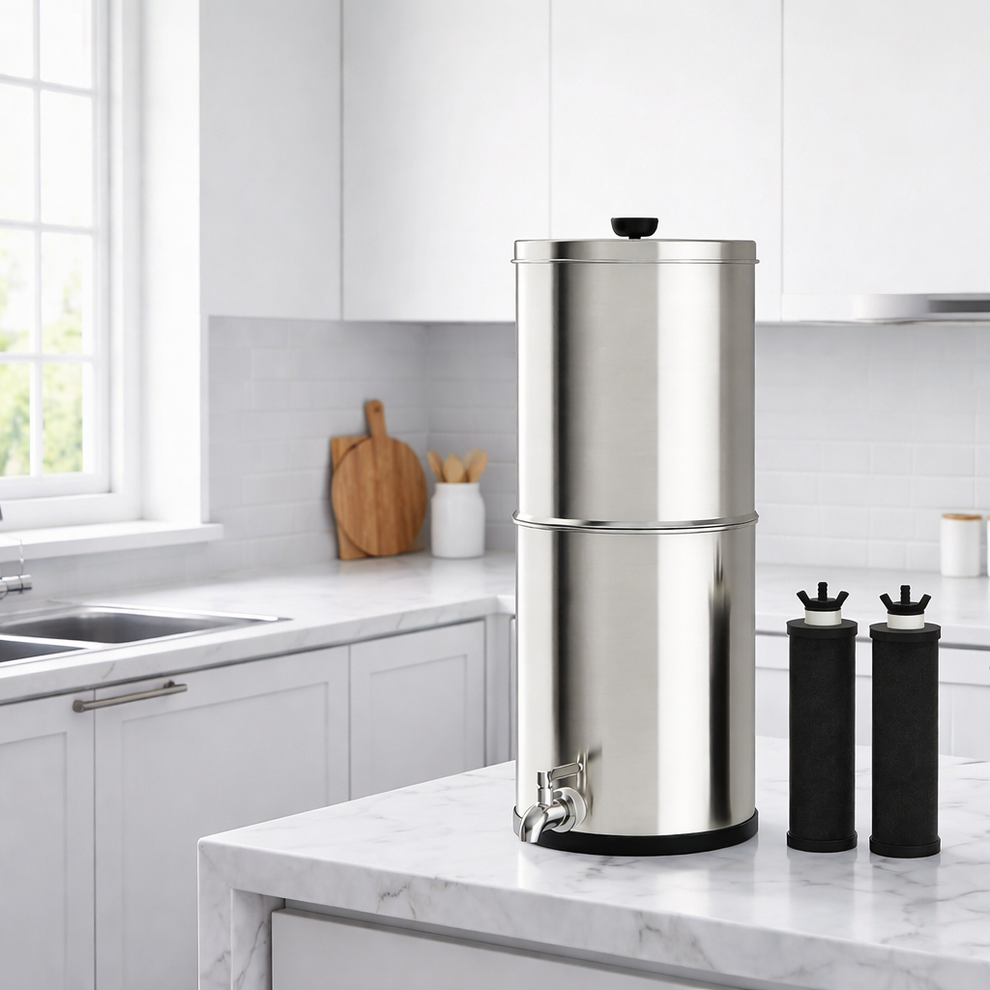
Big Flow 2 Stainless Steel Gravity Water Filter 8.5L
The Puflow Big Flow 2 is a non-electric gravity filtration option designed for users who need a larger-capacity water filtration setup without conventional plumbing installation.
- Capacity: 2.25 gallons (8.5L)
- Filter life: Up to 6,000 gallons
- Flow rate: Up to 4 gallons per hour
- Material: 304 stainless steel
- Power: No electricity required
- Installation: No plumbing required
- Applications: Home, apartment, RV, camping, and emergency preparedness
Who Should Consider This System?
We recommend considering the Big Flow 2 if your priority is a non-electric filtration arrangement with substantial storage capacity. Its 8.5-liter capacity is useful for households or temporary living arrangements that need a larger supply than a small countertop pitcher can provide.
However, it is important to understand that the Big Flow 2 is a gravity water filter, not a conventional RO system. Its filtration performance should be evaluated according to the specific installed filter elements and their documented reduction claims. Do not assume that its performance is identical to an RO membrane.
For a smaller gravity filtration option, compare the Puflow 3.8L Gravity Water Filter. Buyers who need greater storage can also review the Big Flow 3 Gravity Water Filter.
If your requirements involve travel rather than household storage, see our guide to the best portable water filters for travel.
Common Mistakes When Choosing the Best RO Filter
Even experienced buyers can overlook important technical details. The following mistakes are particularly common when comparing residential water filtration systems.
1. Choosing Based on the Highest GPD Rating
High production capacity does not automatically mean better contaminant reduction. Check actual operating conditions, recovery, and verified filtration performance before paying more for a larger system.
2. Assuming More Filtration Stages Mean Better Performance
Additional stages are useful only when they provide a meaningful treatment function. A system with unnecessary cartridges can increase maintenance costs without solving a real water quality problem.
3. Ignoring Replacement Filter Availability
Some buyers compare the purchase price but never check the cost or availability of replacement cartridges. This can make long-term maintenance unnecessarily expensive.
4. Confusing TDS Reduction With Complete Water Purification
A lower TDS reading is not proof that every harmful contaminant has been removed. TDS meters measure the concentration of dissolved substances collectively; they do not identify individual chemicals or establish microbiological safety.
5. Overlooking Wastewater Production
A system that generates excessive reject water can increase operating costs. Compare recovery rates and real-world wastewater ratios rather than relying on broad efficiency claims.
6. Buying Without Testing the Source Water
Without understanding the water supply, it is difficult to determine which contaminants require treatment. Start with a municipal water report or an appropriate private-water test.
7. Forgetting Maintenance
Even a well-designed RO system requires regular maintenance. Neglected cartridges and membranes can compromise performance and reduce system reliability.
8. Treating Every Water Filter as an RO Alternative
Carbon, gravity, ultrafiltration, and reverse osmosis systems work differently. Compare the exact contaminants they are designed and verified to reduce instead of assuming that all filters provide equivalent protection.
Our Expert Recommendation: Which RO Filter Should You Buy?
After comparing the eight major factors, our recommendation is to select a system based on your water quality, household demand, installation conditions, and maintenance budget. There is no single best RO filter for every user.
For Homeowners With Permanent Kitchen Installations
Choose a properly documented under-sink RO system if you want a dedicated drinking water supply. Prioritize verified contaminant reduction, accessible replacement filters, and sufficient daily production. A tankless model is worth considering when cabinet space and on-demand water production are important.
Explore Puflow under-sink systems to compare available configurations.
For Apartments and Rental Properties
A countertop RO system can be more practical when permanent plumbing modifications are undesirable. Before buying, check the dimensions, water filling process, wastewater handling, and actual daily production capacity.
Review Puflow countertop systems for flexible installation options.
For Large Households and Higher Water Demand
Prioritize production capacity, flow rate, storage arrangements, and recovery efficiency. A higher-capacity system may justify its additional purchase price if it significantly reduces waiting time during peak usage.
Compare Puflow high-flow filtration systems against your daily and peak-hour requirements.
For Camping, RVs, and Emergency Preparedness
A non-electric gravity filtration system can be more convenient than a conventional under-sink RO installation. Consider the Big Flow 2 if its storage capacity and documented filter performance match your intended water source.
Remember that no ordinary household filter should automatically be assumed safe for microbiologically contaminated or unknown water. Use an appropriate treatment method for the actual water hazard.
Frequently Asked Questions About Choosing the Best RO Filter
1. What is the most important factor when choosing the best RO filter?
Filtration performance is the most important starting point. Check whether the system has appropriate independent certification and verified contaminant reduction claims for the substances found in your water. After that, compare capacity, efficiency, maintenance, and ownership costs.
2. Is NSF/ANSI 58 certification necessary for an RO water filter?
NSF/ANSI 58 is an important standard for evaluating residential reverse osmosis systems. It addresses material safety, structural integrity, TDS reduction, efficiency, recovery, and specified contaminant reduction claims. Buyers should verify the exact model and specific claims rather than assuming that certification covers every contaminant.
3. How many filtration stages should the best RO system have?
There is no universally ideal number. A properly designed system with sediment filtration, carbon pretreatment, an RO membrane, and appropriate post-treatment can be sufficient for many households. Additional stages are worthwhile when they provide a specific, documented treatment benefit.
4. Is a tankless RO system better than a tank-based system?
Tankless systems are generally attractive for their compact design and on-demand production. Tank-based systems provide stored treated water that can help meet short periods of high demand. The better choice depends on available space, water consumption, production capacity, and installation requirements.
5. How much wastewater does an RO filter produce?
Wastewater production varies by system design and operating conditions. Compare the recovery rate and reject-water ratio under comparable testing conditions. Do not assume that every RO system has the same water efficiency.
6. How often should RO filters be replaced?
Replacement intervals vary by cartridge type, manufacturer recommendations, water quality, and consumption. Sediment and carbon prefilters generally require more frequent replacement than RO membranes. Follow the specific product maintenance schedule and replace components when required.
7. Does an RO water filter remove fluoride?
Reverse osmosis systems can reduce fluoride, but the actual result depends on the system and its verified performance. Look for an explicit fluoride reduction claim in the product documentation. Do not assume that every RO system has identical fluoride reduction performance.
8. Is reverse osmosis better than a gravity water filter?
Neither technology is universally better. RO is generally more suitable when reducing dissolved substances is a priority and a pressurized installation is practical. Gravity filters are useful when portability, simple operation, and independence from electricity or plumbing matter more. Compare the specific contaminants each product is designed to reduce.
9. Is a more expensive RO filter worth buying?
It can be worth the investment if the higher price provides independently verified performance, better water efficiency, greater production capacity, more reliable components, or lower long-term maintenance costs. A higher price alone does not guarantee better filtration.
10. Can an RO water filter be used for well water?
Yes, appropriately designed RO systems can be used with certain well-water supplies. However, private well water should be tested first. Excessive sediment, hardness, iron, or other water quality problems may require pretreatment before an RO system is installed. The system must also be suitable for the measured feed-water conditions.
References and Technical Resources
When comparing water filtration products, we recommend consulting recognized standards organizations and public health authorities rather than relying exclusively on manufacturer marketing materials.
- NSF International – NSF/ANSI 58: Reverse Osmosis Drinking Water Treatment Systems. Technical information about system requirements, TDS reduction, efficiency, recovery, and contaminant-specific claims.
- Centers for Disease Control and Prevention (CDC) – About Choosing Home Water Filters. Guidance on filtration technologies, contaminant reduction, and selecting filters based on specific water quality concerns.
- U.S. Environmental Protection Agency (EPA) – Point-of-Use Reverse Osmosis Systems. Information about RO operating principles, treated water, reject water, and water efficiency.
Choose a Water Filtration System That Fits Your Needs
The best RO filter is not necessarily the most expensive, the highest-capacity model, or the system with the most filtration stages. It is the one that addresses your actual water quality concerns, delivers sufficient treated water, and remains practical to maintain over time.
At Puflow, we encourage buyers to compare verified filtration performance, system design, replacement costs, and application requirements before making a decision. Whether you need an under-sink RO system, a high-flow configuration, a countertop solution, or a non-electric gravity filter, selecting the right technology is the foundation of a reliable water filtration setup.
Start with your water quality requirements, compare the specifications carefully, and choose a system that offers genuine long-term value.