


Is Reverse Osmosis Water Good for Aquariums? What Fish Keepers Need to Know
Yes, reverse osmosis (RO) water can be excellent for aquariums, but it is not automatically the best water to add directly to every tank. RO filtration removes much of the dissolved mineral content and many unwanted contaminants from source water, giving fish keepers greater control over water chemistry. That control is valuable when tap water is unusually hard, contains undesirable contaminants, or is inconsistent from season to season.

The important distinction is between using RO water as a starting point and using it as finished aquarium water. Most freshwater fish need appropriate mineral levels and stable pH conditions, while reef aquariums require carefully managed salinity and mineral chemistry. In many situations, the safest approach is to remineralize RO water or blend it with a suitable source water, then verify the result with reliable tests.
Direct Answer: Is Reverse Osmosis Water Good for Aquariums?
Reverse osmosis water is a good choice for many aquariums when it is prepared for the species and tank type. It can help reduce unwanted dissolved substances and make water parameters more predictable. However, pure RO water has very low mineral content, so adding it directly without considering hardness, alkalinity, and the needs of the fish can create problems.
RO water is especially useful for sensitive freshwater species, planted aquariums that require controlled water chemistry, and marine or reef systems where low-contaminant source water is important. For most freshwater aquariums, remineralize RO water as needed and match the target parameters to the livestock. For reef tanks, use RO or RO/DI water as appropriate for saltwater preparation and evaporation top-off, following a tested reef-water routine.
Our recommendation: Do not choose aquarium water based on a low TDS reading alone. Test the source water, understand your fish's requirements, and measure the prepared water before adding it to the tank.
Table of Contents
- Quick Summary Table
- What Is RO Water?
- How Reverse Osmosis Works
- Benefits of RO Water for Aquariums
- Limitations and Risks
- RO Water for Freshwater, Planted, and Reef Tanks
- RO Water vs. Tap Water vs. Distilled Water
- Pros and Cons
- How to Prepare RO Water Safely
- Choosing an RO Water Filtration System
- Common Mistakes
- Expert Recommendation
- Frequently Asked Questions
- References
Quick Summary: Is RO Water Good for Aquariums?
| Question | Short Answer | Practical Advice |
|---|---|---|
| Is RO water suitable for aquariums? | Yes, if prepared correctly. | Match mineral levels and water chemistry to the species. |
| Can I add pure RO water directly? | Sometimes, but it is not a safe default for routine water changes. | Check GH, KH, pH, and livestock requirements first. |
| Does RO water remove minerals? | It removes much of the dissolved mineral content, but not necessarily every substance. | Test the output instead of assuming it is completely pure. |
| Is RO water good for reef tanks? | Yes, it is widely used as source water. | Mix with appropriate marine salt for water changes; use suitable low-TDS water for top-off. |
| Is RO water better than tap water? | It depends on the source water and aquarium. | RO is useful when tap water chemistry or contaminants are unsuitable. |
| Do I need a remineralizer? | Often, for freshwater tanks using nearly pure RO water. | Choose a product appropriate for the fish, plants, and target hardness. |
| What should I test? | At minimum, relevant hardness and pH parameters. | Also test ammonia, nitrite, nitrate, and other parameters according to the tank and maintenance routine. |
What Is Reverse Osmosis Water?
Reverse osmosis water is produced by forcing water through a semipermeable membrane under pressure. The membrane allows water molecules to pass while rejecting a large proportion of dissolved ions and other contaminants. An RO system normally uses pretreatment filters to protect the membrane and may include post-treatment stages depending on its design.
For aquarium owners, the main advantage is control. Tap water may contain calcium, magnesium, bicarbonate, sodium, chloride, trace metals, disinfectant residuals, and other dissolved substances. Their levels vary by location and water source. Some are harmless at typical concentrations, some are beneficial, and others can create problems for particular aquatic species.
RO filtration reduces many of these substances, producing water with lower dissolved solids than the feed water. The result is a more consistent base for preparing aquarium water, but it is not a guarantee that every contaminant has been removed. Performance depends on the membrane, pressure, water temperature, maintenance, and the characteristics of the source water.
What is the difference between RO and RO/DI water?
RO water has passed through a reverse osmosis membrane. RO/DI water passes through an additional deionization stage that removes many remaining ions. Reef keepers often use RO/DI water when they need very low dissolved-ion levels for salt mixing and evaporation top-off.
For a freshwater tank, RO/DI is not automatically necessary. A well-maintained RO system may be sufficient when its output meets the keeper's requirements. If your source water contains troublesome dissolved substances or your reef setup demands very low conductivity, additional treatment may be worthwhile. Measure the output and follow the requirements of your aquarium rather than buying extra filtration stages without a clear reason.
How Reverse Osmosis Works for Aquarium Water
A typical household RO system uses several stages, although the exact configuration varies. Understanding those stages helps you choose equipment and identify maintenance problems.
1. Sediment filtration
A sediment filter captures suspended particles such as rust, sand, and debris. This protects downstream components and reduces the risk of premature clogging. A sediment filter does not, by itself, remove dissolved hardness or disinfectants.
2. Carbon filtration
Carbon filters reduce chlorine and certain organic compounds. This stage is important because chlorine can damage some RO membranes. Chloramine treatment requires suitable media and adequate contact time; do not assume every carbon cartridge removes chloramine equally well.
3. The RO membrane
The membrane rejects a large share of dissolved salts and other substances. Its performance can be evaluated by comparing feed-water and product-water TDS readings, but TDS is only an aggregate estimate of dissolved ionic content. It does not identify individual contaminants or prove that the water is safe for a particular aquarium.
4. Optional polishing or deionization
Some systems include additional stages to reduce residual dissolved ions or adjust taste and odor for drinking water. For aquarium use, the right configuration depends on the source water and intended tank. A drinking-water system may contain a storage tank, post-carbon filter, or mineralizing cartridge that changes the output. Understand how those stages affect water chemistry before using the water for fish.
Benefits of RO Water for Aquariums
1. Greater control over hardness
General hardness (GH) reflects the concentration of divalent minerals, particularly calcium and magnesium. Carbonate hardness (KH) is commonly used in aquariums to describe alkalinity associated with carbonate and bicarbonate. Both influence water chemistry, but they are not interchangeable.
When tap water is very hard, starting with RO water can make it easier to prepare water that suits species requiring softer conditions. This can be useful for certain soft-water fish and for aquarists who want repeatable conditions across water changes. However, lowering hardness simply because a species is described as a soft-water fish is not enough; identify a suitable target range and keep it stable.
2. Reduced reliance on unpredictable tap water
Municipal water composition can vary with source, treatment, weather, and seasonal changes. RO filtration can reduce many dissolved substances that complicate aquarium maintenance. This is particularly useful when a tap-water test reveals high TDS or unwanted contaminants.
That does not mean every aquarist needs RO equipment. If your tap water is already appropriate for your livestock and has a stable composition, a dechlorinator and routine testing may be more economical. The right choice is the one that solves a real water-quality problem.
3. A cleaner starting point for reef aquariums
Reef systems can be sensitive to the accumulation of unwanted nutrients and dissolved substances. RO or RO/DI water provides a controlled base for mixing marine salt and preparing top-off water. This helps aquarists avoid introducing additional minerals and contaminants that may already be present in their tap water.
RO water itself is not seawater. It must be mixed with an appropriate marine salt product to make replacement saltwater for a water change. For evaporation top-off, add suitable low-salinity source water—not premixed saltwater—because evaporation removes water while leaving most salts behind.
4. More repeatable planted-tank water preparation
Some planted aquarium keepers use RO water to control GH, KH, and nutrient management. A consistent starting point can make it easier to reproduce a preferred water recipe. But plants and fish still require appropriate minerals, and remineralization must account for both plant growth and livestock needs.
5. More precise water changes for specialized aquariums
For aquarists maintaining species with particular water requirements, repeatability can be more valuable than convenience alone. If you record the volume of RO water, remineralizer dose, temperature, GH, KH, and pH, you can prepare subsequent batches more consistently. This is especially useful when water changes are frequent and small variations can create avoidable stress.
Limitations and Risks: Why Pure RO Water Is Not Always Ideal

Very low mineral content can be a problem
Nearly pure RO water contains little calcium, magnesium, and alkalinity compared with many natural and tap-water sources. Fish and aquatic plants need suitable mineral conditions, and some freshwater systems rely on carbonate hardness to help buffer pH. Adding large amounts of unmineralized RO water without planning can lower hardness and destabilize the aquarium's chemistry.
For routine freshwater water changes, use a suitable remineralizer or blend RO water with a compatible source water when appropriate. Measure the prepared water and make changes gradually. Do not attempt to correct a long-standing water-chemistry issue with a sudden, large shift unless you have a clear, species-appropriate plan.
pH readings can be misleading
Pure or very low-mineral water has little buffering capacity, so its pH can be unstable and difficult to interpret with ordinary aquarium test methods. The pH of RO water alone is not a reliable indicator of whether it is appropriate for a tank. Measure the prepared water and focus on the parameters that matter to the livestock.
RO systems waste some feed water
Conventional RO systems discharge a portion of the feed water as concentrate or reject water. The amount depends on the membrane, pressure, temperature, and system design. If you maintain a large aquarium, calculate water demand and reject-water volume before purchasing equipment. A high-flow system may reduce production time, but the actual recovery rate and operating cost matter more than the advertised flow figure alone.
Filtration requires maintenance
Prefilters, carbon cartridges, membranes, and optional DI resin all have service requirements. Neglecting maintenance can reduce performance or allow unsuitable water to reach the aquarium. Replace components according to manufacturer guidance and verify the output with regular testing instead of relying solely on a calendar.
Low TDS does not mean zero risk
A TDS meter estimates the concentration of dissolved ions by measuring electrical conductivity and converting that measurement to an approximate number. It does not test every possible contaminant, and it cannot confirm that water is safe for fish. Use TDS as one monitoring tool, not as a substitute for source-water knowledge and aquarium-specific testing.
Is RO Water Good for Freshwater, Planted, and Reef Aquariums?
The correct answer depends on the type of aquarium and the species being kept. A single water recipe is not appropriate for every tank.
Freshwater community aquariums
For many community aquariums, properly treated tap water is sufficient if its hardness and other parameters suit the fish. RO water is useful when tap water is too hard, has problematic contaminants, or makes it difficult to maintain a consistent target. If you use RO water, remineralize it to the intended GH and KH before adding it to the aquarium.
Soft-water fish and specialized freshwater setups
RO water can be especially helpful when the goal is to prepare softer water with carefully controlled mineral content. The key is to follow the needs of the particular species and maintain stable conditions. Do not interpret "soft water" as "no minerals." The desired GH, KH, and pH depend on the fish, breeding goals, substrate, filtration, and overall setup.
Planted aquariums
RO water can help aquarists control mineral inputs and create a repeatable water recipe. However, plants need suitable nutrient availability, and fish need appropriate mineral conditions. Remineralize with a product designed for the intended aquarium and account for how fertilizers, substrates, and biological processes affect water chemistry over time.
Saltwater and reef aquariums
For reef systems, RO/DI water is often preferred for preparing saltwater and replacing evaporated water because it helps limit the introduction of unwanted dissolved substances. Mix RO/DI water with a suitable marine salt mix for water changes, then verify salinity and temperature. For evaporation top-off, use unsalted RO/DI water and add it gradually to maintain salinity.
For reef keepers, the investment in reliable RO/DI equipment can be worthwhile if the tank consumes significant water or tap water contains troublesome substances. Still, the membrane, DI stage, and output quality should be monitored. A low TDS reading is useful, but it is not a substitute for checking salinity, alkalinity, calcium, magnesium, and other relevant reef parameters.
| Aquarium Type | Is RO Water Useful? | Recommended Approach |
|---|---|---|
| General freshwater community | Sometimes | Use tap water if suitable; if using RO, remineralize and verify GH/KH. |
| Soft-water species | Often | Prepare a stable target hardness and avoid sudden chemistry changes. |
| Planted aquarium | Often, depending on source water | Build a consistent mineral recipe that supports both plants and fish. |
| Reef aquarium | Very useful | Use appropriate RO/DI water for salt mixing and unsalted top-off. |
| Hard-water cichlids or livebearers | Not always necessary | Check whether tap water already meets the species' requirements before buying RO equipment. |
| Quarantine or breeding tank | Potentially useful | Prioritize species-specific parameters and repeatable preparation. |
RO Water vs. Tap Water vs. Distilled Water for Aquariums
RO water is not automatically superior to every alternative. The best source is the one that can be prepared consistently and safely for your livestock.
| Water Type | Main Characteristics | Advantages | Limitations | Best Use |
|---|---|---|---|---|
| Reverse osmosis water | Much of the dissolved ionic content is reduced | Flexible starting point for controlled water chemistry | May need remineralization; produces reject water | Specialized freshwater, planted, and marine systems |
| Treated tap water | Contains minerals and varies by location | Convenient and often inexpensive | May contain disinfectants or unsuitable hardness and contaminants | Community tanks when source water is appropriate |
| Distilled water | Produced through evaporation and condensation | Generally low in dissolved minerals | May cost more to obtain regularly; also needs preparation for many freshwater uses | Small volumes or situations where suitable distilled water is available |
| RO/DI water | RO filtration followed by deionization | Very low dissolved-ion levels when maintained properly | DI resin adds maintenance cost; output still requires appropriate use | Reef water preparation and other applications requiring very low dissolved ions |
Before purchasing equipment, test your tap water. If it is stable, free of problematic contaminants, and suitable for your fish, a quality dechlorinator may be all you need. If the water has excessive hardness or a specific contaminant that your proposed system can reduce, RO filtration may justify the additional expense. Our guide to RO water vs. tap water provides further context for comparing these water sources.
Pros and Cons of Using RO Water for Aquariums
| Pros | Cons |
|---|---|
| Reduces many dissolved substances that can complicate water chemistry. | Often needs remineralization for freshwater aquarium use. |
| Provides a more controllable starting point for hardness and alkalinity. | Does not automatically produce ideal water for every fish species. |
| Useful for reef water preparation when paired with appropriate salt mixes. | RO/DI equipment and replacement media create ongoing costs. |
| Can improve repeatability for specialized aquariums. | Conventional RO systems discharge some feed water as concentrate. |
| May help manage problematic tap-water characteristics. | Requires output testing and routine system maintenance. |
| Supports consistent water recipes for planted and breeding setups. | Low TDS alone cannot confirm that the water is safe or properly prepared. |
How to Prepare RO Water Safely for an Aquarium
Safe preparation is more important than the filtration label on the system. Follow a repeatable process rather than adding water and adjusting chemicals by guesswork.
Step 1: Test your source water
Measure the parameters relevant to your aquarium. Common checks include TDS or conductivity, GH, KH, and pH. Depending on your source and livestock, you may also need to investigate chlorine, chloramine, nitrate, copper, or other contaminants. If you use municipal water, consult the local water-quality report for useful background information.
Step 2: Test the RO output
Check the product water after the system has been running according to the manufacturer's instructions. Compare feed-water and output readings over time. A sudden increase in output TDS can indicate a change in source water, a depleted membrane, a maintenance issue, or a measurement problem. Investigate before using the water for a sensitive aquarium.
Step 3: Remineralize when needed
For freshwater tanks, choose a remineralizer suitable for your target GH and KH. Follow the product directions, measure the prepared water, and avoid assuming that one scoop or dose will produce the same result in every volume. Different products contribute different minerals and buffering capacity.
Step 4: Match temperature and target chemistry
Prepare replacement water close to the aquarium's intended temperature and water chemistry. Large differences can stress fish, especially when the replacement volume is substantial. For saltwater tanks, mix the appropriate marine salt to the manufacturer's directions and verify salinity before use.
Step 5: Make changes gradually
When moving an established aquarium from tap water to remineralized RO water, do not abruptly change all the water parameters without a clear reason. Plan a gradual transition, test consistently, and watch the livestock. Stability is often more important than achieving a theoretical number as quickly as possible.
Step 6: Record the results
Keep a simple log of water source, RO output readings, remineralizer dosage, GH, KH, temperature, and any relevant aquarium parameters. This makes it easier to spot changes and reproduce successful water preparation. For established systems, a repeatable process is more dependable than memory.
Choosing an RO Water Filtration System for Aquarium Use
Not every aquarium owner needs a dedicated high-capacity system. Your decision should reflect how much water you use, the quality of your source water, your available space, and whether the system's output suits the tank.
For small aquariums and occasional water changes
A compact or countertop RO system may be sufficient when water demand is low. Consider output volume, cartridge availability, membrane performance, and whether the product has a final mineralization stage that changes the water chemistry. If the system is primarily designed for drinking water, confirm its output is suitable for your aquarium workflow.
For large freshwater tanks and multiple aquariums
Higher production capacity can save time when water changes consume substantial volumes. Compare realistic daily output under your local water pressure and temperature, not only the headline rating. Also consider reject-water volume, storage needs, filter costs, and whether the system can supply enough water before your maintenance schedule.
For reef keepers
Look closely at membrane performance, carbon pretreatment, DI compatibility, replacement-media availability, and the ability to monitor output quality. A well-maintained system is more valuable than a high-specification unit whose filters are neglected. If you are comparing configurations, our guide to NSF-certified reverse osmosis systems can help you understand certification and system-selection considerations. Certification claims should be checked against the exact model and applicable standard.
Consider flow rate and ongoing costs
Calculate your weekly water demand and how far in advance you can prepare water. A high-flow unit can be convenient for large aquariums, while a smaller system may be more cost-effective for a single nano tank. Include replacement filters, membrane life, optional DI resin, water storage containers, and reject water in your cost calculation.
Explore Puflow's under-sink RO systems and high-flow systems if you need a household water source with a particular installation or production capacity. Before choosing any system for aquarium use, confirm its actual filtration stages and test the water it produces.
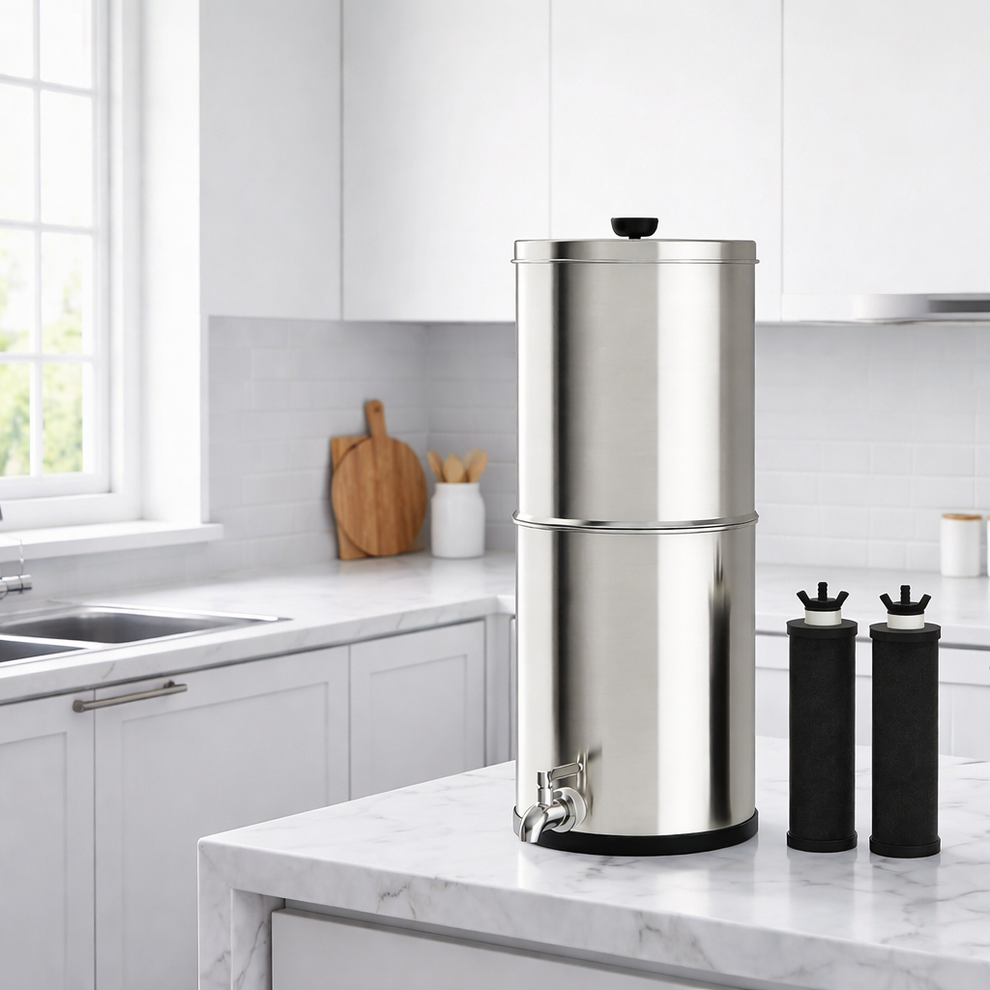
Puflow Big Flow 2 Stainless Steel Gravity Water Filter, 8.5L
The Big Flow 2 is a non-electric gravity water filtration product with an 8.5-liter capacity, a stainless steel body, and no plumbing requirement. It may be convenient for household or portable water-filtering needs, but it should not be treated as an RO system or assumed to produce aquarium-ready water.
- Capacity: 8.5 liters (2.25 gallons)
- Stated filter life: up to 6,000 gallons
- Stated flow rate: up to 4 gallons per hour
- Material: 304 stainless steel
- Power: none required
- Installation: no plumbing required
For aquarium use, verify the exact filtration media, contaminant reduction claims, and resulting water chemistry. If your goal is to lower dissolved mineral content through reverse osmosis, choose a system specifically designed for RO filtration instead.
View Big Flow 2 SpecificationsThis distinction is important: a gravity filter and an RO system solve different water-treatment problems. A gravity filter may be useful for certain household filtration needs, but its capacity or filter-life rating does not establish that it reduces GH, KH, TDS, or specific contaminants to aquarium-appropriate levels.
Is an RO System Worth Buying for Your Aquarium?
The answer comes down to whether RO filtration solves a measurable problem. Start by testing your tap water and checking the requirements of your livestock. If the water is suitable and stable, buying an RO system may add cost without delivering a meaningful aquarium benefit.
If your tap water is very hard, varies significantly, or contains a contaminant that a suitable RO system can reduce, the investment becomes easier to justify. For reef aquariums and multiple tanks, convenience and consistency can also be substantial benefits. For a small freshwater aquarium, however, the cost of the system, replacement filters, storage containers, and remineralizer may exceed the value of the improvement if tap water already works well.
| Situation | Worth Buying RO? | Recommended Decision |
|---|---|---|
| Tap water already matches livestock needs | Usually not essential | Use properly treated tap water and monitor changes. |
| Tap water is excessively hard for the planned species | Often worth considering | Use RO water with a carefully controlled mineral recipe. |
| Reef aquarium with regular saltwater preparation | Often yes | Consider RO/DI and track output quality and operating costs. |
| Several aquariums with frequent water changes | Potentially | Calculate weekly demand and choose a realistic production capacity. |
| Small aquarium with low water demand | Depends | Compare the cost of purchased RO water with owning and maintaining equipment. |
Common Mistakes When Using RO Water in Aquariums
Mistake 1: Adding pure RO water to every freshwater tank
Low-mineral water can be unsuitable for many freshwater fish when used without preparation. Check hardness requirements and remineralize as needed before routine water changes.
Mistake 2: Assuming zero TDS means perfect water
TDS is a useful screening measurement, not a complete contaminant analysis. Use it alongside appropriate water tests and source-water information.
Mistake 3: Confusing GH with KH
GH and KH describe different aspects of water chemistry. A remineralizer that raises one parameter may not raise the other in the way your aquarium needs. Measure both and select the right product for your target conditions.
Mistake 4: Using saltwater for evaporation top-off
In a marine aquarium, evaporation leaves salts behind. Replacing the lost water with additional saltwater can raise salinity. Use appropriate unsalted RO or RO/DI water for top-off, and use correctly mixed saltwater for water changes.
Mistake 5: Ignoring membrane or filter maintenance
A system's output can change as components age or operating conditions shift. Monitor product-water quality and replace components when indicated by the manufacturer's instructions and your measurements.
Mistake 6: Changing water chemistry too quickly
Rapid changes in hardness, pH, salinity, or temperature can stress livestock. Prepare replacement water in advance, check the relevant parameters, and make transitions thoughtfully.
Expert Recommendation: The Best Approach to RO Water
From our experience with water-filtration decision-making, the most reliable approach is to begin with the aquarium's requirements rather than the filtration technology. RO is a tool for improving control, not a universal requirement for healthy fish.
- For beginners: Test your tap water first. If it suits your fish, a reliable dechlorinator and consistent maintenance may be all you need.
- For soft-water aquariums: RO can be valuable when tap water is too hard, but prepare a suitable mineral profile before use.
- For planted tanks: Use RO when it makes your water recipe more controllable, then balance minerals and nutrients for both plants and livestock.
- For reef keepers: RO/DI is often a practical choice for salt mixing and top-off, provided the system is maintained and the output is monitored.
- For commercial or multi-tank setups: Calculate water demand, output capacity, replacement-media costs, and the time required to prepare water. Standardize the process and document test results.
We recommend investing in RO equipment when it solves a specific problem: unsuitable source-water chemistry, unwanted dissolved contaminants, or the need for repeatable water preparation. If none of those issues apply, a system upgrade may not improve the aquarium enough to justify the extra expense.
Frequently Asked Questions
1. Is reverse osmosis water good for aquariums?
Yes. RO water is useful for many freshwater, planted, and reef aquariums because it reduces much of the dissolved mineral content and provides a controllable starting point. For most freshwater applications, remineralize it as needed and verify the target water parameters before use.
2. Can I put pure RO water directly into my fish tank?
Do not assume pure RO water is suitable for routine water changes in every freshwater tank. Its low mineral content can reduce hardness and buffering capacity. Prepare it for the needs of your species and measure the resulting water chemistry.
3. Does RO water need to be remineralized for freshwater fish?
Often, yes. Many freshwater aquariums require suitable levels of calcium, magnesium, and alkalinity. Use a remineralizer or an appropriate blend of source waters to achieve the target GH and KH for your livestock.
4. Is RO water good for saltwater aquariums?
Yes. RO or RO/DI water is commonly used as the source water for preparing marine saltwater. Mix it with an appropriate marine salt product for water changes and use suitable unsalted RO/DI water for evaporation top-off.
5. Is RO/DI water better than RO water for a reef tank?
RO/DI water has an additional deionization stage that can remove many ions remaining after RO filtration. It is often preferred for reef systems requiring very low dissolved-ion levels. Whether you need DI depends on your source water, system performance, and aquarium goals.
6. Does RO water lower aquarium pH?
RO water has little buffering capacity, so its pH can be unstable and difficult to measure reliably. The effect on aquarium pH depends on the tank's existing chemistry, remineralization, substrate, and biological processes. Check the prepared water and aquarium rather than relying on the pH of pure RO water alone.
7. Can I mix RO water with tap water?
Yes, if the tap water is suitable and the blend helps achieve the required parameters. Test both sources and the final mixture. Do not blend water containing a known problematic contaminant unless you have confirmed that the final concentration is acceptable for your aquarium.
8. Is a TDS meter enough to check aquarium RO water?
No. A TDS meter is useful for monitoring dissolved-ion trends and RO system performance, but it does not identify individual substances or confirm aquarium suitability. Use appropriate tests for GH, KH, pH, salinity, and other parameters relevant to your setup.
9. How often should an RO membrane be replaced?
There is no single replacement interval for every system. Membrane life depends on feed-water quality, pressure, pretreatment, usage, and maintenance. Monitor rejection performance and product-water quality, and follow the manufacturer's replacement guidance.
10. Is RO water worth the cost for a small aquarium?
Only if it solves a real water-quality problem or provides a benefit that matters to your setup. If properly treated tap water already suits your fish, buying and maintaining an RO system may be unnecessary. Compare water quality, demand, and ongoing costs before investing.
References
These resources provide technical background for water treatment and aquarium water-quality decisions. Use them alongside species-specific care guidance and measured results from your own water source.
- United States Environmental Protection Agency — Ground Water and Drinking Water. Official background on drinking-water quality and contaminants.
- United States Geological Survey — Water Science School. Educational resources on water properties, dissolved substances, and water quality.
- Merck Veterinary Manual. Veterinary reference for animal health and related care considerations; consult qualified aquatic-animal professionals for species-specific health concerns.
Final Verdict
Reverse osmosis water is good for aquariums when it is used with a clear understanding of the tank's water chemistry. Its main advantage is control: it can reduce many unwanted dissolved substances and make it easier to prepare repeatable water for sensitive freshwater species, planted aquariums, and reef systems.
But pure RO water is not automatically ready for every fish tank. Many freshwater setups need remineralization, and marine systems require correctly mixed saltwater for water changes. Test the source, monitor the output, prepare water to suit your livestock, and make changes gradually.
If your tap water already meets your aquarium's requirements, you may not need an RO system. If it does not, a properly selected and maintained system can be a worthwhile investment. Choose based on measured water quality, real water demand, and long-term operating cost—not on the assumption that lower TDS always means healthier fish.
For household water-filtration options, explore Puflow replacement filters and compare the specifications of each system carefully. For aquarium applications, always verify that the selected filtration method produces water suitable for the intended tank.