


Is RO the Same as Distilled Water? An Expert Analysis
Navigating the complex landscape of water purification can be overwhelming for facility managers, homeowners, and health-conscious consumers alike. When evaluating high-purity water solutions, one question consistently dominates the conversation: Is RO the same as distilled water? As Puflow, a dedicated industry solution provider in advanced water filtration technology, we encounter this specific inquiry daily. People often assume that because both methods produce exceptionally clean drinking water, the underlying processes and the final liquid output are identical. This is a fundamental misconception.

In most professional situations, the distinction between reverse osmosis (RO) and distillation dictates whether a facility operates efficiently or burns through massive utility budgets. While both technologies aim for maximum contaminant removal, they utilize entirely different physical principles to achieve their results. Understanding these mechanical differences is not just an academic exercise; it is the deciding factor in purchasing the right equipment for your specific residential or commercial needs.
Quick Answer
Is RO the same as distilled water? No. While both processes produce highly purified water, they are entirely different mechanical systems. Reverse Osmosis (RO) uses hydraulic pressure to force water through a semi-permeable microscopic membrane, stripping away up to 99% of dissolved solids, heavy metals, and chemicals. Distillation, conversely, uses heat to boil water into steam, leaving solid contaminants behind, before condensing the vapor back into liquid form.
Distilled water is technically purer (often achieving 99.9% purity), but the process is agonizingly slow and consumes massive amounts of electricity. RO is vastly more energy-efficient, produces purified water on demand, and is the undisputed standard for modern drinking water systems.
Table of Contents
- What it is: Reverse Osmosis vs. Distillation
- How it Works: Filtration vs. Evaporation
- Benefits and Limitations of Both Systems
- Comparison Table: RO vs. Distilled Water
- Who Should Use Which System? (And Who Does Not Need Them)
- Common Mistakes When Choosing Purification Methods
- Buying Considerations: A Practical Guide
- Expert Recommendation
- Frequently Asked Questions (FAQ)
- References
What it is: Reverse Osmosis vs. Distillation
To make a commercial or practical judgment, you must first define the technologies.
Reverse Osmosis (RO) is a highly advanced filtration technology. It relies on a physical barrier—a semi-permeable membrane with pores as small as 0.0001 microns. This membrane acts like a microscopic bouncer, allowing pure H2O molecules to pass through while blocking dissolved salts, lead, arsenic, fluoride, viruses, and bacteria. Modern systems, like the Best Countertop RO Water Purifier, often combine this membrane with active carbon block filters to create a multi-stage defense mechanism.
Distillation, on the other hand, is a phase-change process. It mimics the earth's natural water cycle. A water distiller is essentially an electric kettle attached to a cooling coil. It boils raw tap water until it turns into steam. Because heavy metals, minerals, and most bacteria do not vaporize at the boiling point of water (212°F / 100°C), they are left behind in the boiling chamber. The pure steam is then funneled into a cooling tube where it condenses back into liquid distilled water.
How it Works: Filtration vs. Evaporation

From our experience engineering advanced purification systems, understanding the operational mechanics is crucial for assessing long-term maintenance and utility costs.
An RO system is driven by incoming water pressure. If you look at a modern M8-2 Under Sink Water Filter or a high-capacity RO unit, you will notice it requires a minimum municipal water pressure to function. The water is forced against the membrane; the pure water passes through, and the rejected contaminants are flushed down the drain in a stream of wastewater (brine). This continuous flushing mechanism prevents the membrane from clogging prematurely.
A water distiller operates purely on thermal energy. You fill a boiling chamber, plug the unit into a wall outlet, and wait. A standard home distiller takes roughly 4 to 6 hours to produce a single gallon of distilled water. While it wastes zero water down the drain (unlike RO), it consumes a staggering amount of electrical wattage to maintain a rolling boil for hours on end.
Furthermore, distillation has a critical blind spot: Volatile Organic Compounds (VOCs). Certain chemicals, such as chlorine byproducts and synthetic solvents, have a lower boiling point than water. If a distiller does not feature a post-carbon filter, these VOCs will vaporize right alongside the water and condense back into the "purified" pitcher.
Benefits and Limitations of Both Systems
In our testing, we have mapped out the exact operational realities of these two purification methods to help you make an informed buying decision.
| Purification Method | Primary Benefits | Notable Limitations |
|---|---|---|
| Reverse Osmosis (RO) |
|
|
| Distillation |
|
|
Comparison Table: RO vs. Distilled Water
| Feature | Reverse Osmosis Water | Distilled Water |
|---|---|---|
| Purity Level | 95% - 99% Contaminant Removal | 99.9% Contaminant Removal |
| Production Speed | Fast (On-demand flow, up to 800 GPD) | Extremely Slow (1 gallon per 4-6 hours) |
| Energy Consumption | Very Low (Often under 80W for booster pumps) | Extremely High (Continuous heating element, 500W-1500W) |
| Wastewater Generated | Yes (Ratios range from 1:1 to 1.5:1) | No (Except for vapor loss) |
| Taste Profile | Crisp, refreshing (often enhanced by remineralization) | Flat, often described as "clinical" or "empty" |
Who Should Use Which System? (And Who Does Not Need Them)
We recommend specific systems based purely on the application environment.
For beginners and residential users: If you are looking for safe, delicious drinking water for your family, cooking, and coffee machines, Reverse Osmosis is the undisputed champion. The convenience of turning on a tap and getting instant purified water cannot be overstated. By exploring the differences between Tankless RO vs Tank RO, homeowners can find a system that fits perfectly under their sink without occupying massive counter space.
For commercial users: Restaurants, cafes, and hydroponic facilities require massive volumes of purified water daily. Reverse osmosis is the only financially viable option. A robust system like the A10S 800G Tankless RO System can produce hundreds of gallons per day. Attempting to fulfill commercial volume demands with distillation would result in catastrophic electricity bills.
For heavy-duty applications: Distillation has its place. If you are operating a medical laboratory, manufacturing cosmetics, maintaining CPAP machines, or mixing specific chemical reagents, you need water with absolute zero mineral content to prevent scaling and cross-contamination. Distilled water is required here.
Who does not need either: If your local municipality already provides exceptionally clean, soft water with zero lead pipeline issues, and your only complaint is the taste of chlorine, neither RO nor distillation is necessary. A simple carbon-block under-sink filter or a Fluoride Reduction Filter will suffice to improve taste at a fraction of the cost.
Common Mistakes When Choosing Purification Methods
Another major error is ignoring the remineralization phase. Because both RO and distillation strip minerals (calcium, magnesium) from the water, the resulting liquid is slightly acidic and can taste flat. Many modern RO systems solve this by incorporating an alkaline remineralization stage at the end of the filtration cycle. Distillers rarely offer this feature out of the box.
Finally, consumers often misunderstand the wastewater aspect of RO. While legacy systems wasted 4 gallons for every 1 gallon purified, modern innovations have drastically reduced this. If water scarcity is your absolute primary concern and you refuse to produce wastewater, you should bypass RO entirely and look into an atmospheric water generator, which pulls water directly from the ambient humidity in the air.
Buying Considerations: A Practical Guide
Before you finalize a purchase, use this commercial judgment checklist to ensure the system aligns with your lifestyle and budget.
| Consideration | Reverse Osmosis Assessment | Distillation Assessment |
|---|---|---|
| Upfront Cost | Moderate to High ($200 - $600+) depending on capacity. | Low to Moderate ($100 - $300) for standard countertop units. |
| Ongoing Maintenance Costs | Filter replacements every 6-12 months; membrane every 24 months. | Descaling chemicals and exceptionally high electricity utility costs. |
| Installation Requirements | Requires basic plumbing connections to the cold water line and drain. | Zero plumbing required; simply needs a standard electrical outlet. |
| Production Volume Requirements | Excellent for families and high-volume drinking/cooking needs. | Poor. Suitable only for individuals with low volume requirements. |
Expert Recommendation
If you are deciding between these two technologies for home hydration or light commercial use, we firmly advise against distillation due to its energy inefficiency and operational slowness. Reverse osmosis delivers 99% of the purity with 100% more convenience.
For those seeking the pinnacle of modern purification, we recommend upgrading to a direct-flow RO system. These systems eliminate the need for a bulky storage tank, preventing secondary contamination, and provide high-speed filtration exactly when you need it.
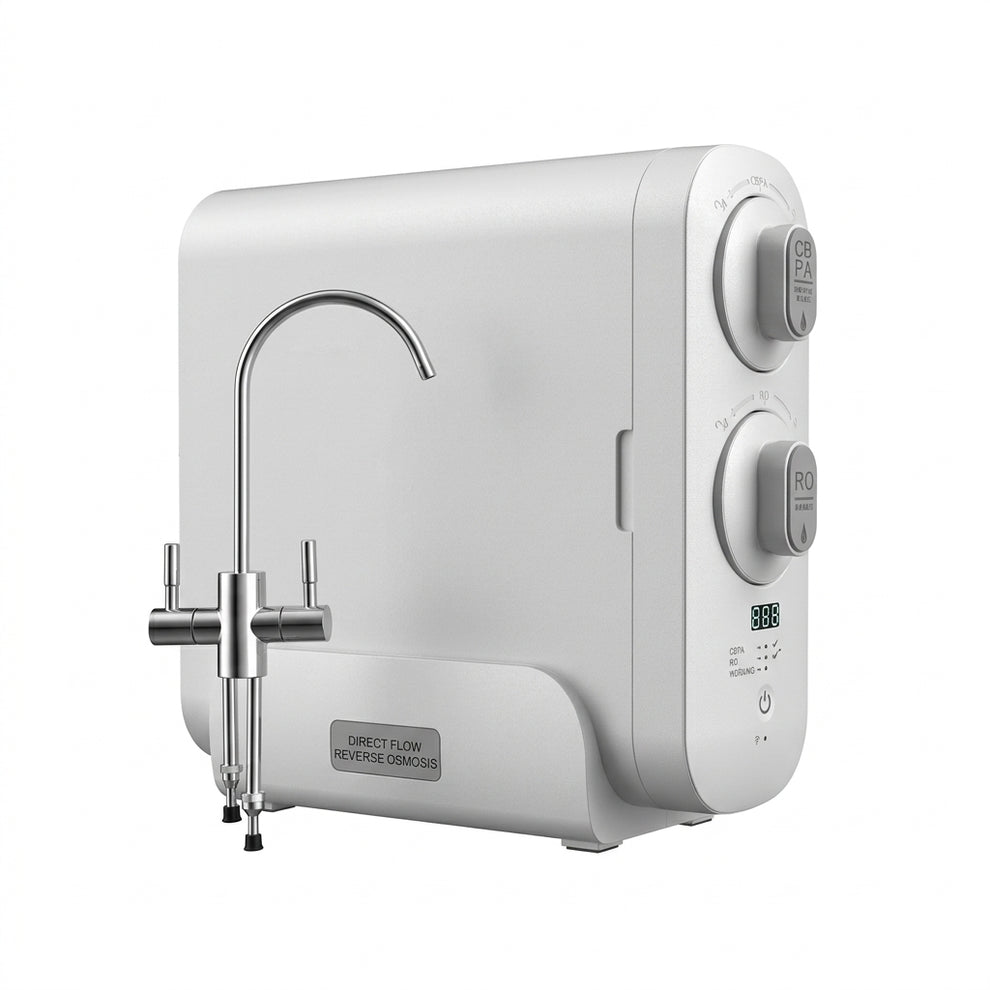
Under Sink RO System 600 GPD Direct Flow TDS Display
From our experience, this is the gold standard for residential and light commercial water purification. It completely bypasses the limitations of traditional distillation and legacy tank-based RO systems by utilizing a powerful internal booster pump to deliver a massive 600 Gallons Per Day.
- Purification Capacity: 600 GPD (Provides a rapid flow rate of 1.5–1.6 L/min).
- Filtration Precision: 0.0001μm (Effectively removes 95% of dissolved salts and heavy metals).
- Efficiency: Features a highly optimized 1.5:1 wastewater ratio with a 60% recovery rate.
- Smart Monitoring: Built-in TDS (Total Dissolved Solids) display ensures you know your water purity in real-time.
- Energy Footprint: Power consumption is a mere 70W during operation, a fraction of the cost of running a water distiller.
Whether you are outfitting a high-end kitchen or upgrading an office breakroom, this system guarantees absolute water security without the agonising wait times of a distillation unit.
Frequently Asked Questions (FAQ)
Neither is inherently "healthier" as both lack essential minerals like calcium and magnesium. However, RO water is often preferred for drinking because many modern RO systems include a remineralization stage that adds these healthy alkaline minerals back into the water, improving both taste and health benefits. Distilled water is generally flat and lacks mineral content entirely.
While RO water is vastly superior to tap water and will drastically reduce scale buildup, it is not 100% pure. Most medical device manufacturers specifically mandate the use of distilled water because its 99.9% purity guarantees zero mineral deposits in sensitive heating elements. For CPAP machines, distilled water remains the safest choice.
Distillation requires changing the physical state of water from liquid to gas. This requires a massive amount of thermal energy. A standard home distiller uses a 500W to 1500W heating element that must run continuously for 4 to 6 hours just to evaporate one gallon of water, making it a highly energy-intensive process compared to the hydraulic pressure used in RO.
References
- United States Environmental Protection Agency (EPA) - Guidelines on drinking water standards, treatment technologies, and contaminant removal efficacy.
- NSF International - Certification standards and mechanical testing protocols for Reverse Osmosis drinking water treatment systems.
- Water Quality Association (WQA) - Industry insights on residential water purification methods, including distillation and membrane filtration technologies.