


10 Reasons to Install a Reverse Osmosis Filter System at Home
If your household is concerned about dissolved minerals, certain metals, nitrate or other contaminants in drinking water, a reverse osmosis (RO) system may be a worthwhile upgrade. The key is to match the system to the contaminants actually present in your water, the amount your household consumes and the maintenance you are prepared to perform. Installing RO simply because it sounds like the most advanced filtration option is not a good purchasing strategy.

Puflow offers water filtration options for different household needs, including under-sink and countertop RO systems, portable filtration and gravity-fed products. Before choosing any of them, understand what reverse osmosis can remove, what it cannot guarantee, and how its ongoing costs compare with simpler filtration. The right decision starts with water quality and daily use, not a product label.
10 Reasons to Install a Reverse Osmosis Filter System at Home
Installing a reverse osmosis filter system at home can reduce many dissolved contaminants, improve water taste, provide a convenient source of drinking water and reduce reliance on bottled water. It may also help households address specific water-quality concerns identified by testing. However, RO is not necessary for every home, does not remove every possible contaminant under all conditions, and requires regular filter maintenance. It is most valuable when the system has verified performance for the contaminants that matter to your household.
Quick Answer
What it is: A water treatment system that uses a semipermeable membrane to separate much of the dissolved material from the water passing through it.
How it works: Household water passes through pretreatment filters and an RO membrane. The treated water is collected for use, while a separate reject-water stream carries away concentrated contaminants. Many systems add a final polishing filter or a remineralization stage.
Main benefits: Reduction of many dissolved contaminants, improved taste for some water supplies, convenient drinking water and potentially less bottled-water packaging.
Limitations: Filter replacement, membrane maintenance, wastewater generation, possible mineral reduction and the need to verify specific contaminant claims.
Who should consider it: Households whose water test results or utility report identify contaminants an appropriately certified RO system is designed to reduce.
Who may not need it: Households whose water already meets their needs and has no relevant contaminant concern, or users who mainly need sediment or chlorine taste reduction.
Our recommendation: Test the water, verify the exact system's performance claims, estimate annual maintenance costs and select a configuration that fits your kitchen and consumption.
Table of Contents
- Quick Summary Table
- Reduce Certain Dissolved Contaminants
- Improve Taste and Odor
- Make Drinking Water More Convenient
- Reduce Dependence on Bottled Water
- Address Specific Water-Quality Problems
- Gain More Control Over Water Treatment
- Choose a System That Fits Your Home
- Understand Minerals and Remineralization
- Plan for Maintenance and Reliability
- Evaluate Long-Term Value
- RO vs. Other Home Water Filters
- Puflow Product Options
- Installation and Buying Checklist
- Pros and Cons
- Expert Recommendation
- Frequently Asked Questions
- References
Quick Summary: Is a Home RO System Worth Installing?
| Reason | Potential Benefit | What to Check | Best Fit |
|---|---|---|---|
| Contaminant reduction | Can reduce many dissolved substances | Independent certification and contaminant-specific performance data | Homes with a defined water-quality concern |
| Taste and odor | May improve the taste of drinking water | Source of the taste or odor and the system's filter stages | Households dissatisfied with their current drinking water |
| Convenience | Provides treated water at home on demand | Flow rate, storage capacity and daily demand | Regular home drinking and cooking |
| Less bottled water | May reduce packaging and store trips | Filter costs, bottle use and local water quality | Households frequently buying bottled water |
| Specific water concerns | Can target selected contaminants when validated | Water test results and system documentation | Homes with known dissolved contaminant issues |
| Installation flexibility | Multiple configurations for different kitchens | Space, plumbing, power and wastewater connection | Homeowners and renters with different installation limits |
| Mineral management | Optional remineralization can change taste | Actual stage design and water composition | Users who prefer a particular taste profile |
| Long-term value | May be economical compared with frequent bottled water purchases | Total ownership cost and expected consumption | Regular, long-term users |
1. Reduce Certain Dissolved Contaminants
The strongest reason to install a reverse osmosis filter system at home is a specific water-quality requirement that the chosen system is designed and verified to address. RO membranes can reduce many dissolved substances, including certain salts and selected contaminants. Actual performance varies with membrane design, water chemistry, operating pressure, pretreatment and the condition of the system.
This distinction matters. A product described as an RO filter does not automatically have verified reduction claims for every contaminant a consumer might be concerned about. If your water report identifies arsenic, nitrate, lead or another substance, check whether the exact system has been tested or certified for the relevant reduction claim and under what conditions.
Start with a water report, not a marketing promise
For municipal water, review the utility's Consumer Confidence Report and contact the utility if the report does not answer your question. For private wells, use a qualified laboratory and test for contaminants appropriate to the local geology and potential sources of pollution. A generic home test strip is not a substitute for laboratory analysis when the result will determine a health-related treatment decision.
In our view, the best purchase is the system that addresses the actual problem with documented performance. Paying for advanced filtration without knowing what needs to be reduced may add expense without delivering a meaningful benefit.
For readers comparing verified systems, Puflow's guide to NSF-certified reverse osmosis countertop systems is a useful starting point. Verify the certification listing and the exact claims for the model you intend to buy rather than relying on the word “certified” alone.
2. Improve the Taste and Odor of Drinking Water
Some households install RO because their tap water has an unpleasant taste or smell. Depending on the source water and the treatment stages, an RO system can improve taste by reducing dissolved substances that affect the drinking experience. A carbon prefilter or postfilter may also help reduce chlorine taste and odor.
However, not every taste problem calls for RO. If chlorine is the main concern and the water otherwise meets your needs, a properly selected activated carbon filter may be sufficient. If water smells like rotten eggs, fuel or chemicals, investigate the cause instead of assuming that a new filter will solve it.
Test the water before choosing the treatment
Compare your tap water with treated water using the same glassware and temperature. If taste is the only concern, begin by identifying whether chlorine, mineral content or another issue is responsible. If there is a sudden change in taste or odor, contact the water supplier or a qualified water professional before relying on a household filter.
For a broader explanation of the differences in drinking-water taste and composition, read Puflow's guide to RO water vs. tap water.
3. Make Drinking and Cooking Water More Convenient
A properly sized home RO system gives households a convenient source of treated water for drinking, tea, coffee, ice and food preparation. Once installed and maintained, it can reduce the need to carry bottled water home or fill a separate pitcher repeatedly.
Convenience depends on capacity. Some under-sink systems use a storage tank, while tankless models produce treated water on demand. Countertop models may be easier to install, but their output, reservoir size and refill routine differ. If several family members fill large bottles every morning, a low-capacity unit may become frustrating even if its filtration performance is suitable.
Match output to daily household demand
Estimate how much water your household uses for drinking and cooking. Consider peak demand, such as preparing several drinks at breakfast or filling bottles before leaving home. Compare that demand with the system's rated production, recovery and storage characteristics, and ask how actual production changes under your incoming water pressure and temperature.
For a fixed kitchen installation, explore Puflow's under-sink RO systems. If you cannot modify the plumbing or want a simpler setup, its countertop RO systems may be more appropriate.
4. Reduce Dependence on Bottled Water
Households that buy bottled water every week may find a home RO system more convenient and potentially less expensive over time. It can also reduce the number of single-use bottles entering the household waste stream. The environmental and financial benefit depends on the local water supply, the bottled water being replaced, the system's operating efficiency and the frequency of filter replacement.
Do not assume that installing RO automatically makes the household's water footprint smaller. RO systems send some water to a reject stream, and the amount varies by design, pressure, temperature and operating conditions. A poorly maintained or inefficient system may deliver less value than expected.
Calculate the break-even point realistically
Compare the cost of the system, installation, replacement filters, membrane changes and any additional water use against what you currently spend on bottled water. Include the convenience of having water available at home, but do not assign a financial saving unless the numbers support it.
If your household drinks only a small amount of bottled water and is already satisfied with safe tap water, a lower-cost filter may be a more sensible purchase. If you buy multiple cases each month, a well-matched RO system may be worth evaluating.
5. Address Specific Water-Quality Problems More Directly
Hard water, high total dissolved solids (TDS), and particular contaminants are not interchangeable problems. RO can reduce many dissolved ions, but it is not always the most practical whole-home treatment for hardness. In many homes, a water softener is better suited to protecting water heaters, reducing scale on fixtures and improving soap performance.
RO is generally used for a smaller drinking-water supply, where its output can be dedicated to consumption and cooking. Treating every gallon of household water with RO can be unnecessarily expensive and may require a much larger system and more extensive plumbing.
Choose the treatment for the actual issue
- Hard water and scale: Consider a water softener if testing confirms hardness and the goal is to protect plumbing and appliances.
- Chlorine taste: A suitable activated carbon filter may be enough.
- Specific dissolved contaminants: Consider RO or another treatment with verified performance for the contaminant.
- Sediment: Use a correctly rated sediment filter where appropriate.
- Microbiological contamination: Do not assume a standard household RO unit alone makes unsafe water microbiologically safe. Obtain a suitable treatment plan and address the source.
For a household focused on dissolved contaminants, the most useful next step is to compare the test results with the manufacturer's validated reduction claims. A high TDS reading alone does not identify which substances are present or whether the water is unsafe.
6. Gain More Control Over Your Drinking-Water Treatment
Installing an RO system gives a household a dedicated treatment stage for drinking water rather than relying exclusively on a general-purpose pitcher filter. That can be valuable when the household has a documented concern and wants a treatment method that can be maintained according to a defined schedule.
Control, however, requires record-keeping. Keep the installation date, filter-change dates, membrane replacement information and any relevant water test results. If the system uses a storage tank, follow the manufacturer's cleaning and sanitization instructions. A filter that is overdue for replacement or a system with a damaged seal may not perform as intended.
Look for independently verified performance
Certifications such as NSF/ANSI 58 are relevant to the evaluation of reverse osmosis drinking-water treatment systems. Certification scope matters: a system may be certified for particular performance attributes without being certified to reduce every contaminant. Confirm the exact model and the individual reduction claims in the certification listing.
For questions about microplastics, avoid broad claims that every filter removes all particle sizes. Performance depends on the membrane, system design, test method and the particles being measured. Puflow's article on the best water filters for microplastics can help frame the comparison, but use product-specific evidence to make the final decision.
7. Choose a System That Fits Your Home and Kitchen
Not every household can accommodate a traditional under-sink system. Renters may not want to drill a countertop or alter plumbing, while small apartments may have limited cabinet space. A countertop RO system can reduce installation complexity, whereas an under-sink model keeps the equipment out of sight and may suit households seeking a permanent kitchen setup.
Before purchasing, measure the available area and check the requirements for water supply, drainage, power and faucet installation. Tankless systems may save storage space, but they still require adequate incoming pressure and a suitable installation. Countertop systems may be easier to relocate, but they can occupy valuable worktop space.
Choose the configuration that matches your living situation
For homeowners who use treated water every day and can modify the kitchen, an under-sink unit is often a practical choice. For renters or people who move frequently, a countertop option may be more convenient. A household that needs water filtration without plumbing changes may prefer a gravity-fed system, provided its documented contaminant-reduction capabilities match the actual requirement.
Puflow's portable and non-electric filtration options are worth comparing when simplicity and mobility matter more than having an installed RO tap.
8. Understand Mineral Reduction and Remineralization
Reverse osmosis reduces many dissolved substances, including minerals that contribute to water's taste. Some users prefer the taste of RO water, while others find it less appealing than their original tap water. Remineralization stages can add selected minerals back into the treated water or change its taste profile, depending on the media and system design.
Do not buy a remineralization stage on the assumption that RO water is inherently unhealthy. For most people, drinking water is not the primary source of essential minerals; diet is generally the more important source. If you have a medical condition requiring specific mineral or electrolyte management, consult a qualified healthcare professional rather than using a filter label as medical guidance.
When is remineralization worth paying for?
Consider it if you prefer the taste, want a particular water profile or have a practical reason to choose that configuration. Compare the additional filter cost and replacement schedule with the benefit you expect. If the standard system already produces water you enjoy and its performance meets your needs, an extra stage may offer little practical value.
For shoppers evaluating this configuration, Puflow's guide to an under-sink reverse osmosis system with remineralization provides a starting point for comparing options.
9. Establish a Predictable Maintenance Routine
RO is not a fit-and-forget purchase. Sediment and carbon prefilters may need replacement at different intervals from the membrane and final polishing filter. Actual replacement timing depends on the manufacturer's guidance, water quality, household usage and operating conditions.
Maintenance is not merely about taste. Pretreatment filters help protect the membrane, and neglected components can reduce flow or affect overall system performance. A system with readily available replacement cartridges and clear service instructions is often a better long-term choice than a cheaper model with uncertain parts availability.
What to include in your maintenance plan
- Record the installation date and each filter replacement.
- Follow the manufacturer's filter and membrane replacement instructions.
- Inspect tubing, fittings and the faucet for leaks.
- Sanitize the system and storage tank when instructed.
- Check for unusual changes in taste, odor or flow.
- Use an appropriate test or service check if you need to verify contaminant reduction.
Before ordering, confirm that replacement filters are available and that the model number and cartridge type are clearly identified. Puflow's replacement filter collection is relevant when comparing ongoing maintenance requirements across its compatible systems.
10. Evaluate Long-Term Cost and Household Value
The purchase price is only one part of the cost of installing a reverse osmosis filter system at home. Installation, replacement cartridges, membrane changes, water use and any required service work all affect the total. A system with a low initial price may become expensive if replacement filters are costly or difficult to obtain.
For a household that drinks RO water daily, the ongoing cost may compare favorably with bottled water. For a household that drinks very little filtered water, the payback may be slower. The correct comparison depends on actual consumption and the treatment performance you need.
Use a simple ownership-cost calculation
Add the purchase price, installation costs, estimated annual filters and membrane expenses, and any relevant operating costs over the period you expect to keep the system. Compare that figure with your current bottled-water spending or the cost of a simpler filtration option that meets the same requirement.
Do not compare a certified RO system that addresses a specific contaminant with a basic carbon pitcher as though the two products provide identical treatment. Compare options against the same water-quality objective. If a simpler filter meets that objective, RO may be unnecessary. If the requirement calls for RO performance, a cheaper alternative may not be an equivalent substitute.
Reverse Osmosis vs. Other Home Water Filtration Options
Choosing RO is a decision about treatment method, not simply product category. Each option has different strengths, limitations and installation requirements. The following comparison is a starting point; verify the performance claims for the exact product before relying on it for contaminant reduction.
| System Type | Typical Strength | Limitations | Best Use Case |
|---|---|---|---|
| Reverse osmosis | Can reduce many dissolved substances when appropriately designed and maintained | Reject water, filter replacement and possible plumbing requirements | Homes with a defined dissolved-contaminant treatment need |
| Activated carbon filter | Can improve chlorine taste and odor and reduce certain listed contaminants | Does not generally provide the same dissolved-solids reduction as RO | Households primarily concerned with taste and odor |
| Gravity-fed filter | Can operate without mains power or a plumbing connection | Performance and flow depend on the exact filter media and design | Portable use, simple installations and situations without plumbing |
| Water softener | Designed primarily to address hardness and scale formation | Does not replace a drinking-water filter for every contaminant | Homes with a verified hardness problem affecting plumbing and appliances |
| Countertop RO system | Provides RO treatment with potentially simpler installation | Uses counter space and may have limited production or reservoir capacity | Renters, apartments and households avoiding under-sink installation |
| Under-sink RO system | Dedicated kitchen water treatment with equipment stored below the counter | Requires suitable installation space and often plumbing work | Permanent home use and regular drinking-water demand |
Puflow Water Filtration Options: Which Configuration Makes Sense?
Puflow offers several product categories that address different installation and usage preferences. Select the configuration based on your water-quality objective, available space and maintenance expectations rather than assuming every household needs RO.
Under-sink RO for a permanent kitchen setup
Under-sink systems are suitable for households that want a dedicated drinking-water supply without placing the main filtration equipment on the countertop. Check production rate, storage or tankless design, installation requirements and replacement-filter availability before deciding.
The Puflow M8-2 under-sink water filter is one product to evaluate against your requirements. Verify the current specifications and the exact contaminant-reduction claims before treating it as a solution to a particular water-quality problem.
Countertop RO for a less permanent installation
Countertop RO systems can be useful in apartments, rental properties or kitchens where an under-sink installation is inconvenient. Their main trade-off is counter space and, depending on the model, the need to refill a reservoir or wait for water production. Compare capacity with your household's busiest usage periods.
Gravity filtration when plumbing access is the priority
Some households need filtration without a fixed plumbing connection or electricity. A gravity-fed system may be appropriate if its specific filter elements have verified performance for the contaminants of concern. It should not be assumed to deliver the same treatment as an RO membrane.
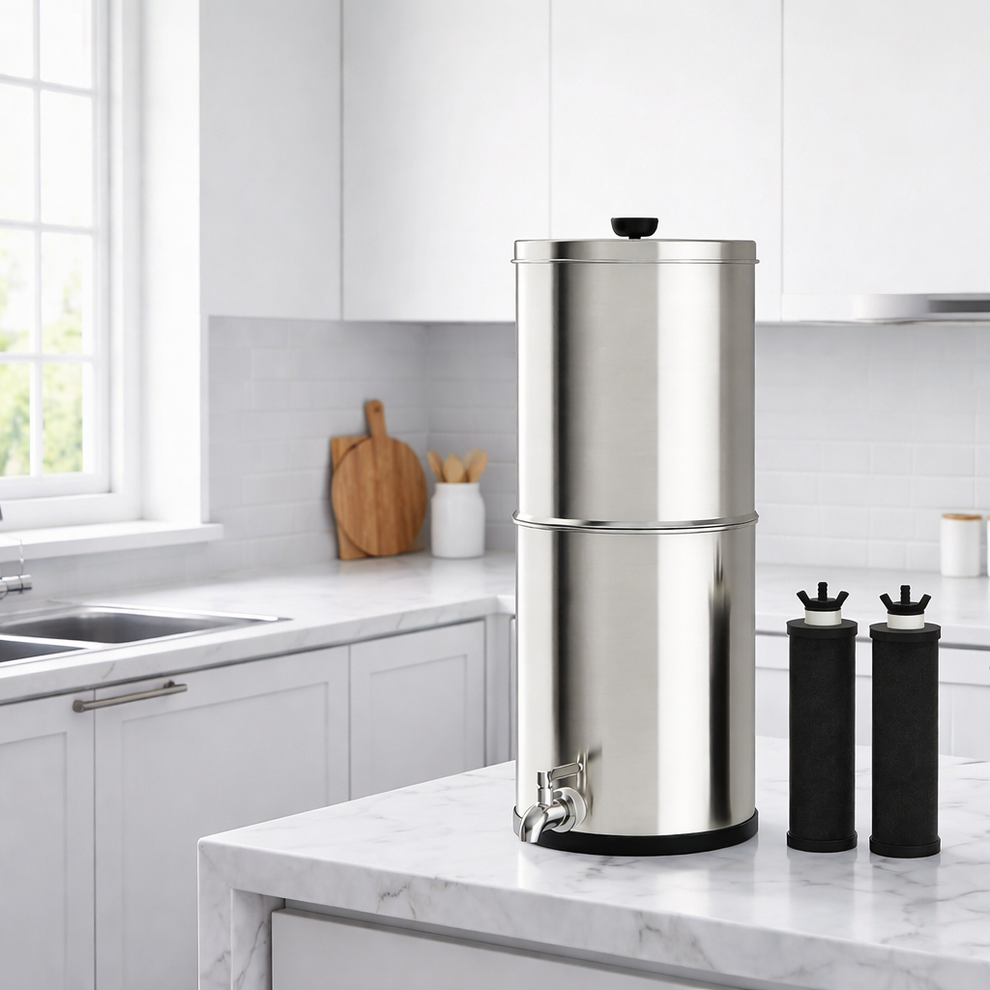
Puflow Big Flow 2 Stainless Steel Gravity Water Filter 8.5L
This non-electric gravity-fed product is an alternative for users who value portability and do not want a plumbing installation. It is not an RO system, so evaluate its filtration method and documented contaminant-reduction performance separately.
- Capacity: 2.25 gallons (8.5 liters)
- Listed filter life: Up to 6,000 gallons
- Listed flow rate: Up to 4 gallons per hour
- Material: 304 stainless steel
- Power: None required
- Installation: No plumbing required
- Potential uses: Home, apartment, RV, camping and emergency preparedness
Filter life and flow rate depend on the manufacturer's stated conditions and actual water quality. Confirm the exact filter configuration and reduction claims before purchase.
Portable filtration for travel and outdoor use
Portable filters address a different problem: treating water while away from the kitchen. They are useful for travel or outdoor activities when the product is designed for the intended water source. A portable bottle should not be assumed to make every unknown water source safe, especially where chemical contamination or other untreated hazards may be present.
For mobile use, compare Puflow's portable water filter bottle and its guide to portable water filters for travel. Select based on the contaminants, capacity and operating conditions relevant to your trip.
Installation and Buying Checklist
Before you install a reverse osmosis filter system at home, complete the following checks. They help avoid buying a system that does not fit the kitchen or solve the water problem.
- Identify the water source. Determine whether you use municipal water or a private well and review available water-quality results.
- Define the treatment objective. List the contaminants or taste issues you want to address and verify the system's documented performance for each.
- Confirm certification scope. Check the exact model and the claims covered by the relevant independent certification.
- Measure installation space. Account for the filter housing, storage tank if present, tubing, power supply and access needed for maintenance.
- Check plumbing and drainage. Verify supply connections, reject-water routing and faucet requirements. Use a qualified installer if necessary.
- Estimate household demand. Compare rated production, recovery and storage with peak drinking-water use.
- Calculate annual costs. Include replacement cartridges, membrane changes, installation and relevant water-use costs.
- Confirm replacement-filter availability. Check cartridge compatibility, replacement intervals and long-term supply.
- Plan maintenance. Keep records and follow the manufacturer's instructions for filter changes and sanitization.
- Retest when appropriate. If the system is intended to reduce a specific contaminant, use suitable testing or professional service to verify that treatment remains effective.
Common Mistakes to Avoid When Installing an RO System
Assuming all RO systems remove every contaminant
RO membranes can reduce many dissolved substances, but performance is not identical across models or contaminants. Review the specific reduction claims and test conditions before purchasing.
Buying based only on a TDS meter
A TDS meter estimates the concentration of dissolved ions; it does not identify which contaminants are present or determine whether the water is safe. A lower reading alone is not proof that every health-related contaminant has been removed.
Ignoring wastewater and recovery rate
RO systems generate a reject-water stream. Ask the manufacturer for the system's recovery information and the conditions under which it was measured. If water efficiency is important, compare this information between models rather than assuming all RO systems perform similarly.
Forgetting the cost of replacement filters
Check replacement prices and availability before committing to a system. A low-cost unit can become a poor purchase if consumables are expensive or difficult to source.
Installing RO when a simpler filter would do
If your main concern is chlorine taste, a suitable carbon filter may be enough. If the problem is hardness affecting appliances, a softener may be more appropriate. Choose the treatment method that addresses the actual issue.
Pros and Cons of Installing a Reverse Osmosis System at Home
| Pros | Cons | Practical Decision |
|---|---|---|
| Can reduce many dissolved contaminants | Performance varies by contaminant and system | Verify the exact reduction claims before purchase |
| May improve drinking-water taste | Some users may dislike the resulting taste profile | Test the water and consider remineralization only if useful |
| Provides treated water at home | Requires regular filter maintenance | Choose a model with available replacement filters |
| May reduce bottled-water purchases | Initial and ongoing costs can be significant | Calculate total cost using actual household consumption |
| Under-sink models keep equipment out of sight | May require plumbing and cabinet space | Measure the installation area before ordering |
| Can be useful for defined water-quality concerns | Generates reject water and may reduce minerals | Compare recovery, water quality and maintenance requirements |
Expert Recommendation: Should You Install a Home RO Filter?
For households with a documented dissolved-contaminant concern, a properly selected and maintained RO system can be a worthwhile investment. For households whose water already meets their needs and whose only complaint is mild chlorine taste, a simpler carbon filter may provide better value with less maintenance.
Choose under-sink RO when you want a dedicated drinking-water supply, have suitable installation space and use enough water to justify the ongoing filter costs.
Choose countertop RO when you want RO treatment but prefer to avoid a permanent under-sink installation. Confirm that its capacity and refill routine suit your household.
Choose gravity filtration when avoiding plumbing and electricity is more important than obtaining RO treatment, and only when the filter's verified performance matches your water-quality objective.
Choose a simpler filter or no additional treatment when water testing and your actual needs do not justify the added complexity of RO.
Puflow's range includes several configurations, but the product category should come second to the water-quality requirement. Start with a test or reliable water report, compare verified performance, and calculate the total cost of ownership. That process is more likely to produce a useful long-term result than buying the system with the longest feature list.
Frequently Asked Questions
1. Is it worth installing a reverse osmosis filter system at home?
It can be worth it when your water-quality results identify contaminants that the selected system is verified to reduce, or when you want a convenient source of RO-treated drinking water. If a simpler filter meets your needs, RO may add unnecessary cost and maintenance.
2. What does a home reverse osmosis system remove?
Depending on its design and validated performance, an RO system can reduce many dissolved substances, including certain salts and selected contaminants. The exact reduction varies by model and operating conditions, so check the specific contaminant claims rather than assuming the system removes everything.
3. Does reverse osmosis make water completely pure?
No household RO system should be assumed to remove every possible contaminant under all conditions. Performance depends on the membrane, pretreatment, water chemistry, maintenance and system design. Use verified product data and appropriate water testing.
4. Does an RO system waste water?
Conventional RO systems produce a reject-water stream as part of the separation process. The amount varies with system design, pressure, temperature and operating conditions. Compare documented recovery performance when water efficiency is a priority.
5. Is under-sink RO better than countertop RO?
Neither is universally better. Under-sink systems keep equipment off the counter and can suit permanent installations. Countertop systems may be easier to install or relocate but can occupy worktop space and have different capacity limits. Choose according to installation constraints and daily demand.
6. Does reverse osmosis remove healthy minerals?
RO reduces many dissolved minerals along with other substances. Most people obtain essential minerals primarily through food, but taste preferences differ. A remineralization stage is an option for people who prefer its water profile; it is not automatically necessary for everyone.
7. How often should RO filters be replaced?
Replacement intervals depend on the model, water quality, usage and manufacturer's instructions. Sediment filters, carbon filters and membranes may have different service lives. Keep a maintenance record and replace components according to the specified schedule.
8. Is a TDS meter enough to confirm RO water is safe?
No. A TDS meter estimates dissolved-ion concentration but does not identify individual contaminants or confirm microbiological safety. Use appropriate water testing and verified system performance information for the contaminants that matter.
9. Can a gravity-fed filter replace an RO system?
Only if its verified filtration performance meets the same treatment objective. Gravity filters and RO systems use different treatment methods and should not be assumed to remove the same contaminants. Check the exact filter media and performance claims.
References
- U.S. Environmental Protection Agency — Ground Water and Drinking Water. Guidance on drinking-water contaminants, water quality and treatment considerations.
- NSF — Water Filters and Drinking Water Treatment. Consumer guidance on filtration, treatment technologies and product certification.
- U.S. Centers for Disease Control and Prevention — About Home Water Treatment Systems. Overview of home water treatment options and considerations when selecting a system.