


8 Best Reverse Osmosis Systems for Aquarium in 2026: An Expert Guide
From our experience engineering and distributing advanced water purification solutions at Puflow, utilizing untreated tap water is the single most common cause of aquarium failure. Whether you are maintaining a sensitive saltwater reef or breeding delicate freshwater discus, the heavy metals, chloramines, phosphates, and silicates present in municipal water supplies act as a slow poison to aquatic life. Chemical tap water conditioners merely bind these toxins; they do not remove them. To achieve biological stability, you must strip the water down to its purest form.

Navigating the market for the best reverse osmosis systems for aquarium applications requires strict commercial and practical judgment. You cannot simply purchase a cheap drinking water filter and expect it to yield zero Total Dissolved Solids (TDS). Aquarium filtration demands specific flow rates, rigorous pre-filtration for chloramine reduction, and often, a dedicated Deionization (DI) stage. In this comprehensive guide, we will break down exactly what makes a marine-grade purification system worth buying, highlight the industry's top performers for 2026, and explain how to avoid catastrophic maintenance errors that cost hobbyists thousands of dollars in lost livestock.
Quick Answer: Are Reverse Osmosis Systems for Aquarium Worth It?
Yes, absolutely. A dedicated RO or RO/DI (Reverse Osmosis / Deionization) system is mandatory for saltwater reef tanks and highly recommended for sensitive freshwater planted tanks. It physically removes up to 99.9% of dissolved solids, preventing toxic heavy metal accumulation, uncontrollable nuisance algae outbreaks, and invertebrate death. If you are serious about the hobby, upgrading to a high-quality unit from our list below is the highest-ROI investment you can make for your aquatic ecosystem.
Table of Contents
- What is an Aquarium RO System?
- How It Works: The Stages of Purification
- Benefits of Reverse Osmosis in Aquaria
- Limitations and Drawbacks
- Who Should Use It & Who Does Not Need It
- Common Mistakes to Avoid
- Buying Considerations
- The 8 Best Reverse Osmosis Systems for Aquarium 2026
- Expert Recommendation
- Summary and Comparison Tables
- Frequently Asked Questions (FAQ)
What is an Aquarium RO System?

A reverse osmosis system for aquariums is a multi-stage water filtration unit designed to strip municipal tap water or well water of nearly all impurities. While home drinking RO systems often feature remineralization cartridges to add taste back into the water, marine and specialized freshwater aquarists require a blank canvas. By understanding the differences between RO water and regular tap water, aquarists can precisely rebuild their water chemistry using controlled synthetic salt mixes or specific buffering minerals.
In most professional situations involving saltwater, these systems are referred to as RO/DI units. The addition of a Deionization (DI) resin stage captures the trace remaining ions (like stubborn silicates and phosphates) that slip past the RO membrane, guaranteeing a final output of 0 TDS.
How It Works: The Stages of Purification
The mechanics of reverse osmosis rely entirely on household water pressure forcing water molecules through semi-permeable barriers. A standard high-grade aquarium setup operates in the following sequence:
- Sediment Filtration: A 1-micron or 5-micron mechanical filter traps rust, sand, and dirt. If this fails, the subsequent stages clog immediately.
- Carbon Block Filtration: Crucial for removing chlorine and chloramines. Chloramines will irreversibly destroy an RO membrane upon contact. For heavy-duty applications in cities with high chloramine usage, dual carbon blocks are necessary.
- The RO Membrane: The heart of the system. Operating at pressures of 50-80 PSI, this thin-film composite membrane rejects up to 98% of all dissolved solids, flushing them down the drain as waste water.
- Deionization (DI) Resin: Positively and negatively charged resins attract and bind any remaining microscopic ions, acting as a final polish to achieve absolute 0 TDS.
Benefits of Reverse Osmosis in Aquaria
The benefits of investing in dedicated reverse osmosis systems for aquarium use cannot be overstated. Untreated tap water contains silicates and phosphates, which act as high-octane fertilizer for cyanobacteria and hair algae. By starting with 0 TDS water, you completely eliminate the fuel source for these visual blights. Furthermore, heavy metals like copper—often leached from household plumbing—are lethal to corals, shrimp, and snails even in trace amounts. An RO system guarantees invertebrate safety.
Limitations and Drawbacks
We must exercise practical commercial judgment when discussing limitations: RO systems waste water. Traditional systems have a pure-to-waste ratio of 1:3 or 1:4. For every gallon of pure water produced, up to four gallons are flushed down the drain. Additionally, RO membranes are highly sensitive to water temperature and pressure. If your home water pressure is below 40 PSI, the system will barely produce a trickle, necessitating the purchase of an electrical booster pump.
Who Should Use It & Who Does Not Need It
For commercial users and serious hobbyists: If you are running a saltwater reef tank, a coral frag farm, or breeding delicate caridina shrimp, an RO/DI system is non-negotiable. Do not attempt these setups without one.
For beginners: If you are setting up a standard community freshwater tank with hardy fish (like guppies, tetras, or African cichlids), you do not strictly need an RO system. In fact, standard tap water treated with a basic dechlorinator is often better for these fish, as it retains the natural calcium and magnesium necessary for their osmoregulation.
Common Mistakes to Avoid
In our testing and customer support experience, the most catastrophic mistake fresh water aquarists make is using pure RO water without remineralizing it. Pure RO water has zero buffering capacity (kH). If placed directly into a tank, the pH will swing wildly, shocking and killing the livestock. You must add equilibrium buffers back into the water before use.
Another major error is failing to monitor filter exhaustion. Aquarists will run an RO system for two years without changing the carbon block. Once the carbon is exhausted, chlorine passes through and instantly burns holes in the expensive RO membrane, ruining the entire unit. Always replace pre-filters every 6 months.
Buying Considerations
When selecting a system, prioritize the GPD (Gallons Per Day) rating. A 50 GPD system produces about 2 gallons an hour under ideal conditions. If you have a 150-gallon tank that requires a 30-gallon weekly water change, waiting 15 hours for water is agonizing. Upgrade to a 100 GPD or 150 GPD system to save time.
Also, evaluate the availability of proprietary vs. universal filters. We recommend systems that utilize standard 10-inch canisters, allowing you to source Replacement Filters easily and affordably without being locked into expensive proprietary cartridges.
The 8 Best Reverse Osmosis Systems for Aquarium 2026
1. Puflow High-Flow Commercial RO System
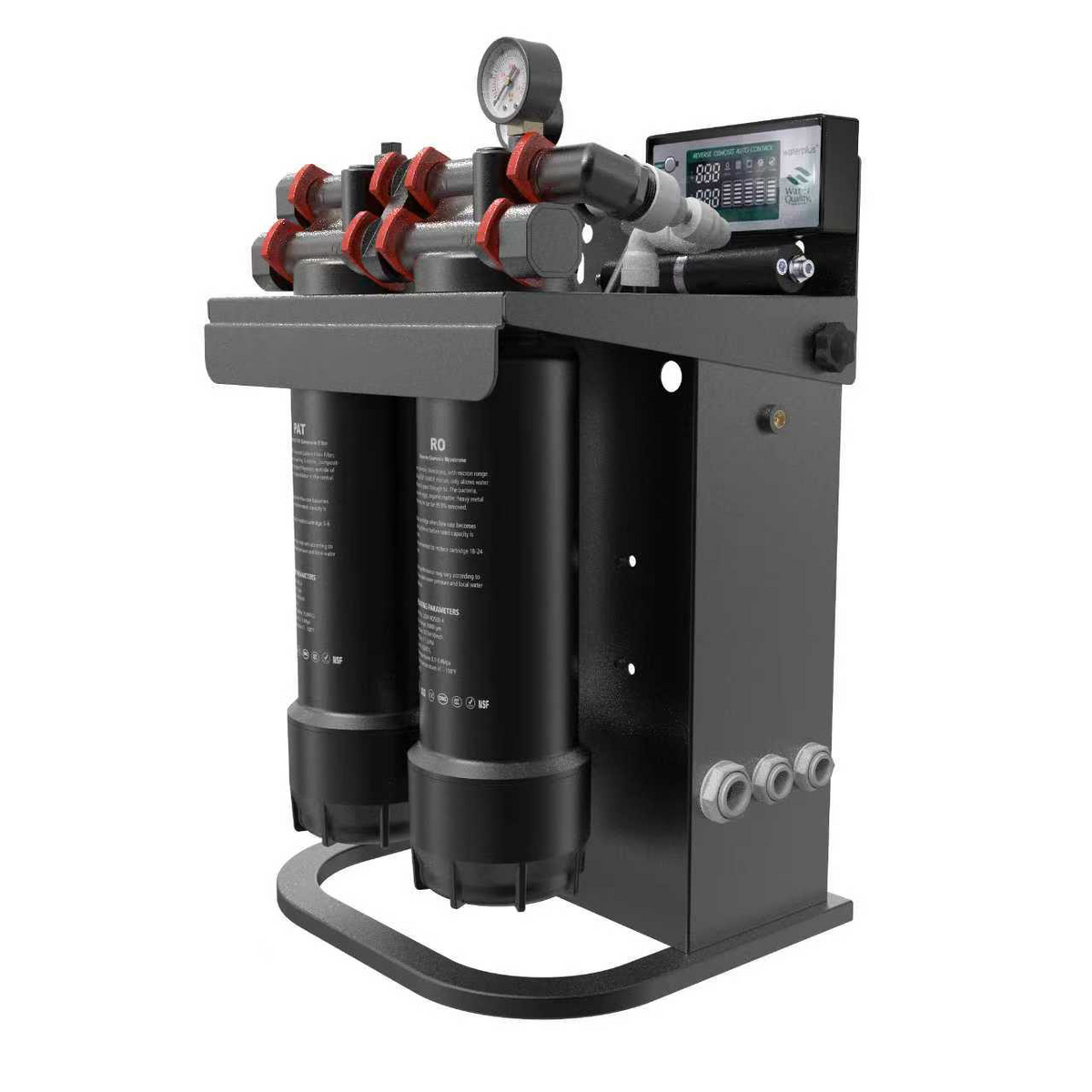
For heavy-duty applications and individuals managing multiple large-scale reef tanks, standard units fail to keep up. We recommend browsing our High-Flow RO Systems. Engineered for maximum output and minimal waste, these units handle high-volume demands efficiently, making them the superior choice for serious aquaculturists.
2. Puflow A10S Under-Sink System (Dual-Purpose Configuration)
If you want pure water for both your family and your freshwater aquarium, a dual-purpose configuration is ideal. Our Under-Sink RO Systems provide massive filtration capacity.

Replacement Filter Set for A10S Under Sink Reverse Osmosis System
- Advanced 0.0001μm RO Filtration: Removes heavy metals, dissolved solids, and microscopic impurities critical for aquarium health.
- Multi-Stage Composite Filtration (CBPA): Radically reduces chloramines and chlorine.
- Quick & Easy Replacement: Tool-free design for fast filter changes, ensuring you never run your system on exhausted carbon.
3. BRS 4-Stage Value Plus RO/DI System
The industry standard for entry-level reef keepers. Bulk Reef Supply builds excellent, universal 10-inch canister systems. The Value Plus model includes a pressure gauge and an inline TDS meter, which are mandatory tools for knowing exactly when your DI resin is exhausted.
4. SpectraPure MaxCap RO/DI
SpectraPure is legendary for its custom-tested membranes. Their systems are highly efficient and feature super-capacity DI cartridges that last significantly longer than competitors. If your tap water has exceptionally high TDS (above 400), this system is a financial lifesaver regarding resin replacement costs.
5. Puflow Portable Non-Electric RO System
For apartment dwellers or nano-tank owners who cannot permanently tap into their plumbing, exploring Portable & Non-Electric systems is the best route. These compact units hook directly up to a standard bathroom faucet, produce your weekly 5 gallons, and pack away easily under the sink.
6. Aquatic Life RO Buddie
The ultimate budget option for beginners. It is incredibly compact and cheap upfront. However, use commercial and practical judgment here: the replacement cartridges are proprietary and small. While cheap to buy initially, running an RO Buddie on a large tank will cost you a fortune in frequent filter replacements.
7. AquaFX Barracuda
A rugged, American-made system favored by commercial fish stores. The Barracuda utilizes high-grade aluminum brackets and heavy-duty housings. It is a workhorse designed to handle harsh municipal water conditions without cracking under pressure.
8. Puflow BigFlow Gravity System (For Off-Grid / Emergency Prep)
While not a traditional pressurized RO system, aquarists dealing with power outages or off-grid setups need reliable backup filtration. Gravity filters serve as excellent pre-filtration stages or emergency water supplies.

Replacement BigFlow 1 Gravity Filter Fluoride and Carbon
Keep your BigFlow 1 gravity water filter running at peak performance. This set includes 2 fluoride filters and 2 carbon filters for effective multi-stage filtration. Excellent for emergency top-off water purification when municipal pressure fails.
Expert Recommendation
Is an aquarium RO system actually worth buying? If you are investing hundreds or thousands of dollars into livestock, risking their lives on municipal tap water fluctuations is negligent. From our experience, we recommend skipping the ultra-cheap, proprietary cartridge units. Invest upfront in a high-quality, standard 10-inch canister system like those featured in our Best Reverse Osmosis System for Home lineup. Ensure your unit has an inline TDS meter and a pressure gauge. This turns water chemistry from a guessing game into a precise, manageable science.
Summary and Comparison Tables
| Water Source | Impurities Present | Best Aquarium Application |
|---|---|---|
| Untreated Tap Water | Chlorine, Heavy Metals, Phosphates | None (Lethal to aquatic life) |
| Conditioned Tap Water | Phosphates, Silicates, High TDS | Hardy Freshwater Fish (Cichlids, Tetras) |
| Reverse Osmosis (RO) | Trace amounts of small ions | Sensitive Freshwater, Planted Tanks (Must remineralize) |
| RO/DI Water | 0 TDS (Absolute Purity) | Saltwater Reef Tanks, Coral Propagation |
| Pros | Cons |
|---|---|
| Absolute control over aquarium water chemistry. | High waste water ratio (Up to 1:4). |
| Eliminates fuel for nuisance algae (silicates/phosphates). | Requires adequate household water pressure (>40 PSI). |
| Protects expensive invertebrates from heavy metal toxicity. | Ongoing maintenance costs for filter/resin replacement. |
| Produces ideal top-off water that won't creep TDS up over time. | Slow production rates require holding containers/vats. |
Frequently Asked Questions (FAQ)
Do I really need the DI (Deionization) stage for my aquarium?
If you are keeping a saltwater reef tank with corals, yes, the DI stage is strictly mandatory. RO membranes typically remove 95-98% of contaminants. The remaining 2-5% often consists of silicates and phosphates which easily pass through the membrane. In a highly lit reef tank, even trace silicates will cause explosive diatom algae blooms. The DI resin captures these remaining ions, yielding 0 TDS.
Can I use home drinking RO water for my fish tank?
It depends on the system. Many under-sink home drinking RO systems feature a final "remineralization" stage to add calcium and magnesium back into the water for taste. If your system has this, you cannot use it for a marine tank, as it adds uncontrollable TDS back into the water. You must draw the water before it hits the remineralization cartridge.
Why is my RO system producing water so slowly?
RO membrane production rates are rated at ideal conditions: usually 77°F (25°C) water temperature and 60-65 PSI of pressure. If you are drawing cold winter tap water at 40 PSI, your production rate will drop by more than half. In most professional situations, aquarists add an electric booster pump to force the pressure up to 80 PSI, maximizing output and minimizing waste water.
Authoritative References & Industry Standards
- United States Environmental Protection Agency (EPA) - Data on municipal tap water contaminants, heavy metal action levels, and chloramine usage.
- Water Quality Association (WQA) - Industry standards, testing, and certification protocols for Reverse Osmosis membrane efficacy.
- Reef2Reef Marine Aquarist Society - Extensive peer-reviewed community data on RO/DI necessity, TDS creep, and coral husbandry standard practices.