


Filtered Water vs. Reverse Osmosis Water: 6 Aspects You Must Consider Before Buying
The water purification industry is heavily saturated with marketing buzzwords. Brands routinely slap the label "purified" or "filtered" on cheap carbon pitchers, leading consumers to believe their tap water is completely safe from industrial runoff, heavy metals, and modern synthetic chemicals. From our experience as engineering practitioners at Puflow, this ambiguity is not just misleading—it is a hazard to public health.

If you are relying on a standard pitcher filter to protect your family from PFAS or lead, you are operating under a false sense of security. To make an informed decision, you must understand the stark, physical differences in filtration technology. The debate of filtered water vs. reverse osmosis water is not a matter of subjective preference; it is a matter of microscopic mechanical separation versus basic chemical adsorption. In this uncompromising guide, we will dissect the 6 critical aspects that separate basic filtered water from true reverse osmosis (RO) purification, providing commercial and practical judgment to help you secure the exact system your household requires.
Quick Answer
When comparing filtered water vs. reverse osmosis water, the primary difference is the precision of contaminant removal. "Filtered water" typically refers to water passed through activated carbon, which removes chlorine, bad tastes, and large sediments, but leaves heavy metals, dissolved solids, and microplastics behind. "Reverse Osmosis (RO) water" is forced through a semi-permeable membrane at 0.0001 microns, physically stripping away 99.9% of all contaminants, including lead, arsenic, fluoride, and forever chemicals (PFAS). In most professional situations, we recommend basic carbon filtration only for municipal water that is already soft and safe. For heavy-duty applications, homes with hard water, or those wanting absolute purity, a Reverse Osmosis system is the only acceptable commercial choice.
Table of Contents
- What It Is: Defining the Terminology
- How It Works: The Mechanics of Purification
- Filtered Water vs. Reverse Osmosis Water: 6 Key Aspects
- Benefits of Each System
- Limitations and Drawbacks
- Who Should Use It & Who Does Not Need It
- Common Mistakes in Water Filtration
- Crucial Buying Considerations
- Expert Recommendation
- Frequently Asked Questions (FAQ)
What It Is: Defining the Terminology
Before examining the 6 aspects, we must define the baseline. Understanding the nuances between RO Water vs Tap Water begins with the technology applied.
Filtered Water generally refers to municipal or well water that has been treated by an activated carbon block or granulated carbon filter. These filters act like a sponge, trapping specific chemicals (primarily chlorine) that cause bad taste and odor.
Reverse Osmosis (RO) Water is the product of a highly advanced, multi-stage pressure system. It utilizes a semi-permeable membrane that only allows pure H2O molecules to pass through. Everything larger than a water molecule is flushed away as waste.
How It Works: The Mechanics of Purification
Standard filtration works through adsorption. As water flows through porous carbon, chemical impurities stick to the vast surface area of the carbon bed. However, once the carbon is saturated, it stops filtering and can even dump concentrated contaminants back into your water.
Reverse Osmosis works through size exclusion and hydraulic pressure. Your home's water pressure forces tap water against a microscopic membrane screen. The pores on this membrane are roughly 0.0001 microns in size. To put that in perspective, a human hair is about 70 microns thick. Bacteria, viruses, heavy metals, and dissolved salts are physically too large to fit through the pores and are diverted down the drain.
Filtered Water vs. Reverse Osmosis Water: The 6 Crucial Aspects
1. Filtration Precision and Micron Rating
The most glaring difference is precision. Standard filtered water systems operate between 1 to 5 microns. This is adequate for stopping sand, rust, and silt. However, Reverse Osmosis operates at 0.0001 microns. This extreme level of precision is required to strip water down to its bare molecular state. If your goal is true purification, basic filtration is entirely inadequate.
2. Contaminant Removal Capabilities
In our testing, standard filters consistently fail to remove dissolved inorganic solids. If your water contains dangerous levels of arsenic, hexavalent chromium, or lead, a carbon filter will only mask the taste. Reverse Osmosis removes up to 99.9% of these Total Dissolved Solids (TDS). Furthermore, for households concerned about modern pollutants, RO is unequivocally the Best Water Filter for Microplastics, as nano-plastics effortlessly bypass standard carbon pitchers.
3. Mineral Retention and Taste Profile
A frequent argument against RO water is that it tastes "flat" because it removes healthy minerals like calcium and magnesium. Basic filtered water retains these minerals. However, relying on tap water for your daily mineral intake is a biological myth; you receive the vast majority of your minerals from food. Still, for those who prefer alkaline water, modern RO technology has evolved. By utilizing an Under Sink Reverse Osmosis System with Remineralization, you achieve absolute purity first, then safely add optimal amounts of healthy calcium back into the water before drinking.
4. System Architecture and Space Requirements
Standard filters are compact. They fit in pitchers, screw onto faucets, or sit inline with your refrigerator. RO systems require complex architecture: pre-filters, the RO membrane, post-filters, and traditionally, a bulky pressurized storage tank. However, commercial advancements have revolutionized this. When comparing Tankless RO vs Tank RO, modern tankless systems save up to 70% of under-sink space while providing unlimited on-demand flow.
5. Wastewater Ratio and Environmental Impact
Because RO membranes physically reject contaminants, they require water to flush those impurities down the drain. Legacy RO systems wasted up to 4 gallons of water for every 1 gallon purified. Standard carbon filtration produces zero wastewater. However, premium modern RO systems feature a 2:1 or even 3:1 pure-to-waste ratio, drastically mitigating environmental concerns.
6. Total Cost of Ownership
Standard filters present a low barrier to entry—often under $50. But because they clog rapidly, replacing cartridges every two months becomes a hidden subscription fee. RO systems require a higher initial capital expenditure (CAPEX), ranging from $200 to $600. Yet, their massive capacity filters (often lasting 12 to 24 months) make the long-term operational expenditure (OPEX) vastly superior for families.
Benefits of Each System
| Standard Filtered Water | Reverse Osmosis Water |
|---|---|
| Pro: Zero wastewater production. | Pro: Removes 99.9% of lead, arsenic, and heavy metals. |
| Pro: Retains naturally occurring minerals. | Pro: Eliminates modern threats like PFAS and microplastics. |
| Con: Cannot remove dangerous dissolved heavy metals. | Con: Requires under-sink plumbing and a power source. |
| Con: Frequent, expensive cartridge replacements. | Con: Produces some wastewater during the flushing phase. |
Limitations to Consider
We must apply commercial judgment here: RO systems require a dedicated power source (for the internal booster pump) and a physical connection to your drain line. If you are renting an apartment where altering plumbing is forbidden, a traditional under-sink RO system is not viable. In these scenarios, you must pivot to the Best Countertop RO Water Purifier, which requires zero installation and plugs directly into a wall outlet.
Who Should Use It & Who Does Not Need It
For commercial users and heavy-duty applications: If your municipal water report indicates high TDS, heavy agricultural chemical runoff, or aging lead pipes, you must install an RO system. The liability of consuming heavy metals over decades is a non-negotiable health risk.
Who does not need it: For beginners or those living in pristine municipal zones (like the Pacific Northwest) where the only issue is a slight chlorine taste, a standard carbon block is sufficient. Additionally, if you are camping or moving frequently, bulky RO systems are useless. You should look into the Best Portable Water Filters for Travel or invest in a high-capacity standalone unit like the Gravity Water Filter 3.8L for off-grid survival.
Common Mistakes in Water Filtration
The most devastating mistake consumers make is assuming boiling water removes chemical contaminants. Boiling kills biological pathogens (bacteria), but it actually concentrates heavy metals and PFAS by evaporating the pure water and leaving the toxins behind in the pot. If your water is chemically contaminated, you must use Reverse Osmosis.
Another error is failing to change RO pre-filters. If you do not change the cheap carbon pre-filters on schedule, municipal chlorine will reach the delicate RO membrane and dissolve it, destroying the most expensive component of your system.
Crucial Buying Considerations
| Consideration | What to Demand | Why It Matters |
|---|---|---|
| Filtration Speed (GPD) | Minimum 400 GPD for tankless systems. | A low Gallons Per Day (GPD) rating means you will stand at the sink waiting 3 minutes to fill a single glass of water. |
| Smart TDS Monitoring | Real-time digital water quality display. | Provides empirical proof that your membrane is functioning and tells you exactly when to change the filters. |
| Certifications | Look for NSF Certified Reverse Osmosis System standards (NSF 58). | Guarantees the system has been independently verified to remove the heavy metals the manufacturer claims. |
Expert Recommendation from Puflow

In most professional situations, treating water filtration as an afterthought results in compromised family health and wasted capital on ineffective pitcher filters. We recommend taking absolute control of your water supply at the point of use. If you want the absolute Best Reverse Osmosis System for Home deployment in 2026, you must prioritize tankless architecture with high-flow pumps.
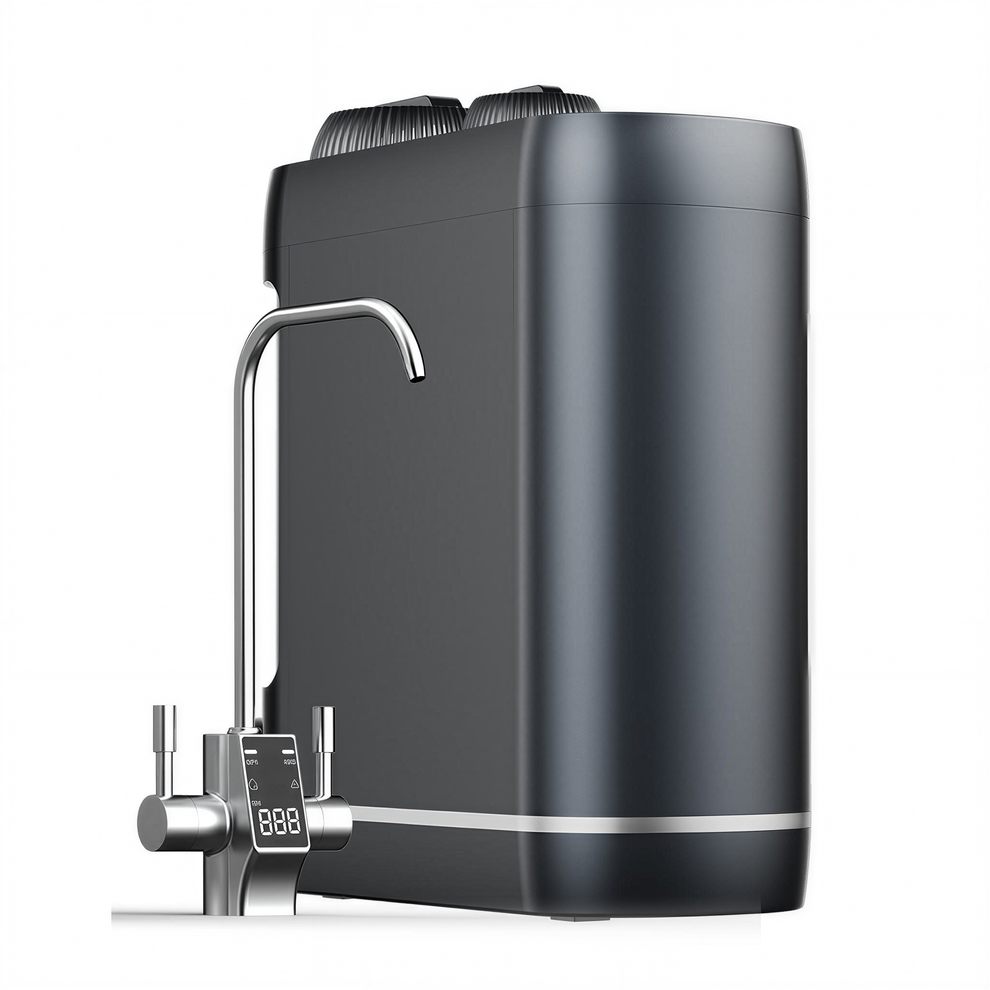
A10S 800G Tankless RO System with Smart TDS
- Filtration Type: Reverse Osmosis (RO)
- Precision: 0.0001μm (Blocks heavy metals & PFAS)
- Flow Rate: 1.58–2.1 L/min (Fills a cup in seconds)
- Rated Capacity: 4000L
- Architecture: Tankless (Saves 70% under-sink space)
- Voltage: 220V / 50Hz (confirm US version 110V if needed)
The Puflow A10S 800G represents the pinnacle of residential purification, combining an aggressive 800 Gallon Per Day throughput with smart TDS monitoring, ensuring you never second-guess the safety of your drinking water.
Frequently Asked Questions (FAQ)
Yes, definitively. Reverse osmosis is vastly superior for removing heavy metals, fluoride, arsenic, and modern threats like PFAS (forever chemicals) and microplastics due to its microscopic 0.0001-micron membrane. Standard filtered water (carbon pitcher filtration) only removes chlorine, bad tastes, and large sediment, leaving dangerous dissolved solids untouched.
Yes, RO is non-discriminatory; it removes all dissolved solids, including trace calcium and magnesium. However, the human body acquires the vast majority of its essential minerals from a balanced diet, not from drinking water. If the "flat" taste of pure water is a concern, you can easily install a post-filter remineralization cartridge to safely add alkaline minerals back into the purified water.
Reverse osmosis is a mechanical separation process, not a sponge. It uses hydraulic pressure to force pure water through a membrane. The rejected contaminants (heavy metals, salts, bacteria) cannot pass through and must be constantly flushed away down the drain. If they were not flushed, the membrane would instantly clog and fail. Premium modern systems have optimized this process to a highly efficient 2:1 pure-to-waste ratio.
Authoritative References & Industry Standards
To ensure our filtration guidance aligns with rigorous public health standards, we rely on data from the following authoritative organizations:
- Environmental Protection Agency (EPA): Federal guidelines outlining the maximum contaminant levels (MCLs) for drinking water and the efficacy of reverse osmosis in removing PFAS and heavy metals. Review EPA Drinking Water Standards
- NSF International: The premier independent certification organization for water filtration. NSF/ANSI Standard 58 specifically governs the rigorous testing and material safety of Reverse Osmosis drinking water systems. Explore NSF RO Certifications
- World Health Organization (WHO): Global public health documentation regarding the safety of consuming demineralized water and the dietary acquisition of essential minerals. Access WHO Water Quality Guidelines